
Most developers skip the spec. They open Cursor, type a paragraph, and let the agent run. It works until it doesn't — usually around the third round of rework, when it becomes clear that the agent built something technically correct but not what was meant.
Spec-driven development fixes this. Write the spec first. Define what you're building, what you're not building, and exactly how it should behave. Then let the AI execute against something concrete.
Tekk.coach makes spec driven development practical. It reads your actual codebase before generating anything, searches the web when your feature touches unfamiliar territory, and outputs a structured spec — not a chat message — that your coding agents can actually work from.
How Tekk.coach Does Spec-Driven Development
Tekk isn't a tool that supports spec-driven development. It IS spec-driven development — built as a native workflow, not a methodology you have to layer on top of a chat window.
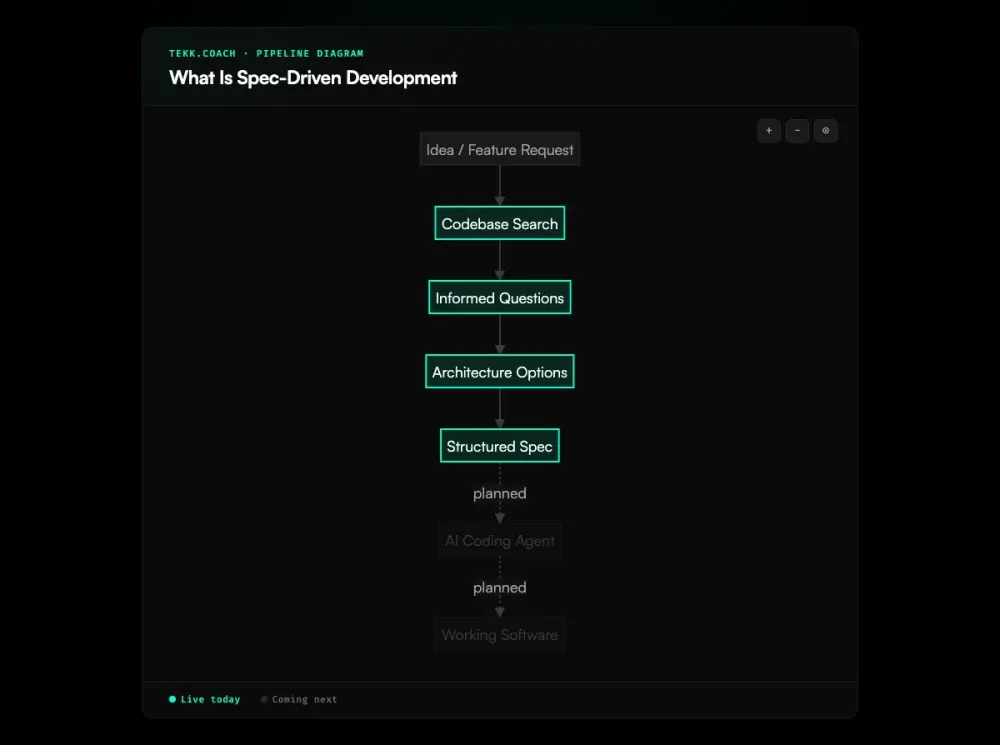
Every session follows the same four stages. First, the agent reads your codebase. It does semantic search, file search, directory browsing — it profiles your repo for languages, frameworks, and dependencies before asking a single question. When it asks "which ORM are you using?" it already knows the answer. The questions it surfaces are the ones your code can't answer.
From there, it presents options: two or three architecturally distinct approaches with honest tradeoffs. Not just "here are your choices" — here's what you gain, what you lose, and what breaks if you pick the wrong one. Then comes the plan, streamed in real-time into a BlockNote editor as a living working document.
That plan isn't a chat message you copy into Notion. It has a TL;DR, explicit Building and Not Building scope sections, subtasks with acceptance criteria and file references, assumptions with risk levels, and validation scenarios. That's what your coding agents execute from. That's the difference between an agent that flails and one that ships.
The plan lives on a kanban card. You can see what's planned, what's in progress, and what's done — all in one workspace. When the spec and the task are the same object, spec drift is a lot harder to ignore. When you're ready to execute those specs across multiple coding agents simultaneously, ai agent orchestration provides the coordination layer.
Key Benefits
Eliminate rework from vague specs When your spec is precise — scope boundaries, acceptance criteria, file targets — your coding agent builds what you meant the first time. The "that's not what I meant" loop stops.
Structured plans your agents can execute A paragraph isn't a spec. Tekk produces subtasks with behavioral acceptance criteria, file references, and dependencies — the kind of prompt that makes Cursor and Claude Code actually work correctly.
Explicit scope boundaries Every plan includes a "Not Building" section. You know exactly what's in scope before anyone writes a line of code. Scope creep has no foothold when the boundary is explicit.
Knowledge gaps filled automatically Building a payment integration? An AI pipeline? Tekk searches the web for current best practices and folds that research into your spec. You don't need to be an expert before you can write a good spec.
How It Works
Step 1: Connect your repo Link your GitHub, GitLab, or Bitbucket repository. Tekk reads your codebase before the session starts — semantic search, file search, directory structure, language and framework detection.
Step 2: Describe what you're building Tell Tekk the feature or problem in plain language. The agent has already read your code, so it asks informed questions — the ones your codebase can't answer, not the generic ones.
Step 3: Review your options For anything non-trivial, Tekk presents two or three architecturally distinct approaches with honest tradeoffs. You pick the direction. The agent doesn't decide for you.
Step 4: Get your spec The complete plan streams into the editor in real-time. TL;DR, scope boundaries, subtasks with acceptance criteria and file references, assumptions, validation scenarios. Edit it directly. It's a living document, not a read-only artifact.
Step 5: Execute with your agents Hand the spec to Cursor, Claude Code, or Codex. Your coding agents get a precise, codebase-grounded prompt instead of a paragraph. They build what you actually meant.
Who This Is For
Developers building with AI coding agents who keep running into the same problem: the agent produced something technically correct but missed the point. The spec wasn't clear enough. Tekk solves the upstream problem.
Solo founders and small teams shipping software without dedicated architects. You're touching payment integrations, auth systems, data pipelines — domains where you don't have deep expertise. Tekk fills the knowledge gaps before the spec gets written, not after the code is wrong.
Product managers who need technically grounded specs, not template-filled PRDs. Tekk's output is something engineers can actually work from: behavioral subtasks, file references, explicit scope. For product-level documents upstream of the implementation spec, the ai prd generator handles that step before the spec workflow begins.
Anyone learning spec-driven development as a practice. The workflow is built in — you don't need to figure out your own spec format or prompt structure. Connect your repo, describe the problem, and Tekk walks you through it.
What Is Spec-Driven Development?
Spec-driven development is the practice of writing a complete, structured specification before writing any code. The spec defines what the software should do — inputs, outputs, acceptance criteria, scope boundaries — and becomes the source of truth for both the development team and the AI agents executing the work.
The methodology has roots going back to 2004, when it was formalized as a synthesis of test-driven development and design by contract. The core idea: if you can precisely describe the external behavior of a system before building it, you can validate implementations against that description rather than guessing.
For years, it stayed mostly academic. Then AI coding agents arrived.
When a developer writes code, incomplete specs are manageable — you figure things out as you go, make judgment calls, ask questions. When an AI agent writes code, an incomplete spec is a bug magnet. The agent fills ambiguity with plausible-looking guesses. The output is technically coherent and wrong in ways that aren't obvious until runtime. Spec-driven development is the discipline that prevents that.
The resurgence of spec driven development in 2025-2026 tracks directly. Thoughtworks added it to their Technology Radar. AWS shipped Kiro — an AI IDE built entirely around the spec-first workflow. GitHub released Spec Kit, an open-source toolkit that pairs with GitHub Copilot and Claude Code. The category went from an academic concept to a mainstream engineering practice in about eighteen months.
The contrast to spec-driven development is "vibe coding" — prompting an AI agent with a rough idea and iterating through hallucinations until something works. Write what you mean precisely, then let the agent execute. One rework cycle avoided covers the cost of writing the spec.
Three things separate good spec driven development from just writing more documentation: scope boundaries (explicit "not building" sections), behavioral acceptance criteria (how the system should act, not what files to create), and codebase context (the spec references what actually exists in your repo, not what you imagine exists). Those three elements turn a spec into something an agent can execute.
Frequently Asked Questions
What is spec-driven development?
Spec-driven development is the practice of writing a complete specification before writing any code. The spec defines what the software should do — inputs, outputs, scope boundaries, and acceptance criteria — and serves as the source of truth for both developers and AI coding agents. Instead of figuring things out during implementation, you figure them out during the spec process, where mistakes are cheap to fix.
What is spec driven development in software engineering?
In software engineering, spec driven development is a methodology where formal specifications precede implementation. It traces back to design-by-contract principles from the 1980s-90s and was formalized as a combined TDD/DbC approach in 2004. In the context of modern AI coding agents, it's experiencing a major resurgence: precise specifications improve the quality of AI-generated code by giving agents a concrete, unambiguous prompt instead of a rough description.
How does spec-driven development work with AI?
AI coding agents like Cursor, Claude Code, and Codex are only as good as their prompts. A vague description produces vague code; a precise spec produces precise implementation. In practice this means writing behavioral acceptance criteria, scope boundaries, and architectural constraints before the agent runs — and grounding those specs in your actual codebase, so the agent knows which files to touch and which patterns already exist.
What are the best spec-driven development tools?
The main tools in 2026 are AWS Kiro (an AI IDE built around spec-first workflows), GitHub Spec Kit (open-source framework for spec-driven development with Copilot and Claude Code), and Tekk.coach (standalone platform that generates codebase-grounded specs and works with any coding agent). General-purpose editors like Cursor and Windsurf can also support spec-driven development when paired with well-structured system prompts or project rules files.
How is spec-driven development different from test-driven development?
Test-driven development (TDD) writes tests first, then writes code to make those tests pass. Spec-driven development writes specifications first — broader behavioral descriptions that may include test scenarios but also define architecture, scope, and integration contracts. The two practices complement each other: a spec can contain test descriptions as part of its acceptance criteria, and TDD can be used to implement what the spec defines. Spec-driven development is broader; TDD is more granular and code-focused.
What does spec driven development reddit say about the practice?
Practitioners on Reddit and developer forums are split. Builders who work heavily with AI coding agents tend to be enthusiastic — the rework loop from vague prompts disappears when specs are tight. Skeptics compare it to waterfall: designing everything upfront sounds like a practice agile was supposed to replace. The most common practical advice: start with one feature, not an entire system. Use the spec to surface hidden complexity before the AI encounters it, not as a rigid contract you're locked into.
How do I get started with spec-driven development?
Start small. Pick one feature and write a spec before you prompt your coding agent. The spec should answer three questions: what does this feature do (behavioral acceptance criteria), what does it explicitly not do (scope boundary), and what exists in the codebase it needs to interact with (file and pattern references). If you're using Tekk.coach, the workflow walks you through this automatically — it reads your codebase, asks informed questions, and generates the spec for you. If you're doing it manually, the spec process itself is valuable: writing it reveals every place you're unclear about what you're building.
Start Planning Free
Connect your repo. Describe what you're building. Get a spec grounded in your actual codebase — not a blank template, not a paragraph in a chat window.
No templates. No PRDs. No ceremony.