
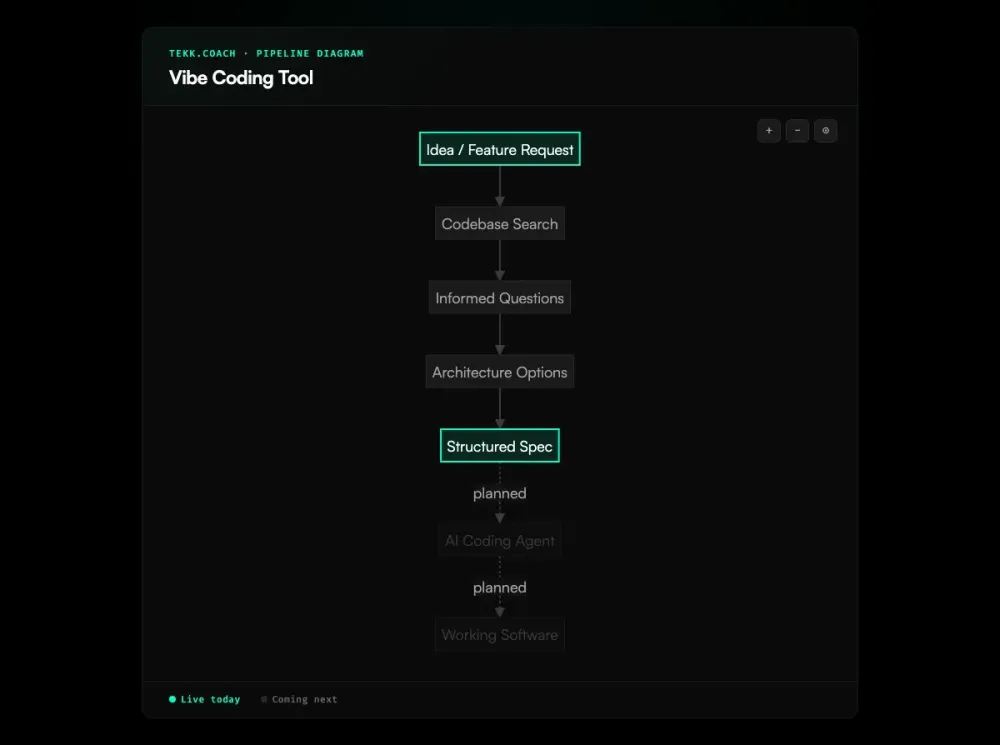
Vibe coding works until it doesn't. Vague prompts send good agents in the wrong direction. You end up with code that looks finished and breaks under real use.
Tekk.coach is the planning layer that fixes this. It reads your actual codebase, asks targeted questions grounded in what it finds, and generates a structured spec before anything gets handed to Lovable, Bolt, Cursor, or Claude Code. Your agents get a real prompt. The code comes out right.
Over 7 million developers now use AI coding tools every day. Bad prompts are still the number one reason the output falls short.
[Try Tekk.coach Free →]
How Tekk.coach Does Vibe Coding
Most vibe coding tools are great at generating code. None of them fix the prompt you're handing in. Tekk operates one step upstream. It's the planning layer where you build the spec your coding agent actually needs.
Before Tekk generates anything, it reads your codebase. Not a generic overview. It runs semantic search, file search, and directory browsing across your repo on GitHub, GitLab, or Bitbucket. It finds your language, framework, ORM, and existing patterns before asking a single question. So the questions aren't generic — they reference your actual files and dependencies.
From there, Tekk presents two or three architecturally distinct approaches with honest tradeoffs. Then it writes the spec, streamed live into a rich text editor as a working document. Not a chat message. A structured spec with a TL;DR, scope boundaries ("Building / Not Building"), subtasks with acceptance criteria and file references, assumptions with risk levels, and validation scenarios.
That spec is what gets handed to your coding agent. "Add auth to my app" sends Cursor flailing. A codebase-grounded spec with schema, routes, acceptance criteria, and scope boundaries sends it shipping.
Key Benefits
Your agents get specs, not paragraphs. A one-liner into Cursor is how you get fragile output. Tekk builds the full spec — schema, routes, acceptance criteria, file targets — derived from your actual codebase, not assembled from generic patterns.
Reads your code before planning. Tekk searches your repo before generating anything. Every question and every plan references your real stack. No generic advice, no assumptions about what you're using.
Scope protection built into every plan. Every spec includes a "Not Building" section. You know what's in and out before any agent writes a line. That's how you stop scope drift from compounding into months of technical debt.
Works with the vibe coding apps you're already using. Tekk doesn't replace Lovable, Bolt, Replit, or v0. It sits in front of them. Connect your repo, plan the feature, hand off the spec. Your existing tools get better at execution. If you want a full workflow — planning, tracking, and expert review in one place — the vibe coding platform is the broader workspace built around the same planning engine.
Catch what vibe coding misses. After building with AI agents, run a security review, architecture review, or performance review. Tekk reads your repo and finds the gaps your agents introduced. As Addy Osmani argues, vibe coding is not the same as AI-assisted engineering — the difference is planning and discipline. Structured ai code review is the quality gate that catches what vibe coding introduces before it reaches production.
How It Works
Step 1: Search — Tekk reads your codebase. Connect your GitHub, GitLab, or Bitbucket repo. Tekk runs semantic search, file search, regex, and directory browsing to understand what you've built. Your language, your framework, your existing patterns — all mapped before you type a word.
Step 2: Questions — Targeted, not generic. Tekk asks 3 to 6 questions grounded in what it found in your code. Not "what stack are you using?" — something like "You're using Prisma — extend the User model or create a separate auth table?" The questions are specific because the research was.
Step 3: Options — Real architectural tradeoffs. Tekk surfaces two or three distinct approaches with honest tradeoffs. Not a recommendation dressed in marketing language. Actual choices with real consequences. When there's one obvious path, it skips this and goes straight to the plan.
Step 4: Plan — Hand off to your coding agent. The complete spec streams into a working document. Scope boundaries, subtasks with acceptance criteria, file references, dependencies, assumptions, and validation scenarios. Take it to Cursor, Claude Code, or Codex — your vibe coding AI gets a prompt worth following.
Who This Is For
Non-technical founders using Lovable, Bolt, Replit, or v0 to build their product. Vibe coding gives you access to development that used to require hiring an engineer. Tekk makes sure the code you ship holds up.
Solo developers and small teams using Cursor or Claude Code who are tired of the "describe in English, get confused output, iterate eight times" loop. One good spec upfront beats six rounds of rework. If you're building with vibe coding apps and want to actually ship something solid, Tekk is the missing step.
Also fits product managers who need technically grounded specs without a senior engineer on call, and any team of 1 to 10 people building fast with AI and starting to feel the chaos — specs in chat threads, lost context, code that no one fully understands.
What Are Vibe Coding Tools?
Vibe coding is a development practice where you describe what you want in plain language and an AI generates the corresponding code. The term was coined by Andrej Karpathy, co-founder of OpenAI, in February 2025 — he described it as a way to "fully give in to the vibes, embrace exponentials, and forget that the code even exists." You express intent, the AI writes code, you iterate. No syntax, no boilerplate. The term went so mainstream it was named Collins Dictionary's Word of the Year for 2025.
The appeal is access. Entrepreneurs, designers, and product managers who couldn't write a line of code can now build software that previously required hiring a developer. AppleInsider reports that App Store review submissions jumped 84% year-over-year in Q1 2026, attributed largely to vibe coding. For existing developers, it's a speed layer. Repetitive scaffolding takes seconds. By 2025 a full ecosystem had emerged: full-stack vibe coding platforms like Lovable and Bolt for non-technical founders, AI code editors like Cursor and Windsurf for developers who want AI inside their workflow. The vibe coding platform category matured separately — tools that manage planning, tracking, and orchestration across the full development lifecycle, not just the generation step.
The problem is input quality. The output of any vibe coding AI is bounded by the prompt you give it. Bad prompts produce bad code, and bad code compounds: security holes, no error handling, brittle logic, unchecked technical debt. An August 2025 survey of 18 CTOs found 16 had experienced production disasters caused by AI-generated code. The New Stack warns that unchecked vibe coding could cause "catastrophic explosions" in 2026. The Stack Overflow blog puts it bluntly: vibe coding without understanding code is a new category of risk. Community consensus has landed: vibe coding without planning is a liability. Tekk is the planning step most vibe coding apps skip.
Frequently Asked Questions
What are the best vibe coding tools?
The leading vibe coding tools split into two categories. Full-stack vibe coding platforms — Lovable, Bolt, Replit, Base44 — are built for non-developers going from idea to deployed app with minimal traditional coding. AI code editors — Cursor, Windsurf, Claude Code, GitHub Copilot — are built for developers who want AI assistance inside their existing workflow. TechRadar tested and ranked 10 vibe coding tools in 2026 for a detailed comparison. The right pick depends on whether you have an existing codebase and how much engineering experience you're working with.
What is a vibe coding platform?
A vibe coding platform is an AI-native development environment built around the prompt-generate-iterate loop. Instead of writing code in a traditional editor, you describe what you want and the platform generates functional code. Most vibe coding platforms handle auth, backend scaffolding, and deployment out of the box. Where they differ is in the depth of AI assistance, the type of output, and who they're designed for.
How does vibe coding AI work?
Vibe coding AI takes a natural language description of a feature or application, infers context from what's already been built, and outputs executable code. The core loop is: describe, generate, test, refine. The AI handles syntax and boilerplate; the builder handles intent and judgment. The quality of the output is directly tied to the quality of the input — which is exactly the gap Tekk fills.
What is the difference between vibe coding and spec-driven development?
Vibe coding is the practice of prompting an AI with rough ideas and iterating on the output. Spec driven development means building from a structured specification — defined scope, acceptance criteria, subtasks, and explicit assumptions — before any code gets written. The two aren't opposites. Tekk combines them: you vibe-code the intent, Tekk formalizes it into a spec, and your coding agent executes against that spec. You get the speed of vibe coding with the precision of a real plan.
Is Tekk.coach a vibe coding app?
Tekk.coach is the planning layer for vibe coding, not a vibe coding app itself. Vibe coding apps generate code. Tekk generates the spec that tells your vibe coding app what to generate. Connect your repo, describe the feature, let Tekk read your codebase and structure your idea into a real specification — then hand that spec to Lovable, Cursor, Claude Code, or whichever agent you're using.
What makes a good vibe coding tool?
A good vibe coding tool understands your existing codebase (not just the prompt you typed), produces maintainable output, and protects you from scope drift and security gaps. Most tools in the market are good at generation but weak on context and discipline. The best setups pair a planning layer — like Tekk — with the generation step, so the AI knows what you're building, what you're not building, and what already exists in your code.
When should I use a vibe coding platform vs just prompting directly?
Prompt directly when you're experimenting on a weekend project with no existing codebase and nothing at stake. Use a structured vibe coding platform when you have real code, real users, or production requirements. The bigger the codebase, the more a planning step matters — an AI that doesn't know your existing architecture will make assumptions that conflict with it. Past the prototype stage: structure first, then generate.
Ready to Try Tekk.coach?
Vibe coding gets you to a working prototype fast. Tekk makes sure the code that comes out is worth keeping. Connect your repo, describe what you're building, and get a structured spec in minutes.
[Start Planning Free →]