
You shipped fast. That's the whole point of vibe coding. But 47% of AI-generated code contains security flaws — and they don't announce themselves. Tekk reviews your AI-generated codebase before it reaches production: security, architecture, performance, and scope creep, grounded in your actual files.
[Try Tekk.coach Free →]
How Tekk Does Vibe Coding Code Review
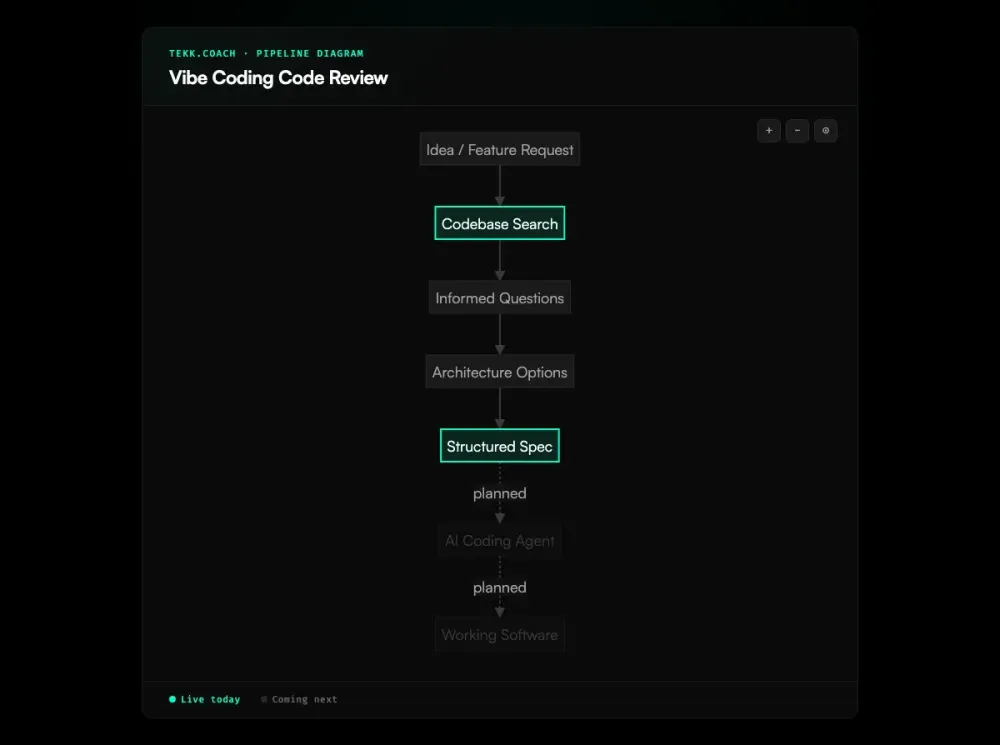
Tekk's Expert Review Mode is built for exactly this. You connect your repo, request the type of review you want, and the agent reads your actual codebase — not a sample, not a paste, the real thing. For teams that also want to prevent problems before they appear, pairing this with a vibe coding tool that generates structured specs upfront is the complementary step. It uses semantic search, file search, and directory scanning to understand your project's structure, patterns, and dependencies before drawing any conclusions.
Then it searches the web for current best practices, framework-specific guidance, and recent vulnerability advisories relevant to your stack. The output isn't a generic list of things AI code usually gets wrong. It's a review of your specific project, with specific files called out and specific recommendations tied to what it found.
Four review types are available: security (vulnerabilities, auth logic, injection risks, hardcoded credentials), architecture (structural issues, coupling, design drift across AI-generated sessions), performance (bottlenecks, inefficient patterns, scalability concerns), and agent improvement (evaluating your AI coding setup and suggesting upgrades).
That last one matters more than it sounds. If your agent setup is part of why the code quality is inconsistent, fixing the review process — not just the current codebase — prevents the same problems on the next project.
Key Benefits
Reviews grounded in your code, not generic advice. Tekk reads your actual repository before generating anything. Every finding references a real file, a real pattern, a real dependency in your project. No boilerplate. No "AI code often has X problem" — it tells you whether your code has that problem.
Four dimensions in one session. Security, architecture, performance, and agent improvement. Most code review tools cover one of these. Tekk covers all four, and the agent can identify when a performance issue is actually an architectural issue in disguise.
Current best practices, not stale training data. Tekk's web researcher fetches relevant documentation, CVE advisories, and framework guides during the review. The recommendations reflect what matters now for your stack.
Expert-level output without the consultant bill. A senior engineer who can audit your authentication logic, flag your database schema, and tell you why your agent sessions are generating inconsistent patterns doesn't come cheap. Tekk is that review on demand.
How It Works
Step 1: Connect your repo. Tekk connects to GitHub, GitLab, or Bitbucket. It reads the full codebase — not just what you paste in.
Step 2: Request your review type. Pick security, architecture, performance, or agent improvement. You can run multiple in the same session.
Step 3: The agent reads your codebase. Semantic search, file search, regex search, directory browsing. The agent builds a working model of your project before it says anything.
Step 4: The agent searches the web for current practices. Your stack, your framework version, current CVE advisories. The review is grounded in what's actually relevant today.
Step 5: You get actionable recommendations tied to your files.
Not "consider reviewing your auth logic." Something like: "Your session invalidation in auth/middleware.js doesn't handle token revocation — here's the pattern to add." Specific, file-referenced, and fixable.
Who This Is For
Vibe coders who shipped fast and want to validate the output. You used Cursor, Claude Code, Lovable, Bolt, or Replit to build something that works. Now you want to know what you missed before it becomes a production incident. Tekk is the review you can't run yourself — unless you happen to have a security engineer and an architect on call.
Non-technical founders who can't audit the code themselves. The app your AI built looks great. The demo went perfectly. But you have no way to know whether the authentication is sound, whether the database queries are safe, or whether the architecture will hold under load. Tekk translates that uncertainty into specific, actionable findings.
Developers who used AI heavily and want a second opinion. You know AI tools make mistakes. You caught some of them. But you've also seen how AI generates code that looks correct, passes your tests, and breaks in production under conditions you didn't test. A structured review before you ship is cheap compared to an incident at 2am.
What Is Vibe Coding Code Review?
Vibe coding code review is the practice of systematically auditing AI-generated code for problems that don't surface during development or basic testing. It emerged as a necessary counterpart to the vibe coding workflow: the same speed that makes AI-first development attractive also means AI tools skip the structural reasoning that human engineers build up over time.
The standard code review process — a senior engineer reading a pull request — doesn't scale to vibe-coded projects. The code is often plausible at the line level but incoherent at the architectural level. AI tools don't track design decisions across multi-session builds. They generate code that satisfies the prompt, not code that fits coherently into a system. This is where a dedicated ai code review layer — one that reads the full codebase and reasons about the design — becomes essential rather than optional.
What a thorough vibe coding code review looks for: injection vulnerabilities (SQL injection via string concatenation is a common AI output), hardcoded credentials and tokens, authentication logic that skips edge cases, scope creep from AI agents that implemented more than you asked for, architectural drift where patterns conflict across sessions, and supply chain risks from libraries the AI recommended without checking for known CVEs.
The difference from standard code review is context. Standard code review assumes a human made deliberate design decisions and you're verifying they're correct. Vibe coding code review assumes those decisions may never have been made — and you're filling the gap.
Frequently Asked Questions
What is vibe coding code review?
Vibe coding code review is the process of systematically auditing AI-generated code before it ships. It checks for security vulnerabilities, architectural problems, scope creep, and design issues that AI tools introduce when generating code without deep awareness of your project's structure or requirements. It's a necessary step because AI-generated code looks functional but often hides significant problems beneath the surface.
How do I review AI-generated code from vibe coding?
The most effective approach is a structured multi-dimensional review: security (injection risks, authentication logic, credentials), architecture (structural coherence across sessions, coupling, drift), and performance (query efficiency, scaling concerns). The challenge is that these require expertise most vibe coders don't have. Upstream, spec driven development reduces how many problems reach the review stage. Downstream, tools like Tekk automate the review by reading your actual codebase, applying current best practices from live web research, and surfacing specific findings tied to specific files.
What security issues do vibe-coded projects typically have?
The most common are: SQL injection from string concatenation (AI's default approach to database queries), hardcoded API keys and tokens, weak authentication logic that skips edge cases like token revocation and brute-force protection, improper input validation, and vulnerable third-party libraries that AI recommended without checking for CVEs. Veracode's 2025 report found 47% of AI-generated code has security flaws. Palo Alto Networks Unit 42 has documented these patterns extensively in vibe-coded applications.
Does Tekk.coach review Lovable, Bolt, or Replit output?
Yes. Tekk connects to GitHub, GitLab, or Bitbucket, so it works with any codebase regardless of what generated it — Lovable, Bolt, Replit, Cursor, Claude Code, or a mix. The review process is the same: read the actual codebase, run the relevant review types, surface specific findings tied to specific files.
How is Tekk's code review different from other AI code review tools?
Most AI code review tools run static analysis against known patterns — they're good at catching syntax-level and known-CVE issues. Tekk's review is different in two ways. First, it reads your full codebase before generating anything, so the findings are grounded in your actual project structure, not a pattern library. Second, it searches the web for current best practices during the review, so the recommendations reflect what's relevant now for your specific framework and stack. It also covers architectural and scope issues that static analysis tools miss entirely.
Is a code review necessary for vibe-coded projects?
Yes, and the data supports it. 47% of AI-generated code has security flaws (Veracode 2025). Aikido Security's 2026 report found AI-generated code is now the cause of one in five software breaches. These aren't edge cases — they're the expected baseline. A vibe-coded project that ships without a review is a project where the security posture is unknown. That's fine for a prototype. It's not fine for anything with real users, real data, or real payments.
Ready to Review Your Vibe-Coded Project?
If your project was built with AI, a review isn't optional — it's the step between "it works in demo" and "it works in production." Connect your repo, pick your review types, and get specific findings tied to your actual files.
[Start Planning Free →]