
TL;DR
User stories written in Miro or Jira have no idea what's in your codebase. So your AI coding agent executes them literally — and produces generic code. Tekk.coach reads your repo first, then generates user stories with acceptance criteria tied to real files and architecture. No workshop, no sticky notes, no manual transfer to Jira. Just specs your AI agent can actually use.
How Tekk.coach Does User Story Generation
Most user story mapping software starts with a blank canvas. You add sticky notes, arrange activities, draw swimlanes, write acceptance criteria. Then someone has to transfer all of that into Jira tickets. Then a developer — or an AI coding agent — interprets the tickets and writes code. Each handoff loses information. As Nielsen Norman Group's analysis of story mapping confirms, the method helps teams maintain visibility and align on what to build — but the map itself contains no implementation detail. By the time your story reaches the code, it says "user can log in" with zero context about your auth implementation.
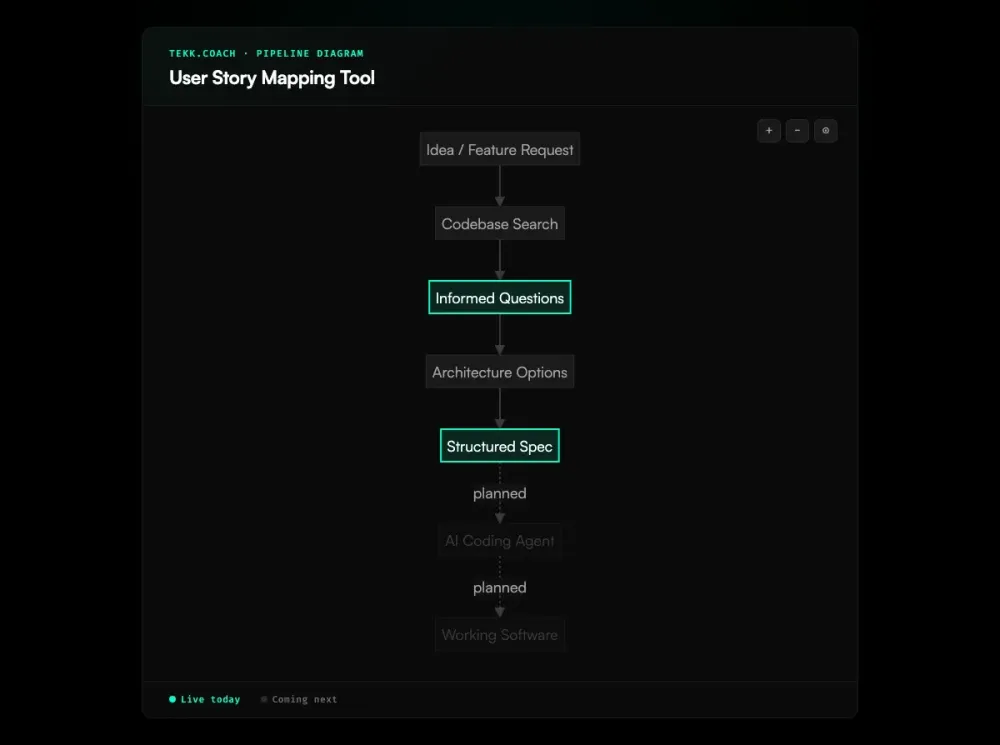
Tekk skips the canvas entirely. You connect your GitHub, GitLab, or Bitbucket repo via OAuth. The AI agent reads your codebase — semantic search, file search, regex, directory browsing, repo profiling. It builds real understanding of what exists before generating a single line of spec. Then you describe what you want to build, and Tekk asks clarifying questions before producing a plan.
Every plan includes subtasks with acceptance criteria that reference actual files and patterns from your repo. Not "user can reset their password." More like: "password reset email triggers via services/auth/emailService.ts, token stored in UserPasswordReset model, expiry validation in middleware/auth.ts." That's acceptance criteria an AI coding agent can execute without guessing — the same standard that spec driven development holds every requirement to.
The output streams into a BlockNote rich text editor as a living document. You edit it. You own it. There's no locked template format. When it's ready, you hand it to Cursor, Claude Code, Codex, or Gemini and let them build.
Key Benefits
Acceptance criteria that reference real code Every subtask links to actual files, functions, and architectural patterns in your repo. AI agents stop guessing and start building correctly.
No manual Jira transfer The workshop-to-ticket transfer step is where story quality dies. Tekk generates structured specs directly from codebase understanding. One step, not three.
Explicit scope boundaries Every Tekk plan includes a "Building / Not Building" section. Same prioritization function as story map release slices — without the canvas.
Built for AI coding agents Tekk plans are structured for Cursor, Claude Code, Codex, and Gemini. Story quality determines code quality. Tekk handles story quality.
Free to start Connect your repo and generate your first spec for free. No credit card, no sales call.
How It Works
Connect your repo. Authenticate with GitHub, GitLab, or Bitbucket via OAuth. Tekk indexes your codebase using semantic embeddings, file search, regex, and directory browsing.
Describe what you want to build. Plain language. No template required. "Add two-factor authentication" or "refactor the billing module to support annual plans."
Answer Tekk's clarifying questions. The AI agent surfaces assumptions and asks targeted questions before generating the spec. This is where workshop-style alignment happens — fast, async, without a Zoom call.
Get a codebase-grounded spec. Your plan includes: TL;DR, scope boundaries (Building / Not Building), subtasks with acceptance criteria referencing real files, risk-rated assumptions, and validation scenarios.
Hand the spec to your AI coding agent. Feed it to Cursor, Claude Code, Codex, or Gemini. The spec has everything the agent needs to build correctly.
Who This Is For
Solo founders and small dev teams (1–10 people) You don't need a facilitated story mapping workshop. You need a spec you can execute today. Tekk replaces the ceremony with codebase-aware planning that takes minutes.
PMs and developers using AI coding agents If you're using Cursor, Claude Code, or Codex, story quality is your bottleneck. Generic "as a user I want..." stories produce generic code — and as Atlassian's community research on AI-generated user stories notes, most AI story generators produce codebase-agnostic output that teams must manually enrich with implementation context. Tekk generates stories grounded in your actual architecture.
Teams tired of the Miro-to-Jira transfer You spent two hours mapping stories on a whiteboard. Now you have to re-enter them as tickets. Then someone has to add acceptance criteria. Then a dev asks what "user can authenticate" means in your specific codebase. Tekk eliminates this loop.
What Is User Story Mapping?
User story mapping is a product planning technique introduced by Jeff Patton in 2005. The core idea: organize user activities horizontally (the "backbone" of the product experience) and break each activity into stories below it. Teams prioritize stories vertically — the top row of each activity forms the minimum viable product. Horizontal swimlanes define release scope.
The technique became a cornerstone of agile product development because it solves a real problem: flat backlogs lose context. When you see 200 tickets in Jira, you lose the thread of what users are actually trying to do. A story map restores the narrative — as Patton later detailed in his O'Reilly book User Story Mapping (2014), the method helps cross-functional teams — PMs, designers, developers — align on what they're building and why.
The current landscape of user story mapping software divides into three categories. Dedicated tools like StoriesOnBoard, FeatureMap, and Avion provide canvas-based mapping with Jira/GitHub integrations. Whiteboard tools like Miro, Mural, and FigJam are used for collaborative discovery workshops. Jira add-ons like Easy Agile TeamRhythm bring mapping into the delivery tool. All of these tools address the discovery and documentation layer. None of them address the codebase layer.
That gap matters more now than it did in 2005. With 87% of agile teams using Scrum and user stories as their primary requirements format, the disconnect between story maps and codebases affects most software teams. AI coding agents execute user stories literally. "As a user, I want to reset my password" tells Claude Code nothing about your email service, your token model, or your existing auth middleware. The story map helped you align on what to build. It doesn't help your AI agent understand how to build it in your specific codebase. Ai project planning that starts from the codebase — rather than a blank canvas — is what bridges that gap. That's the problem Tekk solves.
Frequently Asked Questions
What is a user story mapping tool? A user story mapping tool helps product teams organize user activities and stories into a visual map that shows the full product experience. The map arranges stories horizontally by user activity and vertically by priority, helping teams plan releases and maintain user context across the backlog. Popular user story mapping software includes StoriesOnBoard, Miro, Easy Agile, and FeatureMap.
Is Tekk.coach a user story mapping tool? Tekk is not a visual story mapping canvas — there's no backbone view, no drag-and-drop card organization, no walking skeleton diagram. Tekk is a spec-driven development platform that generates user-story-style acceptance criteria from codebase context. If you need a collaborative workshop canvas for stakeholder story mapping sessions, use Miro or StoriesOnBoard. If you need specs with acceptance criteria your AI coding agent can execute, use Tekk.
What makes Tekk different from a standard AI user story generator? Most AI user story generators take a prompt and produce "As a user, I want..." templates. They're fast, but the output is codebase-agnostic — it doesn't know your auth implementation, your data model, or your existing file structure. Tekk reads your actual repo before generating anything. Acceptance criteria reference real files and patterns. That's the difference between a story an AI agent can execute and a story it has to guess at.
What is the main limitation of user story mapping software? The biggest limitation is the gap between the story map and the codebase. Stories are written in Miro or Jira without knowledge of the actual implementation. This forces two manual transfers: workshop → Jira tickets, and Jira tickets → developer interpretation. Each transfer loses information. For teams using AI coding agents, this information loss directly degrades code quality.
Can I use Tekk with Cursor or Claude Code? Yes. Tekk plans are designed to be handed directly to AI coding agents. The structured spec format — with scope boundaries, acceptance criteria referencing real files, and validation scenarios — gives Cursor, Claude Code, Codex, and Gemini the context they need to build correctly.
What is the "as a user I want" format and why does it fall short? The "As a [user], I want [action] so that [outcome]" format is the standard user story template. It's useful for communicating user intent but fails as a technical specification. The format contains no information about the existing codebase — no file references, no architectural constraints, no implementation patterns. AI coding agents that receive this format without codebase context produce code that is technically correct but architecturally inconsistent with the existing system.
Who should use traditional user story mapping software instead of Tekk? Use Miro, StoriesOnBoard, or Easy Agile if you need: a visual backbone/walking skeleton canvas, collaborative stakeholder workshops with non-technical participants, export-ready story map artifacts for presentation, or story mapping integrated directly into Jira's interface. Teams that manage delivery through a kanban board software setup can use Tekk's Kanban workspace alongside their existing planning tools. Tekk is the right user story tool for developers and PMs who need codebase-grounded specs for AI coding agent execution.
Does Tekk replace Jira? No. Tekk generates specs and plans — it doesn't manage tickets, sprints, or workflows. Most teams use Tekk to produce the spec, then create Jira issues from the subtasks. The difference is that the spec comes from codebase analysis, so the Jira tickets start with accurate acceptance criteria instead of vague requirements.
Stop writing user stories that your AI agent can't use. Connect your repo and generate your first spec in minutes. Tekk reads your codebase first, so your acceptance criteria describe reality — not a best guess.