
Vague plans produce vague code.
Hand a coding agent a paragraph and you get a paragraph's worth of precision back. The agent fills in the blanks with guesses. Then you spend two hours undoing what it guessed wrong.
Tekk generates structured plans your agents can execute. Every plan includes scope boundaries, acceptance criteria per subtask, file references, risk-flagged assumptions, and validation scenarios. Not a template. Not a chat message. A spec grounded in your actual codebase.
[Try Tekk.coach Free →]
How Tekk.coach Does Structured Planning
Every Tekk plan is a living document with a fixed structure. Here is what you get.
TL;DR — Two sentences: what you are building and why. Forces clarity before work starts.
Building / Not Building — Explicit scope boundaries. What the agent should touch and what it should leave alone. This section alone eliminates most rework.
Subtasks — End-to-end behavioral slices, not implementation notes. Each one includes acceptance criteria the agent can verify, file references pointing to exact locations in your repo, and declared dependencies so nothing runs out of order.
Assumptions — Each assumption gets a risk label (low, medium, high) and a consequence statement: what breaks if that assumption is wrong. Problems surface before the agent writes a line of code.
Validation scenarios — Concrete end-to-end test cases. Not "it should work" but specific steps and expected outcomes.
The document streams into a BlockNote editor in real time. You own it. Edit any section before anything executes. It is the spec your team works from.
This is not a Notion template with placeholder text. Tekk reads your codebase and writes the plan against what it finds. The subtasks reference your files. The assumptions name your dependencies. The scope fits your project.
Key Benefits
Scope protection on every plan. The Building / Not Building section is mandatory, not optional. Explicit exclusions stop coding agents from building adjacent things you never asked for. That is the most common failure mode in AI-assisted development.
Subtasks your agent can verify. Acceptance criteria are written as behavioral outcomes: "user can now do X," not "modify file Y." Your agent knows when the task is done. So do you.
File references so the agent edits the right place. No more "it created a new component instead of updating the existing one." The plan names the target files because Tekk read them first.
Risk-labeled assumptions. Every plan makes assumptions. Tekk names them. You catch integration mismatches, missing environment variables, and architectural conflicts before coding starts.
How It Works
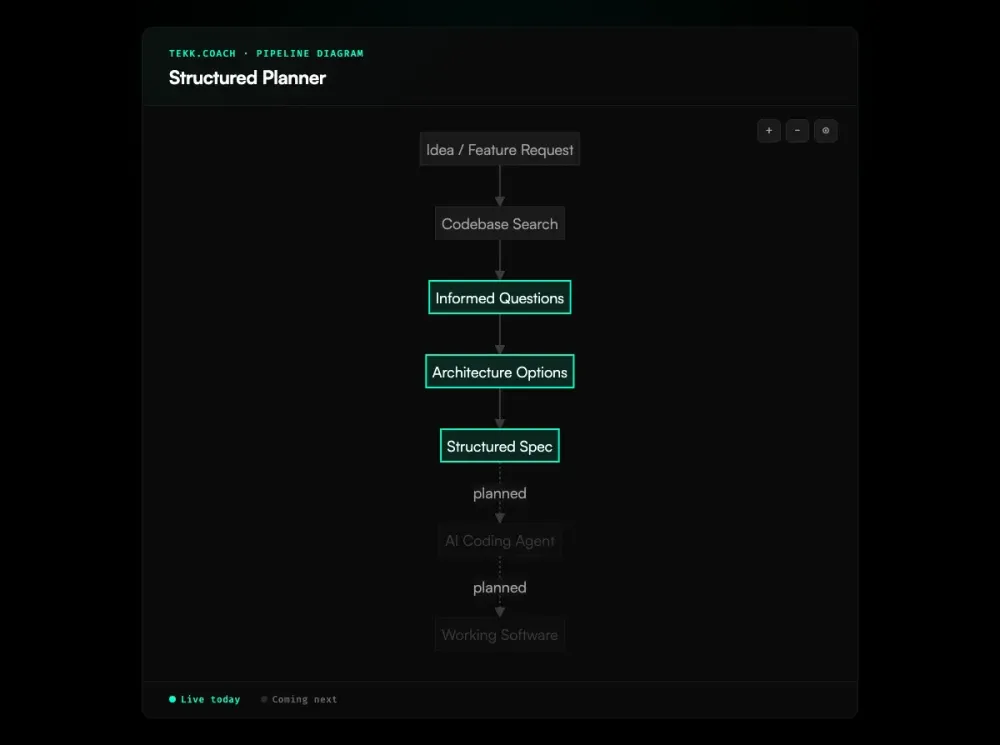
Tekk runs four stages for every task. It is not a one-shot prompt.
Search. Before asking anything, the agent reads your codebase. Semantic search, file search, regex search, directory browsing. It profiles your repo: languages, frameworks, services, packages. It knows what it is working with.
Questions. The agent asks 3 to 6 questions grounded in what it found. No generic questions. It does not ask what framework you are using if it can find that out by looking.
Options. For non-obvious problems, the agent presents 2 to 3 architecturally distinct approaches with honest tradeoffs. When one path is clearly right, it skips this step.
Plan. The structured plan streams into the BlockNote editor. TL;DR, scope, subtasks, assumptions, validation. The working document.
The full planning workflow — Search through Plan — is live today. Execution dispatch (sending the approved plan to a coding agent like Cursor or Claude Code) is coming next.
Who This Is For
Developers who keep getting rework from AI agents. You give Cursor a task description and get back code that mostly works but missed something. The problem is the spec, not the agent. Tekk fixes the spec.
PMs who need structured specs. Describing what a feature needs to do is one skill. Translating that into something an agent can execute is another. Ai project planning is where that translation happens — and Tekk handles it with codebase context included.
Solo founders who need architect-level plans without an architect. You are building across backend, frontend, and infrastructure at the same time, no senior engineer on the team. Tekk reads your code, asks the right questions, and produces a plan a senior engineer would recognize as thorough.
Anyone using Claude Code, Cursor, or Codex. These agents execute on what you give them. Tekk makes what you give them dramatically better. Connect your repo, describe the problem, get a spec, run the agent.
What Is a Structured Planner?
A structured planner produces plans with explicit organization. Not a task list, but a document that defines scope, breaks work into verifiable pieces, surfaces assumptions, and specifies success criteria.
In software development, structured plan development matters because plan quality determines output quality. A task list says "add authentication." A structured plan says which auth pattern, which files to create, which existing files to modify, what the acceptance criteria are for each step, and what is not being built (no password reset, no OAuth, no admin impersonation in this sprint). This is the foundation that spec driven development formalizes — and the reason specs outperform task lists when agents are doing the implementation.
That distinction matters when you work alone. It matters more when you work with AI coding agents that execute exactly what they are told. A good structured plan is what separates a coding agent that ships from one that flails.
The difference between a task list and a structured plan is the difference between "build auth" and "here is the exact spec your agent needs to build auth correctly the first time."
FAQ
What is an AI task planner for developers? An AI task planner for developers goes beyond scheduling. It reads your codebase, understands the technical context, and generates structured plans with acceptance criteria, file references, and scope boundaries. Those are the inputs coding agents need to execute correctly. Tekk reads your repo before producing a single subtask.
How does a structured plan development process work? Structured plan development starts with understanding what already exists in the codebase. Then it defines what will be built, what will not, how each piece can be verified, and what assumptions are in play. Tekk automates this: it searches your repo, asks clarifying questions, and generates the structured output. You review and edit before anything executes.
What is plan and execute in software development? Plan and execute is the discipline of fully specifying work before handing it to an implementation layer, whether that is a developer or a coding agent. The plan is the spec. The execute step is the agent running against it. Tekk handles the plan step today. When teams need agents working in parallel, ai agent orchestration across those concurrent workstreams is the natural extension. The execute dispatch layer — sending the approved plan to Cursor, Codex, or Claude Code — is coming next.
What does Tekk.coach's structured planner output include? Every Tekk plan includes a TL;DR summary, a Building / Not Building scope section, subtasks with acceptance criteria and file references, assumptions labeled by risk level with consequence statements, and validation scenarios for end-to-end testing. The full document streams into a BlockNote editor you can edit before execution.
How is Tekk different from a structured planner like Notion or Linear? Notion and Linear are good at tracking work. Neither reads your codebase before writing a plan. When you create a task in Linear, you write the description from scratch. When Tekk creates a plan, it has already read your repo, found the relevant files, understood your stack, and grounded every subtask in actual code. The output is specific, not generic.
Can I use Tekk as an AI task planner for Claude Code or Cursor? Yes. Tekk is built to produce the structured specs that Claude Code and Cursor need to execute correctly. Connect your GitHub, GitLab, or Bitbucket repo, describe the feature, let Tekk generate the plan, then hand it to your agent of choice. When execution dispatch ships, you will be able to do this from inside Tekk directly.
Is a structured planner worth it for solo developers? Most solo developers skip planning and prompt their coding agent directly. Then they spend twice as long fixing what the agent got wrong. The planning step is the highest-leverage thing you can do to improve agent output quality. Tekk makes it fast: Search, Questions, Options, Plan. The workflow takes minutes. The rework it prevents takes hours.
Start Planning Free
Your coding agent is only as good as the plan it runs on. Give it a real spec.
[Start Planning Free →]
Connect your repo. Describe the problem. Get a structured plan. Ship.