
TL;DR
Sprint planning fails when the tickets are too vague. Your AI coding agents — Cursor, Claude Code, Codex — can't execute on "fix the auth flow." They need a real spec. Tekk.coach reads your codebase, asks the right questions, and turns each sprint item into a structured spec with scope boundaries, subtasks, file references, and acceptance criteria. Before the sprint starts. No story points. No planning poker. No meetings.
[Try Tekk.coach Free →]
How Tekk.coach Does Sprint Planning
Most sprint planning software helps you schedule work and track whether you finished it. That's useful. It's also not the problem that kills sprints.
The problem is the gap between "this ticket is in the sprint" and "this ticket is ready to build." When that gap is filled with vague descriptions and implicit assumptions, mid-sprint confusion is guaranteed. If a human developer picks up a bad ticket, they ask questions. When an AI coding agent picks up a bad ticket, it builds the wrong thing — silently, quickly, and completely.
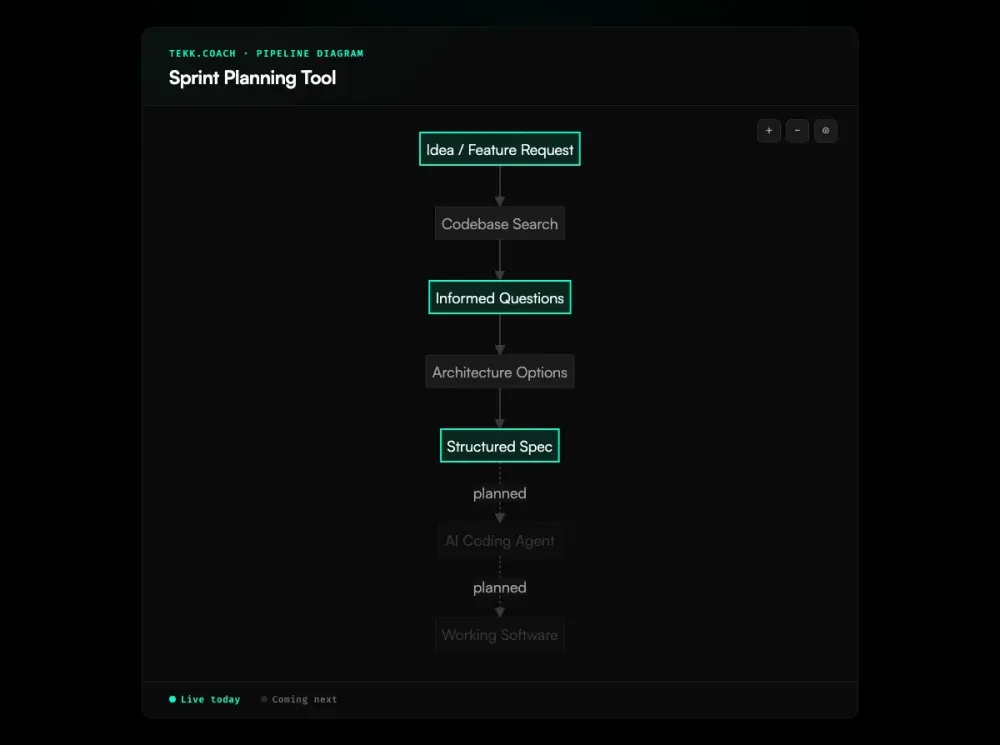
Tekk closes that gap. You describe a sprint item — in plain language or with a rough spec. Tekk connects to your GitHub, GitLab, or Bitbucket repo, reads the relevant code, and runs a multi-turn planning workflow grounded in spec driven development principles: it searches your codebase, asks clarifying questions, proposes scoped options, then generates a full structured plan. That plan includes a TL;DR, explicit scope boundaries (what's building, what's not), subtasks with acceptance criteria and file references, assumptions flagged with risk levels, and validation scenarios.
The output streams into a rich text editor — not a chat thread. It's a living document. You can edit it, review it, hand it to a teammate, or feed it directly to Cursor or Claude Code. Every spec is grounded in your actual codebase, not a generic template.
This is not sprint ceremony. Tekk has no velocity charts, no burndown reports, no sprint health dashboards. What it has is the spec layer that should exist between your sprint tool and your AI agents — and currently doesn't.
Key Benefits
Specs that AI agents can actually execute. Ticket titles cause agent failures. Tekk produces structured specs — scope boundaries, file references, acceptance criteria — that give AI coding agents the context to ship correctly on the first run.
Codebase-grounded from the start. Tekk reads your actual repo before generating anything. It doesn't guess at file names or assume architectural patterns. Every plan references what's already there.
No ceremony overhead. No estimation meetings. No planning poker. No story point debates. Traditional sprint planning is timeboxed to two hours per week of sprint — and most teams still run over. Describe the work, get a spec, move to execution. That's the entire workflow.
Expert review built in. After a spec is generated, you can run security, architecture, performance, or agent-improvement reviews against it. Catch bad assumptions before they become bad code.
Works with the tools you already use. Tekk connects to GitHub, GitLab, and Bitbucket via OAuth. Plans are designed to feed directly into Cursor, Claude Code, Codex, and Gemini.
How It Works
Connect your repo. Authenticate with GitHub, GitLab, or Bitbucket. Tekk indexes your codebase using semantic search, file search, regex, and directory browsing.
Describe a sprint item. Tell Tekk what you want to build — in plain language. No special format required.
Answer a few questions. Tekk asks targeted clarifying questions to scope the work correctly. This takes minutes, not a meeting.
Get a structured spec. Tekk generates a full plan: TL;DR, scope boundaries, subtasks with file references and acceptance criteria, assumptions, validation scenarios. It streams into a rich text editor.
Execute. Hand the spec to Cursor, Claude Code, Codex, or a human developer. The spec is ready to build from.
Who This Is For
Solo founders and small teams building with AI agents. If Cursor or Claude Code is doing your implementation work, your sprint items need to be specs, not ticket titles. Tekk is the step between "I know what I want to build" and "my agent builds it correctly."
Developers who want sprint structure without sprint ceremony. You don't need velocity charts or planning poker. You need to know exactly what each task requires before you start. Ai project planning at the task level — not the portfolio level — is what makes execution reliable. Tekk gives you that without the overhead of a traditional agile sprint planning tool.
Teams where sprint tickets keep going wrong mid-sprint. If your sprints derail because tickets were too vague, or because the implementation hit unexpected code complexity, Tekk's codebase-grounded specs surface those problems before coding starts — not after. Research shows teams with a commit-done ratio below 60% are underperforming on sprint plans — and vague tickets are the most common cause.
What Is a Sprint Planning Tool?
A sprint planning tool is software that helps development teams prepare for and execute a sprint — a fixed time period (usually 1-4 weeks) in which a team commits to shipping a defined set of work. Sprint planning is a core Scrum event where teams select backlog items, define a sprint goal, estimate effort, and break work into executable tasks.
Traditional agile sprint planning tools — Jira, Linear, ClickUp, Zenhub, Monday.com — focus on the process layer: backlog management, story point estimation, velocity tracking, capacity planning, sprint health reporting. These tools answer "what will we work on and did we finish it?" They are well-built for that job. With 87% of agile teams using Scrum and the agile tools market growing at 18.5% CAGR, the process layer is mature.
What they don't do: make the content of each sprint item executable. An item in Jira is a title, a description, some story points, and maybe a label. That's enough for a human developer to ask follow-up questions. It is not enough for an AI coding agent to build from. As AI agents take on more implementation work, the ticket quality problem becomes a sprint delivery problem. Even AI-assisted sprint planning tools focus on predictive estimation and ticket summarization — useful, but they still don't make the content of a ticket executable. The sprint planning software market hasn't caught up to this shift yet.
The best sprint planning ai tool for teams using AI agents isn't the one with the best burndown chart — it's the one that ensures every sprint item has a spec that an agent can execute. That's a different problem, and teams that rely on kanban board software to manage their backlog still need this spec layer to make AI execution reliable.
Frequently Asked Questions
What is a sprint planning tool? A sprint planning tool helps development teams prepare for a sprint by organizing backlog items, defining a sprint goal, estimating effort, and tracking completion. Traditional sprint planning software (Jira, Linear, ClickUp) focuses on the process of planning — selecting work and tracking velocity. Tekk.coach focuses on the content of planning — turning sprint tasks into structured, codebase-grounded specs before execution starts.
How is Tekk.coach different from sprint planning software like Jira or Linear? Jira and Linear manage the sprint process: backlog ordering, story points, burndown charts, sprint health. Tekk manages the sprint content: it reads your codebase and turns each sprint item into a structured spec with scope boundaries, file references, subtasks, and acceptance criteria. The two can coexist. Tekk fills the gap between "ticket in sprint" and "ticket ready to execute."
Is Tekk.coach an AI sprint planning tool? Yes, in the sense that it uses AI to generate codebase-grounded plans. But Tekk's AI is not estimating story points or suggesting sprint composition. It's reading your actual codebase, asking clarifying questions, and producing structured specs for each item. It's an ai sprint planning tool for teams whose execution layer is AI coding agents — where spec quality directly determines whether the sprint ships.
Does Tekk.coach replace Jira or my existing sprint planning software? No. Tekk is not a sprint management platform. It has no velocity tracking, sprint boards, burndown charts, or retrospective templates. It's the spec layer — the step that should happen between "this item is in the sprint" and "this item is handed to an agent." Most teams would use Tekk alongside their existing agile sprint planning tool, not instead of it.
Does Tekk.coach support story points and sprint velocity? No. Tekk has no estimation features, no story points, and no velocity tracking. If your team needs those, Jira, Linear, or Zenhub are better fits. Tekk is for teams that want zero ceremony: describe the work, get a spec, execute.
What AI coding agents does Tekk.coach work with? Tekk's specs are designed to be fed directly into Cursor, Claude Code, Codex, and Gemini. The structured format — scope boundaries, file references, acceptance criteria — gives these agents the context they need to execute correctly.
Is Tekk.coach a good agile sprint planning tool for remote teams? Tekk is async-friendly. Planning happens in writing — structured specs in a rich text editor that teammates can read, comment on, and edit without a synchronous meeting. If your sprint planning meetings are mostly "let's figure out what this ticket actually means," Tekk handles that before the meeting happens.
How much does Tekk.coach cost? Tekk is free to start. You can connect a repo and generate specs without paying. Paid plans are available for teams that need additional usage.
Sprint tickets don't fail because teams chose wrong items. They fail because no one agreed on what each item actually required. Tekk makes that agreement happen before a single line of code is written. Use Tekk as your sprint planning ai tool — connect your repo, spec out your sprint items, and give your AI agents something they can actually execute.
[Start Planning Free →]