
Writing the spec before the code is the right idea. Doing it well is the hard part. Most developers either skip it (too slow) or do it badly (too generic). Neither works when your coding agent is the one executing.
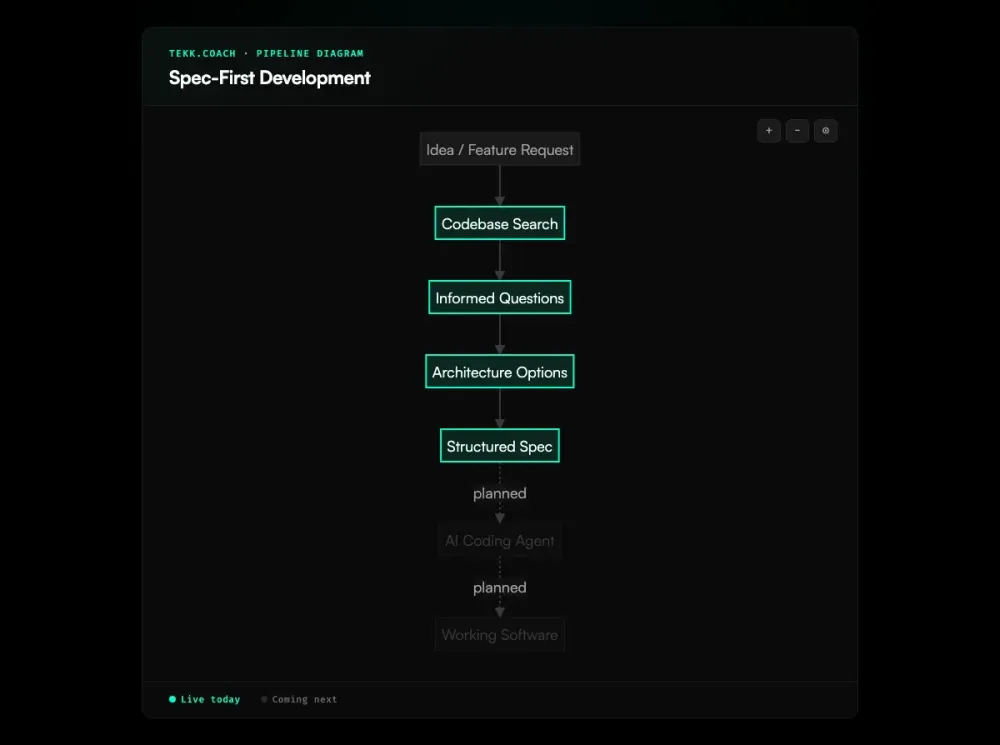
Tekk.coach makes spec-first development practical. The agent reads your codebase, asks the questions you'd otherwise skip, and generates a complete structured spec — before a single line of code is written. You review and approve. Your coding agent executes correctly.
[Try Tekk.coach Free →]
Key Benefits
Spec generation without the authoring burden You describe what you want to build. The agent extracts the full requirements through conversation — clarifying questions, architectural options, scope definition. You approve the output, not write it.
Codebase-grounded from the start The agent reads your repo before engaging. Specs reference your actual files, frameworks, and dependencies. No generic plans that conflict with your existing architecture.
Hard scope definition built in Every plan has a "Not Building" section. You know exactly what's in and what's out before any code is written. The spec enforces scope-first thinking.
Living document, not a static file The spec streams into an editable editor and stays connected to the kanban task. It doesn't drift because it's the active working document, not secondary documentation.
Knowledge gaps filled during planning When you're building something outside your expertise, Tekk searches the web for current best practices and folds that knowledge into the spec. You don't need to become an expert first.
How It Works
Step 1: Connect your repo Link GitHub, GitLab, or Bitbucket. Tekk indexes your codebase — languages, frameworks, services, packages. One-time setup.
Step 2: Describe the feature Create a task and describe what you want to build. A paragraph is enough — the agent handles extracting the full requirements from here.
Step 3: Agent reads the code Before asking anything, the agent searches the codebase. It identifies files the change will affect, patterns to respect, and constraints the spec should account for. No generic questions.
Step 4: Clarify and choose 3–6 questions grounded in the code. Then 2–3 distinct architectural approaches with honest tradeoffs. You pick the direction.
Step 5: Spec generated — before any code is written TL;DR, Building / Not Building scope, subtasks with acceptance criteria and file references, assumptions with risk levels, validation scenarios. The complete spec is ready before your coding agent starts. Review it, edit it, then execute.
Who This Is For
Developers with coding agents who've experienced the rework cycle. You prompt Cursor or Claude Code, it writes hundreds of lines of code, you realize it missed the edge cases or built things out of scope. Spec-first development short-circuits that cycle. Tekk makes it fast enough to actually do.
Founders and solo builders who hate writing documentation but need the discipline it provides. Tekk gives you the benefit of spec-first (correctly scoped, correctly architected features) without the overhead of authoring a 10-page requirements document. You describe the problem; the agent generates the spec — much like an ai prd generator handles the requirements structure so you don't have to.
Small teams without dedicated architects. You're touching authentication, payments, data pipelines — domains where you don't always know the right approach. Tekk reads the codebase and searches for current best practices so the spec reflects both your actual architecture and the current state of the art. You don't need to become an expert first.
Anyone building with AI coding agents who is tired of seeing the same feature reworked two or three times because the original prompt was underspecified. Spec-first is the fix. Tekk is how you actually implement it without it becoming a process burden.
What Is Spec First Development?
Spec-first development is the practice of writing a specification — defining what software should do, its constraints, and its acceptance criteria — before writing any code. The spec is the source of truth. Code derives from it.
The practice has roots in API design (OpenAPI's "design-first" philosophy, where the API contract is defined before implementation), but it's been substantially redefined by the AI coding wave. When AI coding agents are doing the implementation, the quality of the output depends almost entirely on the quality of the input. A one-paragraph description produces one-paragraph results. A structured spec with acceptance criteria, scope boundaries, and file references produces production-quality implementation.
Three levels of spec-first rigor are recognized by practitioners: spec-first (spec written before development begins), spec-anchored (spec maintained throughout feature evolution), and spec-as-source (spec is the only file humans edit; code is never touched directly). Most teams start at the spec-first level — it's the lowest investment with the highest return relative to ad-hoc prompting.
Common objections and why they don't hold:
- "It looks like waterfall" — modern spec-first specs are lightweight and conversational, not 50-page requirements documents. Writing a Tekk spec takes 10–20 minutes.
- "Requirements change" — specs should be lightweight and editable. A Tekk spec is a living document you can update between sessions.
- "It's too slow" — without a spec, the first implementation is fast and the rework is slow. With a spec, you invest 15 minutes upfront and skip the rework cycle.
Spec-first development doesn't work for everything. Exploratory research, rapid prototyping, and small bug fixes don't benefit from structured specs. The skill is knowing which category your work falls into.
Frequently Asked Questions
What is spec first development?
Spec-first development means writing a specification before writing any code. The spec defines what the software should do, its constraints, its scope boundaries, and its acceptance criteria. In AI-assisted development, specs are particularly important because coding agent quality directly correlates with prompt quality — a structured spec produces dramatically better output than an informal description.
What is the difference between spec-first and code-first development?
Code-first (or vibe coding) starts with implementation and discovers requirements during coding. It's fast for exploration and prototyping. Spec-first inverts this: requirements are explicit before implementation begins, edge cases surface during spec review not code review, and scope is defined before anyone starts building. For features that need to be right the first time, spec-first is significantly more efficient despite the upfront time cost.
How does spec first development work with AI coding agents?
The spec is the prompt. Instead of giving your coding agent (Cursor, Claude Code, Codex) an informal one-paragraph description, you give it a complete specification with subtasks, acceptance criteria, file references, and explicit scope boundaries. The agent then has a precise picture of what to build — less guessing, less rework. For teams running multiple agents in parallel, pairing this with ai agent orchestration extends that precision across every concurrent workstream. Tekk.coach generates that spec from your codebase and conversation.
Does spec first development add too much overhead for small features?
Yes, for genuinely small tasks. Bug fixes, minor UI changes, and obvious one-line modifications don't need a structured spec. Spec-first development pays off for complex features, cross-cutting changes, and work in domains where you don't have deep expertise. Tekk is a planning tool for features you're committed to shipping correctly — not a ticket tracker for everything you touch.
How is spec-first development different from waterfall?
Waterfall front-loads all requirements into a long document that's rarely revisited. Spec-first in a modern context is lightweight, iterative, and provisional: a short structured plan you write before a single feature, not a multi-month requirements phase. The spec is meant to be edited as you learn. The similarity is sequencing — spec before code. The difference is scope, formality, and revision cadence.
What tools support spec first development in 2026?
The main tools are Tekk.coach (standalone platform, codebase-aware), Kiro (AWS IDE with spec workflow built in), Augment Code/Intent (enterprise living-spec platform), GitHub Spec Kit (open-source framework), and various frameworks like BMAD-METHOD and OpenSpec. Tekk is the only tool that reads your codebase automatically before generating the spec — the others work from your description or a template you fill in manually.
How do I write a good spec for AI coding?
A good spec defines what you're building (in testable terms), what you're explicitly not building, specific subtasks with acceptance criteria, assumptions and their risk levels, and end-to-end validation scenarios. The spec should reference your actual files and architecture, not generic patterns. Tekk.coach generates this structure automatically — you describe the feature, the agent reads the codebase and asks clarifying questions, and the complete spec is generated before you start coding.
What is the ROI of spec first development?
Research cites 50–80% implementation time savings for well-specified features and error reductions up to 50% compared to informal prompting. Real-world practitioners report 40% fewer prompt-and-fix cycles with structured spec workflows. The ROI timeline is roughly 3–6 months before the aggregate savings become obvious — earlier for complex features, later for simple ones.
Ready to Try Tekk.coach?
Spec-first development works. The hard part isn't the concept — it's writing a good spec fast enough that it doesn't feel like a burden. Tekk handles the spec generation; you handle the approval.
Connect your repo and run a planning session. The first spec takes 15 minutes and the first rework cycle you avoid will tell you everything.
[Start Planning Free →]