
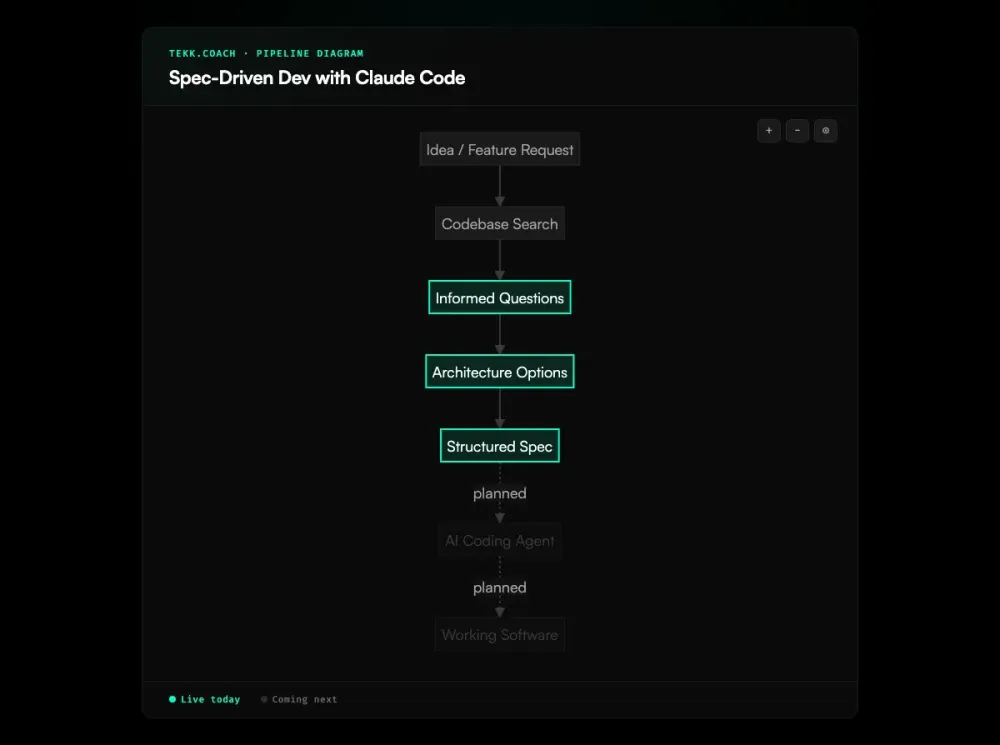
You use Claude Code. It's fast. But you're getting rework — wrong files targeted, scope that ballooned, architecture that doesn't match what you meant. The model isn't the problem. The spec is.
Tekk.coach generates codebase-grounded specs that you hand to Claude Code. The agent reads your actual repository, asks questions based on what it finds, searches the web for current best practices, and produces a structured plan — TL;DR, explicit scope boundaries, subtasks with acceptance criteria and file references. You review it, then execute. No flailing.
[Try Tekk.coach Free →]
Key Benefits
Specs grounded in your actual code — not generic boilerplate Tekk reads your repository before generating anything. The spec references your actual files, your framework, your existing patterns. Claude Code doesn't have to guess.
Web research folded into the spec Building something outside your expertise — payments, security, AI agents, data pipelines? Tekk searches the web for current best practices and folds the findings into your plan, similar to how an ai prd generator would consolidate requirements. You don't research separately; the research lives in the spec.
Explicit scope protection Every plan has a "Not Building" section. Claude Code knows exactly what's in and what's out before a single token of implementation runs. Scope creep is a prompt problem. Tekk fixes the prompt.
Living documents, not chat messages Plans stream into BlockNote, an editable rich text editor. Refine the spec before you execute. The document persists — next week, next session, you still have the full plan and the reasoning behind it.
Zero CLAUDE.md management overhead Stop manually writing and updating spec files before every Claude Code run. Tekk generates the spec. You review and approve. Then you execute.
How It Works
Step 1: Connect your repository Link your GitHub, GitLab, or Bitbucket repo. Tekk indexes it once and updates as you work. No paste-into-chat required.
Step 2: Describe what you're building One sentence or three paragraphs — either works. You're describing intent, not writing the spec. Tekk handles the spec.
Step 3: Answer 3-6 questions grounded in your code The agent reads your codebase first, then asks the questions your code raises. These aren't generic discovery questions. They're the hard questions — the ones a senior engineer would ask before starting.
Step 4: Review the generated spec The plan streams into the editor in real time. TL;DR, Building / Not Building, subtasks with acceptance criteria and file references, assumptions with risk levels, validation scenarios. Edit anything. Every field is live.
Step 5: Execute with Claude Code Hand the spec to Claude Code — manually today, or via the execution layer coming next. Claude Code now has a structured, codebase-aware spec instead of a vague sentence. It runs correctly the first time.
Who This Is For
You're already using Claude Code. You've figured out the basics — how to prompt it, how to structure your CLAUDE.md, when to use sub-agents. But you're still hitting rework. 84% of developers now use AI tools, and the ceiling isn't the model — it's the spec. Not because Claude Code is bad, but because the spec is thin. You described what you wanted in one sentence and expected the model to fill in everything it doesn't know about your codebase, your conventions, and your intent. That's the gap Tekk closes.
This is for solo founders and small teams shipping real software with AI coding agents. You don't have a dedicated architect to write specs. You don't have time for a 20-page PRD. But you need something between "a sentence" and "a full design document" — and that something needs to be grounded in your actual code, not generic best practices from a training dataset.
If you're using Claude Code and asking yourself "why does it keep targeting the wrong files" or "why did it build the thing I explicitly said not to build" — the spec is the answer. Tekk generates that spec.
What Is Spec-Driven Development With Claude Code?
Spec-driven development (SDD) is a workflow where a structured specification document is the primary artifact — written and reviewed before any code runs. In the context of Claude Code, SDD means you don't hand the agent a one-line prompt. You hand it a structured plan: what you're building, what you're not, what the subtasks are, what acceptance criteria each subtask must meet, and which files it touches.
The pattern that's emerged in 2026 — Requirements → Design → Tasks → Implementation — puts the human in a planning and review role, and the agent in an execution role. Phase gates replace mid-run course correction. You review the spec, not the code halfway through generation.
With Claude Code specifically, SDD matters because the model is powerful enough to execute complex multi-file changes — which means a bad prompt produces a lot of wrong work before you catch it. Codebase-aware spec generation (what Tekk provides) takes SDD further: instead of writing the spec yourself from scratch, the agent reads your code first and writes the spec grounded in what it finds.
Frequently Asked Questions
What is spec-driven development with Claude Code?
Spec-driven development with Claude Code is a workflow where you generate a structured specification — covering scope, subtasks, acceptance criteria, and file targets — before running Claude Code on any implementation. Instead of prompting Claude Code with natural language descriptions, you hand it a precise plan that the agent can execute against your actual codebase.
How do I add spec-driven development to my Claude Code workflow?
The minimal approach: before every Claude Code session, write a spec in markdown covering what you're building, what you're not, the subtasks, and which files each subtask touches. Put it in CLAUDE.md or paste it as context. The Tekk approach: describe the feature in Tekk, answer a few codebase-grounded questions, and let the agent generate the spec — then execute with Claude Code from the output.
What should a Claude Code spec include?
At minimum: a TL;DR of what's being built, explicit scope boundaries (what's in and what's out), a list of subtasks with acceptance criteria, the files each subtask touches, key assumptions, and validation scenarios. The "Not Building" section is the most commonly skipped — and the most likely cause of Claude Code over-building.
How is Tekk different from writing specs manually for Claude Code?
Manual spec writing starts from scratch every time. Tekk reads your codebase first — semantic search, file search, framework detection — then generates a spec that references your actual code. It also folds in live web research when you're building in unfamiliar territory. The spec quality is higher, and you're not spending time doing the research or writing the structure yourself.
Does Tekk replace Claude Code?
No. Tekk is the planning layer before Claude Code runs. You still use Claude Code for execution. Tekk generates the spec that Claude Code executes from. Think of it as the difference between giving a contractor a napkin sketch vs. a detailed blueprint — both result in construction, but the quality of the output differs.
What does the spec look like before it goes to Claude Code?
It's a structured document with: a TL;DR, a "Building / Not Building" section, numbered subtasks each with behavioral acceptance criteria and specific file references, a list of assumptions with risk levels, and end-to-end validation scenarios. It streams into Tekk's BlockNote editor as an editable document — you refine it before executing.
Can I use Tekk with other coding agents besides Claude Code?
Yes. Tekk plans to support Cursor, Codex, and Gemini via OAuth in the execution layer. The spec output is tool-agnostic — it's a structured document that any coding agent can work from, and ai agent orchestration across multiple agents is on the roadmap. Claude Code is the most common pairing today.
Is spec-driven development worth the extra planning time?
For greenfield features and significant changes: yes. Practitioners report that planning time is recouped immediately in execution — fewer re-runs, less scope correction, less architectural rework. For trivial changes (renaming a variable, fixing a typo), SDD overhead isn't worth it. The workflow earns its cost on anything with more than three moving parts.
Ready to Try Tekk.coach?
Your Claude Code runs are only as good as the spec you give them. Connect your repo, describe what you're building, and get a codebase-grounded plan in minutes.
[Start Planning Free →]