
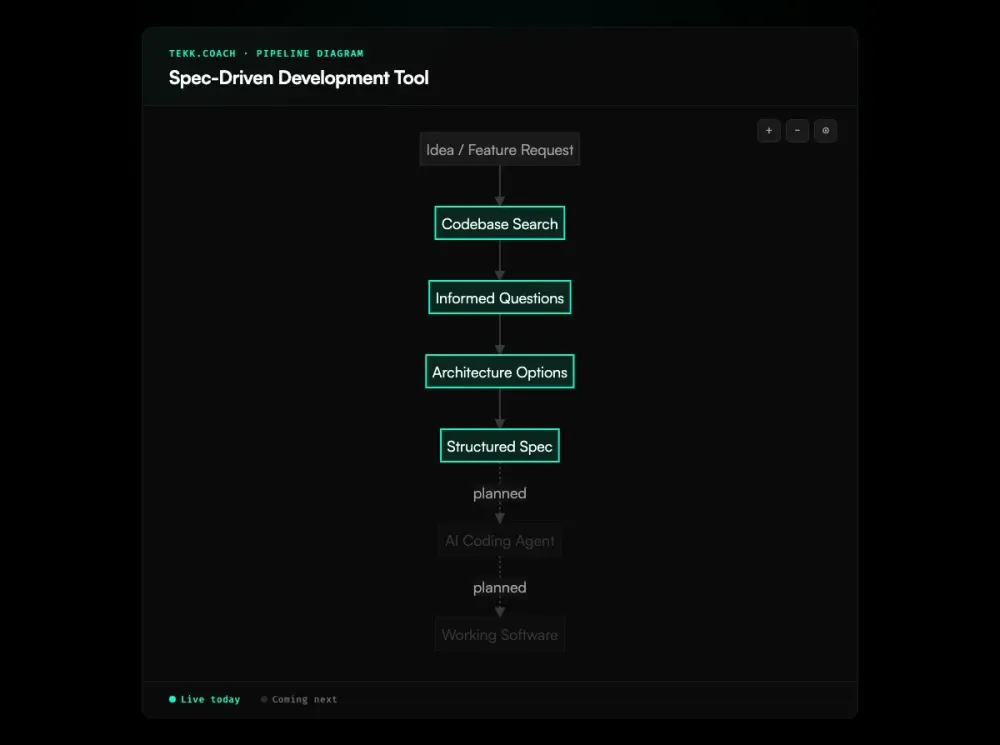
There are over 20 spec-driven development tools now. Most of them give you a structured template and call it done. A few actually read your codebase. One connects planning, specs, and task tracking in a single workspace without asking you to change your editor or coding agent. The foundational methodology is spec driven development — Tekk is the tool that automates the hardest part of practicing it.
That's Tekk.coach. Connect your repo, describe the feature, get a codebase-grounded spec your coding agents can execute.
[Try Tekk.coach Free →]
Key Benefits
Codebase-aware spec generation The agent reads your repo before generating anything. Specs reference your actual files and patterns — not boilerplate that conflicts with what's already there.
Explicit scope protection built in Every plan has a "Not Building" section. You define scope before coding starts, not after scope has crept. This is the spec section most teams skip because it's uncomfortable — Tekk requires it.
One workspace for planning and tracking Tekk's kanban board connects each task to its full planning session. You see what's planned, in progress, and done — with the spec, subtasks, and agent conversation accessible from the card.
Agent-agnostic output Tekk generates specs that Cursor, Codex, Claude Code, or Gemini can execute. You keep your existing coding agent. Tekk is the planning layer on top, not a replacement.
Expert review on demand Beyond spec generation, Tekk supports security reviews, architecture reviews, performance reviews, and agent improvement reviews — all reading your actual codebase. One tool for planning and review. Teams that also need to produce product briefs before the spec can use the ai prd generator as the upstream step in the workflow.
How It Works
Step 1: Connect your repo Link GitHub, GitLab, or Bitbucket. Tekk indexes languages, frameworks, services, and packages — a one-time setup that takes a few minutes.
Step 2: Open a new task Describe what you want to build. A paragraph is enough. The agent extracts the full requirements through the planning conversation.
Step 3: Agent reads your code Before asking anything, the agent searches the repository. It identifies files the change will affect, existing patterns to respect, and constraints the spec should account for.
Step 4: Questions and options 3–6 clarifying questions, grounded in the code. Then 2–3 architecturally distinct approaches with honest tradeoffs. You pick the direction.
Step 5: Spec generated Complete plan streamed into the task editor: TL;DR, Building / Not Building, subtasks with acceptance criteria and file references, assumptions, validation scenarios. Edit the document, then hand it to your coding agent.
Who This Is For
Developers using Cursor, Claude Code, or Codex who've experienced the rework cycle. You prompt the agent, it writes code that looks right, you realize it missed something, you rework it. Tekk short-circuits that cycle by producing a spec the agent can execute correctly the first time. When you're coordinating multiple agents on a feature, ai agent orchestration manages the parallel execution layer so specs and task assignments stay coherent.
Founders and solo builders who don't have a dedicated architect. You're building features across domains where you might not know the right questions to ask. Tekk reads the codebase, identifies the relevant constraints, and structures the plan so the implementation is right from the start.
Small teams (1–10 people) building multiple features in parallel and losing track. Specs in markdown files, tasks in Jira, context in chat windows. Tekk consolidates planning, specs, and task management into one place with no process overhead.
Anyone who's tried open-source spec frameworks and found them still manual. GitHub Spec Kit and BMAD-METHOD are great structures — but you fill them in. Tekk generates the content, grounded in your code.
What Is a Spec-Driven Development Tool?
A spec-driven development tool is software that supports or automates the practice of writing specifications before writing code, specifically in AI-assisted development workflows. The core insight: AI coding agents produce significantly better output when given structured specifications vs. informal prompts. Studies cite 50–80% implementation time savings for well-specified features and error reductions up to 50%.
The tool category emerged as developers moved from "give the agent a paragraph" to "give the agent a spec" — and then discovered that writing good specs is itself a skill that takes time. Spec tools either help you structure the spec (templates, frameworks) or generate it for you (AI-powered platforms). The better ones do both.
In 2026, the landscape has over 20 viable platforms. They separate into two categories: living-spec platforms that keep the spec connected to the codebase and execution (Tekk.coach, Augment Code/Intent), and static-spec tools that produce structured documents you maintain manually (Kiro, GitHub Spec Kit, OpenSpec, BMAD-METHOD, Cursor rules). The critical difference: static specs drift from implementation within hours once the codebase starts changing. Living specs don't drift because they're the working document, not a secondary artifact.
The practice gained significant momentum in 2025 when Thoughtworks placed spec-driven development in its Technology Radar and GitHub released Spec Kit. By early 2026, a combined 137,000+ GitHub stars across the top four spec tools signals real practitioner adoption, not just academic interest.
Frequently Asked Questions
What is a spec-driven development tool?
A spec-driven development tool is software that helps developers write structured specifications before writing code with AI coding agents. The spec defines requirements, scope, acceptance criteria, and implementation approach — giving the coding agent a complete picture of what to build rather than an informal description.
How is Tekk.coach different from GitHub Spec Kit?
GitHub Spec Kit is an open-source framework that gives you structured spec templates and supports 22+ AI agent platforms. It's a structure you fill in — the framework is the tool, not the generator. Tekk.coach generates the spec content for you, reading your codebase first so the output is grounded in your actual files and patterns, not generic requirements.
Is Tekk.coach a Kiro alternative?
Yes — specifically if you want spec-driven development without switching your IDE or locking into AWS. Tekk works alongside Cursor, VS Code, or whatever editor you use. You plan in Tekk, then execute in your preferred coding agent. Kiro does both planning and implementation in a single IDE, which is a different tradeoff.
How does Tekk.coach work with Cursor?
Tekk generates the codebase-grounded spec — with subtasks, acceptance criteria, file references, and scope boundaries. You use that spec as the detailed prompt for Cursor's agent or composer. Cursor then has a precise instruction set instead of a one-paragraph description. Fewer rework cycles, tighter scope.
What spec-driven development software should I use in 2026?
Depends on your situation. For teams that want codebase-aware spec generation without switching tools: Tekk.coach. For enterprise teams with multi-repo coordination needs: Augment Code/Intent. For AWS-native teams that want everything inside an IDE: Kiro. For open-source flexibility: GitHub Spec Kit. The tool landscape has matured enough that there's a clear fit for each scenario.
What are the main problems with spec-driven development tools?
Spec drift is the biggest unsolved issue — most tools produce static documents that diverge from implementation within hours once code starts changing. Other common issues: over-specification (specs that become pseudo-code), context limitations (specs that don't account for the actual codebase), and overhead for simple tasks (spec-driven workflows don't pay off for bug fixes or minor changes).
How long does it take to generate a spec with Tekk.coach?
A typical planning session runs 10–20 minutes depending on feature complexity. That includes the codebase read, the question-and-answer phase, and spec generation. For complex features, the planning time usually saves multiple hours of rework downstream.
Do I need to know how to write a spec to use Tekk.coach?
No. You describe what you want to build — a paragraph is enough to start. The agent extracts requirements through the planning conversation: clarifying questions, architectural options, scope discussions. The spec it generates is complete and structured without you authoring it from scratch.
Ready to Try Tekk.coach?
The spec-driven development tool landscape is crowded. Most tools give you structure. Tekk gives you a spec generated from your actual codebase, in a workspace that connects planning, specs, and task tracking.
Connect your repo and run your first planning session in under five minutes.
[Start Planning Free →]