
TL;DR
Your specs are in a chat window. Your tasks are in Linear. Your agents are in Cursor. Nothing talks to each other. Every handoff drops context. That's not a platform — that's three tools and a prayer.
Tekk.coach is a spec-driven development platform that connects your GitHub, GitLab, or Bitbucket repo, reads your actual codebase, generates structured specs your agents can execute, and manages your work on a kanban board — all in one workspace. Connect your agents (Cursor, Codex, Claude Code, Gemini) through OAuth and orchestrate execution from the same place you planned it. The full methodology behind this workflow is spec driven development — Tekk is the platform that makes it practical at team scale.
Over 30 SDD frameworks exist in 2026. Most of them hand you a template to fill in. Tekk writes the spec for you.
[Try Tekk.coach Free →]
How Tekk.coach Works as a Spec-Driven Development Platform
Most SDD tools are frameworks, not platforms. GitHub Spec Kit is a CLI toolkit — you write the spec. Kiro is an IDE plugin — you fill in a form inside one editor. OpenSpec is a phase structure — you still do the thinking. They structure specs. They don't generate them.
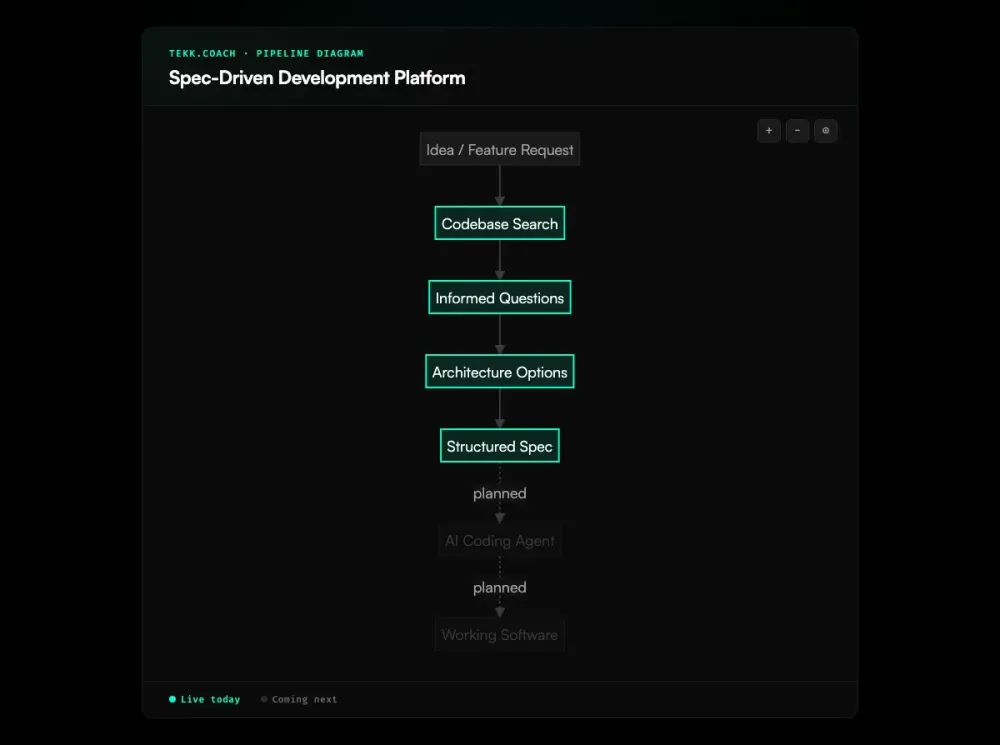
Tekk is different at the foundation. You describe the problem in plain language. The agent reads your repository first — semantic search, file search, directory browsing — before asking a single question. It knows your language, framework, ORM, and package structure. Questions are grounded in what it actually found in your code.
From there, the agent presents 2-3 architectural approaches with honest tradeoffs. Then it writes the complete spec, streamed into a rich text editor as a living document: TL;DR, Building / Not Building scope boundaries, subtasks with acceptance criteria and file references, assumptions with risk levels, and validation scenarios. You edit it directly.
That spec lives on a kanban card. You see everything in one board: what's planned, what's in progress, what's done. When you're ready to execute, you select your agent — Cursor, Codex, Claude Code, or Gemini — and Tekk dispatches the work. The same workspace where you planned is where you track.
Key Benefits
One workspace, no context switching Spec generation, task management, agent orchestration, and expert review — all connected. No copying specs from a chat window into Linear into Cursor. The plan flows directly to execution.
Specs written from your actual codebase The agent reads your repo before generating anything. Specs reference your real files, your actual framework, your existing patterns. Your coding agent gets a spec that fits your architecture, not a generic template.
Agent-agnostic orchestration Cursor, Codex, Claude Code, Gemini — bring whatever you're already paying for. Tekk connects through OAuth, the same way you connected GitHub. No CLI wrappers, no prompt injection, no copy-paste. You pick the agent; Tekk handles the handoff. The coordination layer is purpose-built ai agent orchestration — not a wrapper around individual agent APIs.
Built-in expert review Security review, architecture review, performance review, agent improvement. Tekk reads your code and delivers actionable findings grounded in your specific setup. No other SDD platform has this. It's the senior engineer who isn't on your payroll.
Web research during planning Building outside your expertise? The agent searches the web for current best practices and folds that knowledge into your spec. Hours of pre-planning research, gone.
Scope protection by default Every spec includes an explicit "Not Building" section. Scope boundaries documented before anyone writes code. Scope creep dies when what's out is as clear as what's in.
How It Works
No PRDs. No backlog grooming. The full spec-driven development lifecycle in one workflow.
Step 1: Connect your repo Link your GitHub, GitLab, or Bitbucket repository. The agent profiles your codebase: languages, frameworks, services, dependencies, file structure. This happens once. Every spec you generate from that point is grounded in your actual code.
Step 2: Create a task and describe the problem Add a task to your kanban board. Describe what you need in plain language — "Add magic link auth," "Build a Stripe webhook handler," "Set up a Redis cache layer." No templates. No syntax requirements.
Step 3: The agent reads your code and asks informed questions Before generating a spec, the agent searches your repository. Semantic search, file search, regex, directory browsing. It asks 3-6 questions grounded in what it found — not generic questions, questions about your actual architecture. Optionally, it searches the web for current best practices and folds the findings in.
Step 4: Review options, approve the spec The agent presents 2-3 architectural approaches with honest tradeoffs. You pick the direction. The agent writes the full spec, streamed into a living document you can edit directly. Building / Not Building scope boundaries, subtasks with acceptance criteria, file references, assumptions with risk levels, validation scenarios.
Step 5: Execute with your agents, track on the board Select your coding agent — Cursor, Codex, Claude Code, or Gemini. Tekk orchestrates execution: subtasks grouped by dependencies, parallel execution waves for independent work, all output to a single feature branch. The kanban card shows real-time progress.
Step 6: Review When execution completes, use Tekk's review mode to run a security, architecture, or performance review before merging. The agent reads the resulting code and flags issues grounded in your specific setup.
Steps 1-4 are live today. Steps 5-6 (execution dispatch and agent orchestration) are coming next.
Who This Is For
Small teams adopting SDD as a workflow
You've decided to move away from vibe coding and build with structure. You want specs that your agents can execute correctly, task management that doesn't require a Jira admin, and one place to see your entire development cycle. You don't have a dedicated architect. Tekk is that architect.
Solo founders and developers already using Cursor or Claude Code
You're building a product with AI coding agents and it's getting messy. Specs in chat threads and markdown files. Cursor executing confidently in the wrong direction because the prompt was vague. You're not looking to learn SDD theory — you want a platform that makes your existing agents work correctly without adding ceremony.
Product managers who need technically grounded specs
You're handing off features to developers or coding agents. You need specs with scope boundaries and acceptance criteria, not paragraphs of requirements. Tekk adjusts depth — detailed explanations for non-technical contexts, tight architectural specs for engineering teams. If you need a product requirements document before the implementation spec, the ai prd generator handles that upstream step.
Tekk is not the right fit for enterprise teams that need Jira-style workflow customization, approval chains, or process governance. It's opinionated, lightweight, and built for people who want to ship, not coordinate.
What Is a Spec-Driven Development Platform?
A spec-driven development platform is a purpose-built workspace for planning, specifying, and executing AI-assisted software development. It's distinct from two adjacent categories: SDD frameworks (CLI tools and templates that structure specs you write yourself) and SDD IDE integrations (like Kiro, which adds spec workflows to one editor).
A platform provides the full lifecycle in one place: repo connection, spec generation, task management, agent orchestration, and code review. The integration is the point. Frameworks give you structure for one step. A platform connects every step.
The need for this category emerged alongside AI coding agents. When developers started using Cursor, Codex, and Claude Code at scale, the quality of the prompt became the determining factor in whether the agent shipped working code or code that required rework. Spec-driven development addresses the prompt quality problem. A platform addresses the workflow fragmentation problem — specs in chat, tasks in Linear, agents in separate IDEs, review in pull requests with no connection back to the original spec.
In 2026, the SDD landscape includes 30+ tools — frameworks like GitHub Spec Kit and OpenSpec, IDEs like Kiro, and desktop apps like Intent (Augment Code). Most of them are strong within one phase of the workflow. The platform category is the one that covers all phases.
Frequently Asked Questions
What is a spec-driven development platform?
A spec-driven development platform is an integrated workspace that covers the full SDD lifecycle: connecting your codebase, generating structured specs, managing tasks, orchestrating AI coding agents, and reviewing output. It's different from a framework (a template structure you apply yourself) or an IDE integration (spec tools built into one editor). The platform is the integration layer between your specs, your tasks, and your agents.
What integrations does a spec-driven development platform need?
At minimum: repo host integration (GitHub, GitLab, Bitbucket), coding agent support (Cursor, Claude Code, Codex, Gemini), and task management. Tekk covers all three. Repo integration is deep — semantic search, file search, directory browsing — not just a URL connection. Agent integration is through OAuth, not CLI wrappers.
How does Tekk compare to Kiro as a platform?
Kiro is an agentic IDE built on AWS infrastructure. Strong for AWS-heavy projects with its Specify → Plan → Execute workflow. The constraint: it's locked to one IDE, biased toward AWS services, and specs are static (they drift from implementation once work begins). Tekk is a standalone platform that works with any coding agent (Cursor, Codex, Claude Code, Gemini) and any repo host. It adds capabilities Kiro doesn't have: web research during planning, kanban task management, expert review mode (security, architecture, performance), and an agent-agnostic execution layer. Different tool for a different team profile.
How is Tekk different from GitHub Spec Kit as a platform?
Spec Kit is an MIT-licensed CLI toolkit that structures specifications you write yourself. It supports 22+ AI agent platforms and has strong open-source momentum (72.7k stars). It's not a platform — it's scaffolding. You write the spec; Spec Kit routes it to your agent. Tekk reads your codebase, asks informed questions, and generates the spec. If Spec Kit is the blank page with good structure, Tekk is the agent that fills it in, tracks the work, and reviews the output.
Can I use my existing coding agents with Tekk?
Yes. Tekk supports Cursor, Codex (OpenAI), Claude Code (Anthropic), and Gemini. You connect your agents the same way you connect a repo — through OAuth. Tekk doesn't replace the agents you're already paying for. It gives them better specs and coordinates execution across them from one workspace.
What does "spec-driven" mean for a platform vs. just a tool?
With a standalone tool, spec-driven means "write a spec before writing code." With a platform, it means your entire development workflow is anchored in specs — from initial planning through task tracking, execution, and review. The spec isn't a document you write once. It's the working document your team uses, your agents execute from, and your review process references. The platform keeps that spec connected to every other step.
Is this just Jira with AI bolted on?
No. Jira tracks tasks after they're already defined. Tekk generates the plan, structures the spec, creates the tasks, and connects them to execution. The kanban board in Tekk isn't a project management layer — it's a view into AI-grounded specs. Every card links to a full planning session with codebase context. And there's no ceremony: no custom workflows, no approval chains, no backlog grooming. Connect your repo, describe the problem, get a spec, execute.
Does Tekk work for existing codebases, not just greenfield projects?
This is where Tekk is most useful. Adding features to a complex existing codebase is where spec quality matters most — new code needs to fit what's already there. Tekk's agent reads your repository before generating anything. Every spec it produces references your actual files, framework, and architectural patterns. It won't suggest a migration pattern that conflicts with your ORM or an API structure that doesn't match your existing conventions.
Start Building With a Real Platform
You don't need another framework to bolt onto your existing mess of tools. Connect your repo, describe the problem, get a structured spec grounded in your actual codebase, and execute with the agents you're already using.
Tekk is the spec-driven development platform that covers the full cycle.
[Try Tekk.coach Free →]