
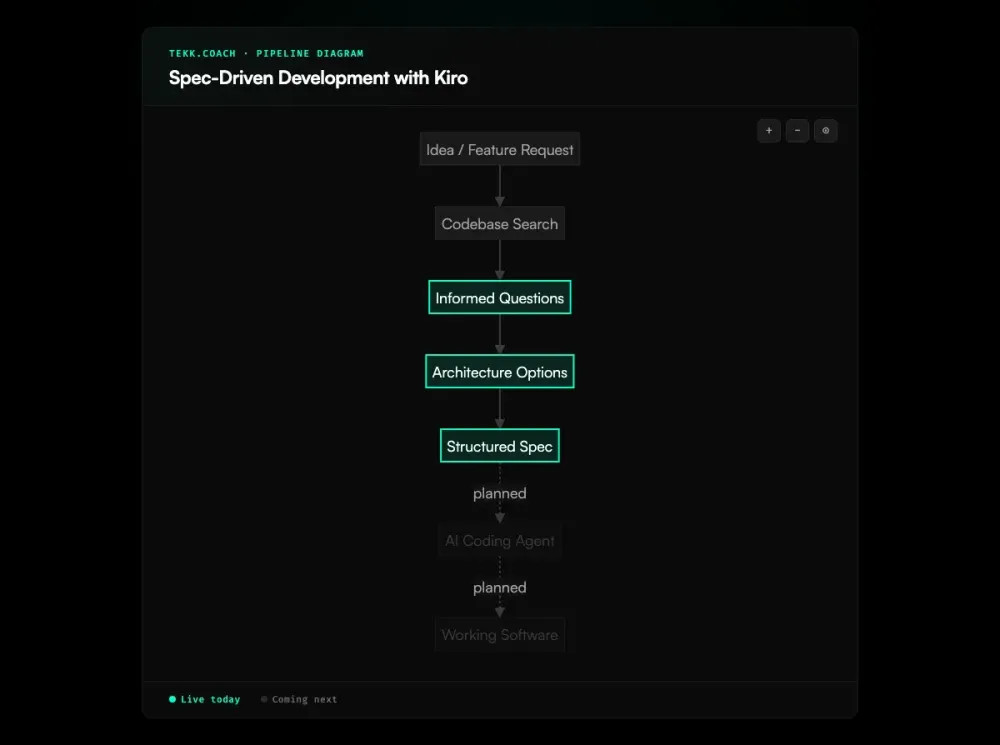
Kiro is AWS's agentic IDE with spec-driven development built in. It's a real tool doing something useful. But it's also a new IDE, an AWS ecosystem play, and a commitment to one coding agent. If you want spec-driven development without switching your editor or locking into AWS, there's a different path.
Tekk.coach is a standalone spec driven development platform — agent-agnostic, IDE-agnostic, codebase-aware. Connect your repo, plan the feature, execute with whatever coding agent you already use.
[Try Tekk.coach Free →]
Key Benefits
No IDE switching Keep Cursor, VS Code, or whatever editor you use. Tekk is a planning layer you use before dispatching to your existing tools — not a replacement for them.
Works with any coding agent Cursor, Codex, Claude Code, Gemini — Tekk generates specs any of them can execute. You're not locked into one agent or one cloud provider. When you need to run agents in parallel, ai agent orchestration handles the coordination layer across all of them.
Codebase-first spec generation Before asking a question, Tekk's agent reads your repository. Specs reference your actual files, patterns, and dependencies. Output is grounded in your code, not your description of your code.
Project-level visibility Tekk's kanban board shows every planned feature, in-progress task, and completed work — each linked to its planning session. Kiro's spec workflow operates at the individual feature level, with no cross-feature view.
Explicit scope protection Every plan has a "Not Building" section. Scope creep is a spec problem, not a coding problem. Tekk solves it at the planning stage.
How It Works
Step 1: Connect your repository Link GitHub, GitLab, or Bitbucket. Tekk indexes the codebase — languages, frameworks, services, dependencies. Supports any cloud provider; no AWS requirement.
Step 2: Create a task Describe what you want to build. A paragraph is enough — the agent's job is to extract the full requirements from the conversation, not to receive them pre-formed.
Step 3: Agent reads your code Before engaging, the agent searches your repository — semantic search, file search, regex, directory browsing. It identifies relevant files, existing patterns, and architectural constraints. No generic questions from here.
Step 4: Clarifying questions and architectural options The agent asks 3–6 questions based on what it found. Then it presents 2–3 architecturally distinct approaches with honest tradeoffs. You choose the direction.
Step 5: Spec generated The complete plan streams into the BlockNote editor: TL;DR, Building / Not Building, subtasks with acceptance criteria and file references, assumptions with risk levels, validation scenarios. Review and edit the document, then execute with your preferred coding agent.
Who This Is For
Developers already using Cursor or Claude Code who want structured specs without switching their editor. Kiro requires adopting a new IDE. Tekk works alongside what you already have. The planning session runs in Tekk; the implementation runs in whatever agent you prefer.
Teams not on AWS who want spec-driven development without AWS dependency. Kiro's deepest integrations are AWS-native. Its roadmap follows AWS infrastructure. If your stack is elsewhere, that lock-in is a real cost.
Small teams building multiple features in parallel who need project-level visibility. Tekk's kanban board shows every task's status alongside its planning session. You see what's planned, in progress, and done in one view — not just the spec for the feature you're currently working on.
Builders who want spec-driven development without process overhead — no new IDE, no AWS account, no restructuring your workflow. Connect the repo, describe the feature, get the spec, execute. That's the path.
Kiro is the right call if: you're AWS-native, you want spec-driven development inside your IDE rather than as a separate planning layer, and you're willing to switch editors and adopt the full Kiro ecosystem. Those are real tradeoffs worth making for the right team. Teams that also need product-level documents upstream can use the ai prd generator before moving into the spec workflow.
What Is Spec-Driven Development with Kiro?
Kiro implements spec-driven development by generating three structured files before any code is written: requirements.md (user stories and acceptance criteria in EARS notation), design.md (technical architecture and sequence diagrams), and tasks.md (sequenced implementation plan). The developer reviews and iterates on these files before Kiro begins implementation.
EARS (Easy Approach to Requirements Syntax) is a structured format for writing unambiguous requirements, originally developed for safety-critical systems. Kiro applies it to AI coding to ensure generated requirements are testable and traceable.
Kiro launched mid-2025 as part of AWS's push into agentic development tooling. It expanded to AWS GovCloud in February 2026 and added SageMaker integration in March 2026. It's powered by Claude (Anthropic's models) and is priced at $20/month, same as Cursor.
The broader spec-driven development landscape in 2026 includes IDEs (Kiro, Tessl), standalone platforms (Tekk.coach, Augment Code/Intent), open-source frameworks (GitHub Spec Kit with 70k+ stars, OpenSpec, BMAD-METHOD), and coding agents with informal spec support (Cursor's .cursorrules). The category has grown from a handful of tools to over 20 viable platforms since mid-2025.
Frequently Asked Questions
What is Kiro and how does it differ from Tekk.coach?
Kiro is an agentic IDE built by AWS that implements spec-driven development inside the editor itself — before writing code, it generates requirements, design, and task files. Tekk.coach is a standalone planning platform that does the same spec generation but works as a separate layer you use before dispatching to your existing coding agent (Cursor, Claude Code, Codex). The core difference: Kiro replaces your IDE, Tekk works alongside it.
Do I need an AWS account to use Kiro?
Kiro is built around AWS infrastructure. Its deepest integrations — SageMaker, GovCloud support, AWS service connections — are AWS-native. You can use Kiro without an AWS account for basic development, but the tool is designed for and heavily optimized for AWS workflows. Tekk.coach has no cloud provider dependency.
Is Kiro worth using for spec-driven development?
For AWS-native teams who want spec-driven development inside their IDE and are willing to switch from Cursor or VS Code, Kiro is a strong choice. Benchmark data shows about 40% fewer prompt-and-fix cycles with Kiro's structured approach vs. direct agent prompting. The spec generation takes real time (20–30 minutes is reported for complex features), but the reduction in rework pays it back. For teams not on AWS or unwilling to switch editors, the adoption cost outweighs the benefit.
Can I use Tekk.coach with Kiro?
They serve overlapping purposes. Kiro generates specs and implements. Tekk generates specs and dispatches to external agents. Using both would mean running two planning workflows for the same feature. Most developers choose one or the other based on whether they want to stay in their existing IDE.
What does spec-driven development with Claude Code look like?
Claude Code is a terminal-based coding agent. Spec-driven development with Claude Code means writing a detailed spec first, then providing it as context when invoking Claude Code. Tekk.coach generates that spec — codebase-grounded, structured, with subtasks and acceptance criteria — and Tekk's execution layer (coming next) will dispatch directly to Claude Code via MCP integration.
What are the main Kiro alternatives for spec-driven development?
Kiro alternatives split by what they offer: standalone planning platforms (Tekk.coach — agent-agnostic, codebase-aware), enterprise tools (Augment Code/Intent — multi-repo, large codebase support), open-source frameworks (GitHub Spec Kit — templates and structure without a platform), and other IDEs with spec features (Tessl). The right choice depends on whether you want IDE-level integration or a separate planning layer.
What are Kiro's main limitations?
IDE switching cost (leaving Cursor or VS Code is non-trivial), AWS dependency, limited model selection compared to Cursor, spec generation overhead that doesn't pay off for small tasks, and no cross-project visibility. One developer reported spending 20–30 minutes writing descriptions only to find Kiro misunderstood key points, requiring a full re-run of the spec workflow.
Is Tekk.coach a Kiro alternative?
Yes — specifically for teams that want spec-driven development without switching their IDE or locking into AWS. Tekk.coach reads your codebase, generates the same class of structured spec, and works with whatever coding agent you already use. The key difference is architecture: Kiro is the IDE and the agent, Tekk is the planning layer that makes your existing agents more effective.
Ready to Try Tekk.coach?
Spec-driven development works. The question is how much you want to give up to adopt it. Tekk.coach doesn't ask you to switch your IDE or change your cloud provider — connect your repo and you're planning in minutes.
Keep Cursor. Keep your workflow. Get specs grounded in your actual codebase.
[Start Planning Free →]