
TL;DR
You're building with AI coding agents. Cursor, Claude Code, Codex. They write code fast. They also keep building the wrong thing.
Your specs live in chat threads and markdown files nobody reads. You paste a paragraph into Cursor and get code that ignores your existing architecture. You rework it. Again. According to Anthropic's 2026 Agentic Coding Trends Report, developers use AI in roughly 60% of their work but can only fully delegate 0-20% of tasks — the gap is almost always a spec problem.
Tekk.coach is a spec-driven development platform that reads your actual codebase, asks questions grounded in what it found, and generates structured specs your agents can execute correctly the first time. No templates to fill in. No PRDs to write. You describe the problem. The agent does the thinking. If you're also building the product brief, Tekk's ai prd generator handles that step with the same codebase-first approach.
ThoughtWorks calls SDD "one of the most important practices to emerge in 2025." Over 30 tools exist in this space. Most of them make you write the spec yourself. Tekk writes it for you.
[Try Tekk.coach Free →]
How Tekk.coach Does Spec-Driven Development
Most spec-driven development tools hand you a template and say "fill this in." GitHub Spec Kit gives you CLI scaffolding. Kiro gives you a form in the IDE. You still have to figure out what to write.
Tekk flips that. You describe the problem in plain language. "Add magic link auth." "Build a webhook system for Stripe." The agent does the rest.
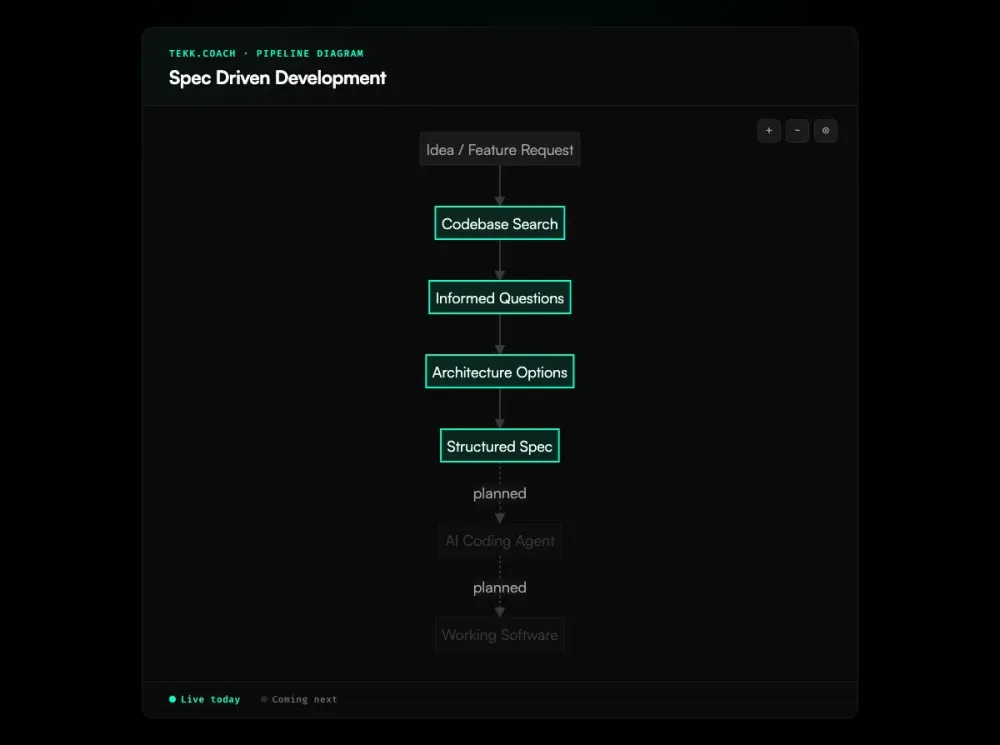
Before writing a single line of spec, it reads your repository. Semantic search, file search, directory browsing. It knows your language, framework, ORM, and package structure. It knows what files exist and how they connect.
Then it asks 3-6 questions. Not generic ones. Questions grounded in what it found in your code. "Your auth middleware uses Express sessions. Do you want magic link to coexist or replace the current flow?" That kind of question.
From there, it presents 2-3 architectural approaches with honest tradeoffs. What each approach gives you, what it costs, what breaks. Then it writes the complete spec.
The output isn't a chat message you copy-paste. It streams into a rich text editor as a living document. TL;DR. Building / Not Building scope boundaries. Subtasks with acceptance criteria and file references. Assumptions with risk levels. Validation scenarios. You edit the spec directly, then hand it to your coding agent.
Why Spec-Driven Development with Tekk.coach
Your agents stop flailing
A structured spec with file references, acceptance criteria, and scope boundaries gives your coding agent exactly what it needs. No ambiguity. No hallucinated architecture. Code that fits your existing system on the first pass. The Prezi engineering team found that adopting SDD "has a high potential of changing how you look at software development" — largely because agents stopped producing code that conflicted with existing architecture.
You don't write the spec
Other spec-driven development tools make you the bottleneck. You research the right approach, figure out codebase implications, write it all down. Tekk's agent does that. It reads the code, researches best practices, and produces the spec. You review and edit.
Web research fills your knowledge gaps
Building a payment integration and don't know Stripe's latest webhook patterns? The agent searches the web during planning and folds that knowledge into your spec. Hours of research, gone.
Scope protection is built in
Every spec includes an explicit "Not Building" section. You know what's in and what's out before anyone writes code. Scope creep dies when boundaries are documented.
Works with any coding agent
Tekk generates specs for Cursor, Claude Code, Codex, and Gemini. Not locked to one IDE. You bring whatever tools you already use. When you're ready to coordinate multiple agents, ai agent orchestration is the layer that manages parallel execution across all of them.
How It Works
No ceremony. No backlog grooming. Five steps from idea to executable spec.
1. Connect your repo
Link your GitHub, GitLab, or Bitbucket repository. The agent profiles your codebase: languages, frameworks, services, dependencies, file structure.
2. Describe the problem
Tell the agent what you need in plain language. "Add user roles and permissions." "Build a Stripe subscription flow." "Set up a CI pipeline for our monorepo." No special syntax. No templates.
3. The agent reads your code
Before asking a single question, the agent searches your repository. Semantic search via embeddings, file search, regex, directory browsing. It builds context from your actual code, not assumptions.
4. Informed questions, then options
The agent asks 3-6 questions based on what it found. Then it presents 2-3 architecturally distinct approaches with honest tradeoffs. What each approach gives you, what it costs, what breaks.
5. Structured spec, ready to execute
The agent writes the full spec, streamed into a rich text editor as an editable living document. Subtasks with acceptance criteria, file references, dependencies. Hand it to Cursor, Claude Code, or Codex and they execute correctly.
Who This Is For
Solo founders and small teams
You're shipping a product with AI coding agents and it's getting messy. Specs in chat threads. Markdown files scattered across your repo. Rework every time Cursor misinterprets what you meant. You don't have a senior architect to write specs for you. Tekk is that architect.
Developers building outside their expertise
You're a backend engineer adding a payment integration. Or a frontend developer setting up infrastructure. Or a PM who needs to hand off a technically grounded spec instead of a paragraph of requirements. Tekk researches the domain, reads your code, and produces a spec that covers what you don't know.
People who hate process overhead
You tried Jira and hated it. You tried writing PRDs and they went stale on day one. Backlog grooming, alignment meetings, endless ceremony. Not your thing. You want to describe the problem, get a spec, and start building. Tekk is built for exactly that.
What Is Spec-Driven Development?
Spec-driven development (SDD), also called specification driven development or spec first development, is a methodology where you write a structured specification before writing code. The spec defines what the system should do: requirements, user flows, behaviors, edge cases, constraints. Code comes from the spec, not the other way around. The concept was first formalized in 2004 as a combination of test-driven development (TDD) and design by contract (DbC).
It stayed niche for two decades. Then AI coding agents made it relevant overnight. As researchers at arXiv describe it, SDD specs function as "executable validation gates" rather than traditional human-read documents — they're machine-consumable contracts that AI agents can actually follow. When you're prompting Cursor or Claude Code, the quality of that prompt determines whether you get working software or a mess you rewrite.
In 2026, spec-driven development is everywhere. GitHub released Spec Kit (72.7k stars). AWS launched Kiro with a Specify, Plan, Execute workflow. ThoughtWorks added SDD to their Technology Radar. Martin Fowler's team documented three distinct SDD tool categories — spec generators, spec validators, and full platforms. Over 30 frameworks now support spec-driven workflows, from OpenSpec and BMAD-METHOD to full platforms like Tessl.
It's worth noting the honest tradeoffs. Arcturus Labs found that keeping specs in sync with code creates growing maintenance overhead at scale. That's exactly why Tekk reads your codebase live rather than relying on stale documents.
The lesson is simple. AI coding agents are only as good as their input. A vague prompt produces vague code. A structured, codebase-aware spec produces code that works.
Frequently Asked Questions
What is spec-driven development?
A methodology where you write a structured specification before writing code with AI. The spec defines what to build: requirements, behaviors, constraints, acceptance criteria. It becomes the source of truth for your AI coding agent. Instead of pasting a vague prompt into Cursor, you give it a complete spec. The result is code that works on the first pass.
How is Tekk.coach different from GitHub Spec Kit?
Spec Kit is an open-source CLI toolkit with templates for writing specs yourself. It supports 22+ AI agents but doesn't generate specs. You write them. Tekk.coach reads your codebase, asks informed questions, and generates the spec for you. Spec Kit is the blank page. Tekk is the agent that fills it in.
How does Tekk compare to Kiro for spec-driven development?
Kiro is an AWS IDE with spec generation built into the editor. Strong for AWS-heavy projects with its Specify, Plan, Execute workflow. Tekk.coach is a standalone spec-driven development platform that works with any coding agent (Cursor, Claude Code, Codex, Gemini) and any repo host (GitHub, GitLab, Bitbucket). Kiro locks you into one IDE. Tekk is agent-agnostic and includes web research, expert review, and kanban management.
Can I use Tekk with Cursor for spec-driven development?
Yes. Tekk generates the spec. Cursor executes it. Tekk reads your codebase, asks questions, produces a structured spec with subtasks, file references, and acceptance criteria. Then you hand that spec to Cursor. The spec tells Cursor exactly what to build, which files to modify, and what done looks like.
Does spec-driven development work for existing codebases?
This is where SDD matters most. Adding features to a complex existing codebase means understanding how new code interacts with existing systems. Tekk's agent reads your repository first. Every question and every spec reference is grounded in your actual architecture. The spec won't suggest patterns that conflict with what's already there.
Is spec-driven development just waterfall?
No. Waterfall writes a massive spec and builds for months. Spec-driven development writes a focused spec and builds in minutes with an AI agent. The whole loop can take an afternoon. The spec is a living document you iterate on, not a frozen contract. Version control for your thinking, not a bureaucratic gate.
What does a Tekk spec actually include?
A TL;DR (what we're building and why). Building / Not Building scope boundaries. Subtasks with acceptance criteria and file references. Assumptions with risk levels and consequences if wrong. Concrete validation scenarios. It streams into a rich text editor where you edit it directly. The working document, not a chat message. For a deeper look at spec driven development tool options across the ecosystem, the comparison covers the full category landscape.
Do I need to be technical to use Tekk.coach?
No. Tekk adjusts depth based on your level. Non-technical founders get clear explanations of architectural decisions. Engineers get tight specs referencing specific files and patterns. The spec is always grounded in the codebase regardless.
Start Building with Better Specs
Your coding agents are only as good as their specs. Stop pasting paragraphs into Cursor and hoping for the best. Connect your repo, describe what you need, and get a structured spec that references your actual code with clear scope boundaries and acceptance criteria.
[Try Tekk.coach Free →]