Generic PRD generators fill templates. They produce polished documents from whatever you describe — with no knowledge of what your codebase actually contains.

Tekk.coach generates PRDs from your actual codebase. It reads your repo before asking a single question, grounds every specification in the database schema, API patterns, and architecture that already exist, and produces a living document your AI coding agents can execute directly.

Try Tekk.coach Free →


How Tekk.coach Does PRD Generation

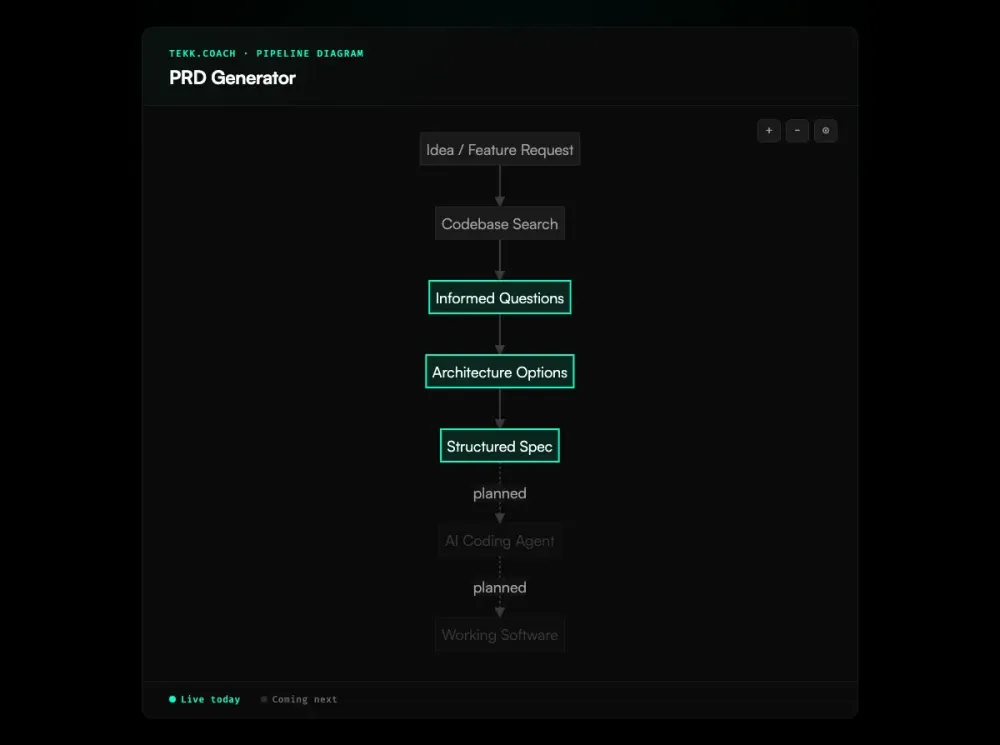
Before generating anything, Tekk reads your codebase — semantic search via embeddings, file search, directory browsing, repository profiling. It knows your language, framework, ORM, auth model, and existing patterns before you've described a single feature.

Then it asks 3-6 informed questions grounded in what it found. Not "who is the target user?" — that's a PM template question. "Your current auth uses sessions, not JWTs — do you want this feature to extend the existing model or introduce token-based auth?" That's what codebase-aware questioning looks like.

After your answers, Tekk presents architectural options where they exist — two or three distinct approaches with honest tradeoffs. You pick the direction. Then the spec streams in real-time into a BlockNote rich text editor as a living document.

Every plan includes: a TL;DR, explicit Building and Not Building scope boundaries, subtasks with acceptance criteria and file references, assumptions with risk levels, and validation scenarios. This isn't a formatted document for stakeholders. It's a precision spec that Cursor, Claude Code, or Codex can execute correctly.

Key Benefits

Grounded in your actual codebase The database schema already exists. The auth model is already in place. The API patterns are already established. Tekk reads all of it before generating the spec, so the PRD reflects what will actually work — not what sounds right from a blank page.

Explicit scope protection in every plan Every Tekk plan includes a "Not Building" section as a first-class requirement. You know exactly what's in scope and what's not before anyone writes code. Generic PRD generators produce feature lists; Tekk forces scope discipline.

Output AI coding agents can execute immediately Subtasks with acceptance criteria and file references. Dependency ordering. Specific files to touch. When you hand a Tekk spec to Cursor or Claude Code, the agent has precision instructions — not a vague feature description it has to interpret.

Living document, not a chat export Plans stream into an editable rich text editor. They're stored, searchable, and connected to your Kanban board. You don't copy-paste from chat — the spec is the working document the team builds from.

Multi-turn exploration before the plan Complex features require deliberation: what are the options? What breaks with each choice? Tekk presents architecturally distinct approaches with honest tradeoffs before committing to a plan. You make the call with full information.

How It Works

Step 1: Connect your repository Link your GitHub, GitLab, or Bitbucket repo. Tekk gets read access. This is what makes the PRD generator different — codebase reading happens before any specification is produced.

Step 2: Describe what you want to build "Add magic link auth." "Refactor the payment flow." "Build a CSV export for the analytics dashboard." Plain language. The agent reads the codebase first, then asks clarifying questions based on what it found — not generic template questions.

Step 3: Choose your architectural approach For features with real implementation choices, Tekk presents 2-3 architecturally distinct options with honest tradeoffs. You pick the direction. For features with an obvious path, it skips this and generates the plan directly.

Step 4: Receive the structured spec The full PRD streams into the editor in real-time: TL;DR, scope boundaries (Building / Not Building), subtasks with acceptance criteria and file references, assumptions with risk levels, and validation scenarios. Editable immediately.

Step 5: Execute with your coding agents Open Cursor, Claude Code, or Codex. Hand them the spec. Your agents have the structured instructions they need — specific files, accepted behaviors, dependency ordering — to execute correctly the first time.

Who This Is For

Developers using AI coding agents who are tired of rework You give Cursor a paragraph, it builds something, it's not quite right, you iterate for two hours. The spec was the problem. Tekk produces the spec that should have been the prompt — grounded in your codebase, with scope boundaries and acceptance criteria. Rework drops when the input is right.

Solo founders who need to move fast without process overhead You don't want to write a 20-page PRD and schedule three alignment meetings. Connect your repo, describe the problem, get a spec grounded in your actual codebase, execute with your agents. That's the whole workflow. No ceremony.

Product managers who need technically grounded specs Not template-based deliverables — real specifications that reflect the system being built. Tekk reads the codebase so the PRD doesn't ask engineering to implement something that doesn't fit the existing architecture. Less back-and-forth, fewer rewrites.

Small teams (1-10 people) building with AI coding agents You're shipping fast. Context lives in scattered markdown files and chat threads. Tekk gives you one place where specs are generated, stored, and connected to your Kanban board — all grounded in the codebase you're actually building.

What Is a PRD Generator?

A PRD (Product Requirements Document) generator is a tool that produces structured product specifications from user inputs — typically a description of the feature, target audience, and goals. Traditional PRDs are long-form documents covering functional requirements, acceptance criteria, scope boundaries, and success metrics.

AI PRD generators apply large language models to accelerate this document creation, reducing time from idea to draft. The category ranges from lightweight web tools (paste a description, get a formatted document) to sophisticated platforms that integrate with product workflows and maintain context across sessions.

The landscape is maturing. ChatPRD is the dominant specialized tool for PMs with 100,000+ users. General-purpose LLMs (Claude, ChatGPT) score higher on raw output quality in head-to-head tests but lack persistent codebase context. Collaborative tools like Miro and Figma embed PRD generation in visual workspaces. The emerging frontier — codebase-integrated PRD generation — is where the most technically demanding use case lives: producing specs that AI coding agents can execute, not just stakeholders can read.

The critical insight for developers using AI coding agents: the PRD is the prompt. The quality of the spec directly determines the quality of agent output. A generic template-filled PRD produces generic, context-free code. A codebase-grounded spec with acceptance criteria and file references produces code that fits the system. The PRD generator choice is the coding agent quality decision.


Ready to Try Tekk.coach?

Connect your repo and generate a codebase-grounded spec for your next feature. Your AI coding agents need precision instructions, not template-filled documents — and the difference shows in the first execution.

Start Planning Free →