
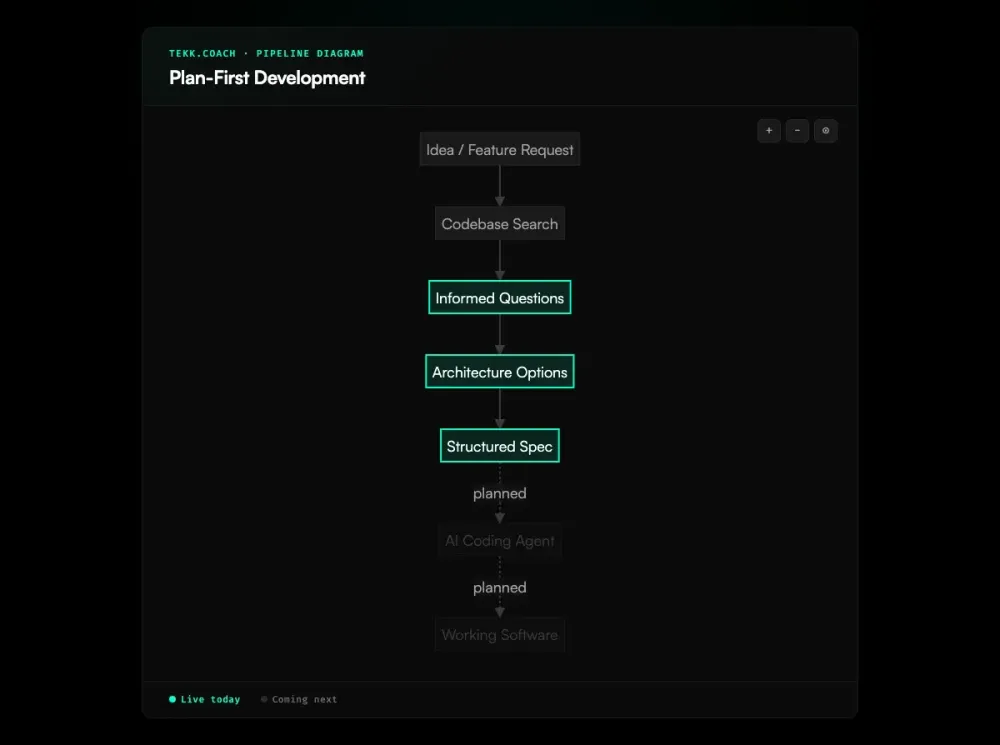
Vibe coding is fun until your third rework of the same feature. Unstructured prompts produce unstructured code — wrong scope, wrong files, security holes you didn't see coming. Plan-first development fixes that. Define exactly what you're building (and what you're not) before a single line of code runs.
Tekk.coach is built around plan-first development. Every session starts with planning — the agent reads your codebase, asks grounded questions, and generates a spec driven development artifact with explicit scope boundaries and subtasks. You approve the plan. Then you execute. No more agent drift, no more scope creep, no more rework.
[Try Tekk.coach Free →]
Key Benefits
Scope locked before execution starts Every plan includes a "Building / Not Building" section. No implicit assumptions, no agent drift, no "I thought you meant..." Your coding agent runs against a defined boundary, not an open question.
Planning grounded in your actual codebase Tekk reads your repository before generating the plan. Subtasks reference your actual files, your framework, your patterns. Planning that ignores your codebase produces specs that don't fit your architecture.
Domain expertise on demand during planning Building a payment integration? An auth system? An AI agent? Tekk searches the web for current best practices and folds the findings into the plan. You don't need to be an expert in every domain you build in.
Plans persist — not chat threads Your plan lives in Tekk's workspace, linked to a kanban task. Next session, next week, it's still there with the full reasoning. Planning in chat threads means starting from scratch every time.
One workspace for planning and tracking Plan in Tekk, track in Tekk. Each kanban card links to its full planning session. You see what's planned, what's in progress, and what's done — without switching between a chat tool and a project tracker.
How It Works
Step 1: Describe what you're building One sentence or a paragraph. You're describing intent. Tekk handles the rest of the planning.
Step 2: Tekk reads your codebase The agent searches your repository — semantic search, file search, directory analysis. It learns your tech stack, your conventions, your existing patterns. Planning is grounded in your actual code before a question is asked.
Step 3: Answer grounded questions 3-6 questions based on what the agent found in your code. Not "what framework are you using?" — it already knows. The hard questions: the edge cases your current architecture doesn't handle, the migration risks, the scope boundaries you haven't defined yet.
Step 4: Review the plan The spec streams into the editor in real time. Read through it. Edit anything. The "Building / Not Building" section is the most important — confirm the boundaries are right before you execute.
Step 5: Execute from the plan Hand the spec to your coding agent. Or use Tekk's execution layer (coming next) to dispatch directly. The agent now has a structured, codebase-grounded plan. One run. No rework. Teams running multiple agents can go further with ai agent orchestration to dispatch independent subtasks in parallel from the same approved plan.
Who This Is For
Developers and founders who've felt the vibe coding hangover — you ran an agent on a loose prompt, got a lot of code back, spent two days fixing it, and thought "there has to be a better way." There is. Plan first. Tekk is where you do that.
Solo builders and small teams shipping with AI coding agents (Cursor, Claude Code, Codex) who can't afford to lose days to rework. You don't have a dedicated architect or a formal spec process. But you need something between "a sentence" and "a 20-page PRD." Tekk generates that middle layer: structured, scoped, codebase-aware, reviewable in 15 minutes.
Product managers who need specs that engineers and agents can actually use. Not a requirements document. A plan with subtasks, acceptance criteria, and explicit scope — the kind of plan that survives contact with implementation. Teams that start from a higher-level product document can use an ai prd generator to get from product intent to a structured requirements document before drilling into implementation specs.
What Is Plan-First Development?
Plan-first development is the discipline of defining scope, structure, and acceptance criteria before writing any code — or giving any instructions to a coding agent. The plan is the primary artifact. Code is a derived output.
In AI-assisted development, plan-first has become the professional standard in response to the failures of vibe coding. Vibe coding — prompting AI agents with natural language and accepting whatever they produce — generated a wave of messy, insecure, architecturally unsound code in 2024-2025. Analysis from late 2025 found AI-co-authored code from unstructured prompts contained 1.7x more major issues than human-written code. By early 2026, Andrej Karpathy coined "agentic engineering" — the structured, plan-first successor to vibe coding.
In practice, plan-first development with AI agents means: define what you're building and what you're not, generate a structured spec with subtasks and acceptance criteria, review the spec, then execute. Phase gates instead of mid-run corrections. The plan phase is where human judgment lives. Execution is delegated to the agent.
Frequently Asked Questions
What is plan-first development?
Plan-first development is the practice of completing a structured plan — covering scope, subtasks, acceptance criteria, and explicit boundaries — before writing any code or dispatching any AI coding agent. The plan is the primary artifact; code is generated from it, not the other way around.
What's the difference between plan-first development and vibe coding?
Vibe coding means prompting an AI agent with natural language and letting it build. It's fast to start and expensive to finish — the agent makes architectural decisions without full context, adds things you didn't ask for, and misses things you did. Plan-first development defines scope explicitly, locks boundaries, and gives the agent a structured spec. One approach optimizes for starting quickly. The other optimizes for shipping correctly.
How does plan-first development work with AI coding agents?
The workflow: write a structured spec covering what you're building, what you're not, and what each subtask requires. Hand that spec to your coding agent (Cursor, Claude Code, Codex). The agent executes against the spec rather than guessing at intent. Plan-first development moves the judgment calls — scope, architecture, tradeoffs — into the planning phase where humans review them, instead of discovering them in agent output.
Is plan-first development slower?
The planning phase adds time upfront. Practitioners consistently report this time is recouped in execution: fewer agent re-runs, less rework, less scope correction. For any feature with more than two or three moving parts, planning time pays for itself on the first clean execution. For trivial changes, it isn't worth it.
What happens when you skip planning in AI development?
You get what the research calls "agent drift" — the agent fills planning gaps with its own assumptions. Unstructured prompts produce 1.7x more major code issues. Roughly 25% of AI-generated code from vague prompts contains a security flaw. Without explicit scope boundaries, agents routinely over-build — adding features you didn't ask for that then become things you maintain.
What does a plan-first spec include?
A solid plan-first spec has: a clear description of what's being built, an explicit list of what's out of scope, subtasks broken down to single-responsibility behavioral slices with acceptance criteria, the specific files each subtask touches, key assumptions and their risk levels, and validation scenarios. The "Not Building" section is the most important piece. It's the boundary that prevents scope creep.
How does Tekk.coach support plan-first development?
Tekk's entire workflow is plan-first by design. Every session starts with planning: the agent reads your codebase, asks grounded questions, and generates a structured spec — all before any execution. Plans stream into an editable living document with scope boundaries, subtasks, acceptance criteria, and file references. Execution (via your coding agent) only starts after you've reviewed and approved the plan. The kanban board tracks what's planned vs. in progress vs. done.
Ready to Try Tekk.coach?
If you're building with AI coding agents and want to stop the rework loop, plan-first development is the answer. Tekk is the workspace built around it — codebase-aware planning, structured specs, scope protection, all in one place.
[Start Planning Free →]