
Running multiple AI coding agents on the same codebase without a plan is chaos. Conflicting changes. Duplicated work. Three PRs that can't be merged. The problem isn't the agents — it's that they all started from the same underspecified instruction. As Mike Mason argues in Coherence Through Orchestration, Not Autonomy, the missing layer in AI coding isn't better models — it's better coordination.
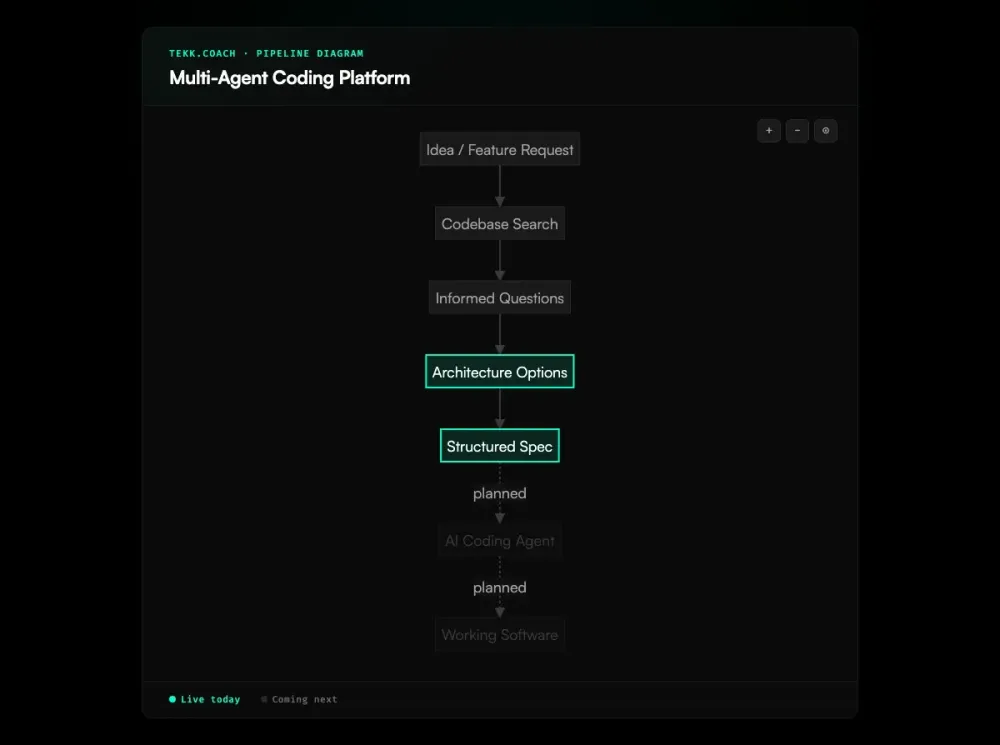
Tekk is building the multi-agent coding platform that fixes this from the foundation: plan first, then orchestrate. The planning layer is live today. The dispatch layer — running Cursor, Codex, Claude Code, and Gemini in parallel waves — is coming next.
How Tekk.coach Does Multi-Agent Coding
Part 1: Live Today — Spec Generation Built for Parallel Execution
Before any agent touches code, Tekk reads your codebase. It searches your repository using semantic search and file analysis, then asks targeted questions based on what it actually found — not generic boilerplate questions. From there it generates a structured spec with subtasks decomposed by dependency order.
Each subtask includes acceptance criteria, file references, a behavioral scope statement ("user can now do X"), and explicit dependencies on other subtasks. That dependency map is what enables parallel execution to work. Independent subtasks can run simultaneously. Dependent ones queue in order. Without this structure, parallel agents don't know what to do in what order — and they step on each other.
Every plan also includes an explicit "Not Building" section. Scope boundaries are defined before a single agent starts. This isn't ceremony — it's what prevents parallel agents from building the same thing three different ways. This is spec driven development as the prerequisite for multi-agent execution: the plan comes first, then the agents run.
The planning workflow (codebase read → questions → options → plan) is live now. You can use the structured specs with any coding agent today, manually.
Part 2: Coming Next — Dispatch and Orchestration Layer
Tekk will connect to Cursor, Codex, Claude Code, and Gemini via OAuth — the same way GitHub connects today. Once you approve a plan, Tekk takes it from there.
It groups independent subtasks into parallel execution waves and batches related subtasks — those that touch the same files or share context — into coherent jobs per agent. All jobs push to a single shared feature branch. You review one PR at the end, not one per agent.
Real-time progress appears on your kanban board as agents work. You can see which agents are running which jobs and what's completed.
Key Benefits
Spec decomposition built for parallel execution (live) Every Tekk plan breaks subtasks into dependency order. Independent subtasks are explicitly identified so they can run simultaneously without stepping on each other. This is the structural foundation multi-agent execution needs to work correctly.
Dependency-aware subtask grouping (live) Tekk doesn't just list tasks — it maps their relationships. Which subtasks must complete before others can start. Which can run in parallel. You see this before any agent runs, and you can edit it.
Works with agents you already pay for (no new lock-in) Tekk isn't a coding agent. It orchestrates the ones you're already using — Cursor, Codex, Claude Code, Gemini. You don't switch tools. You add a coordination layer on top of what you already have. The full picture of ai agent orchestration — from dependency mapping to parallel dispatch — is what Tekk is building toward.
Single PR output (coming next) All parallel jobs push to one shared feature branch. One PR. One review. The merge point is where multi-agent chaos usually surfaces — conflicting implementations, divergent patterns, review overhead that wipes out the time you saved. Google's 2025 DORA Report found that higher AI adoption correlated with a 154% increase in PR size and 91% more code review time — exactly the downstream cost that uncoordinated parallel agents create. Tekk handles the merge coordination so you don't have to.
How It Works
Step 1: Connect your repository Tekk supports GitHub, GitLab, and Bitbucket. It reads your actual codebase — languages, frameworks, file structure, existing patterns — before generating anything. No pasting context manually.
Step 2: Describe what you're building Tell Tekk what the feature is. It asks 3–6 questions grounded in what it found in your code. Not generic questions. Questions like "your auth layer uses magic link — should this feature reuse that flow or add a separate session type?"
Step 3: Get a structured spec with dependency-ordered subtasks (live) The plan streams into your task editor as a living document: TL;DR, Building / Not Building scope boundaries, subtasks with acceptance criteria and file references, dependencies, assumptions with risk levels, and validation scenarios. Edit it before anything executes.
Step 4: Approve and dispatch (coming next) Click Execute, select your agents, confirm. Tekk decomposes the approved subtasks into parallel waves based on dependencies. Independent groups run simultaneously across Cursor, Codex, Claude Code, or Gemini — each agent working in isolation on its assigned jobs.
Step 5: Review one PR (coming next) All jobs push to a shared feature branch. When agents complete, you get notified. Review the PR on GitHub. Merge when you're satisfied. The kanban card marks the task complete.
Who This Is For
Teams running multiple agents and hitting coordination problems. You've tried spawning parallel agents. Some of it works, but you're spending time managing conflicts, re-explaining context to each agent, and sorting out what to merge. The chaos is eating the time savings. Deloitte's analysis of AI agent orchestration confirms that agent sprawl without a coordination layer destroys the efficiency gains. Tekk gives you the planning foundation those agents were missing.
Developers who want to parallelize AI coding output. You're using Cursor or Claude Code and building features sequentially. You want to run multiple agents in parallel but haven't had a reliable way to decompose the work without things colliding. Tekk's dependency-aware subtask structure makes parallelism intentional rather than accidental.
Solo founders and small teams who want to scale what they can ship. You're building with AI agents already. The bottleneck isn't the agents — it's getting a spec good enough that agents can execute without coming back with questions or going in the wrong direction. Structured ai project planning is what makes the difference between agents that flounder and agents that ship. Tekk solves that problem, and the orchestration layer will let you run multiple agents simultaneously without adding coordination overhead.
What Is a Multi-Agent Coding Platform?
A multi-agent coding platform coordinates multiple AI coding agents — each working on different parts of a codebase simultaneously — to compress development time through parallelism. In the original "conductor" model, a developer guides one agent at a time. In the orchestrator model, a platform decomposes a task into subtasks, assigns agents to each, manages workspace isolation so they don't conflict, and merges results into a single output.
The category emerged clearly in 2025–2026 as individual coding agents became capable enough to work autonomously on multi-file changes — a shift Anthropic documented in their 2026 Agentic Coding Trends Report, which found that multi-agent systems are replacing single-agent workflows as developers integrate AI into 60% of their work. The challenge shifted from "can the agent code?" to "how do you coordinate multiple agents working on the same codebase without them producing conflicting, redundant, or incoherent output?" Research backs this up: the MAGIS framework (NeurIPS 2024) showed that a multi-agent system with specialized roles — Manager, Developer, QA Engineer — achieved an eight-fold improvement over single-agent GPT-4 on GitHub issue resolution. That coordination problem is what multi-agent platforms address.
The landscape currently splits into two approaches. The first — tools like Conductor, Cursor 2.0 subagents, and OpenAI Codex multi-agent — focuses on execution coordination: spawn agents, isolate workspaces, provide dashboards, merge results. The second approach, which Tekk represents, focuses on planning quality as the prerequisite for orchestration: structured specs and dependency-ordered subtasks that make parallel execution coherent rather than chaotic. Both are real approaches. They're not mutually exclusive — they're sequential. The plan has to come before the dispatch.
Frequently Asked Questions
What is a multi-agent coding platform?
A multi-agent coding platform lets multiple AI coding agents work on the same codebase simultaneously, each handling different subtasks in parallel. The platform manages workspace isolation (so agents don't overwrite each other's work), task assignment, and output merging. The goal is to compress development time that would otherwise require agents to work sequentially.
How does multi-agent coding work?
A task gets decomposed into subtasks. Independent subtasks — those with no dependencies on each other — can run in parallel across multiple agents. Dependent subtasks queue in order. Each agent works in an isolated environment (typically a git worktree or separate branch) so changes don't conflict mid-execution. When all agents complete, their work merges back to a shared branch. Google research found that centralized multi-agent coordination — where a single coordinator directs sub-agents — outperformed a single agent by 80% on complex tasks. The quality of the decomposition determines whether parallel execution is coherent or chaotic.
What agents does Tekk support for multi-agent coding?
The orchestration dispatch layer (coming next) will support Cursor, Codex (OpenAI), Claude Code, and Gemini via OAuth connections — the same way you connect GitHub today. Tekk won't replace these agents. It will coordinate them. In the meantime, the structured specs Tekk generates today can be used manually with any of these agents.
Is Tekk's multi-agent orchestration available now?
The planning layer is live: codebase-aware spec generation with subtasks decomposed by dependency order, ready for parallel execution. The dispatch layer — where Tekk actually connects to agents via OAuth and runs parallel waves — is coming next. The positioning note at the top of this page says it plainly. We'd rather be honest about what's live than oversell a roadmap.
How is Tekk different from Conductor as a multi-agent coding platform?
Conductor is a Mac app for running multiple Claude Code agents in parallel with isolated git worktrees. It's execution-focused and well-built for what it does. The gap is what happens before dispatch: Conductor starts with whatever instruction you provide. If the instruction is underspecified, each agent is executing a different interpretation in parallel — which is fast, but not coherent. Tekk generates the structured, dependency-ordered spec before any agent runs. Tekk's orchestration layer (coming next) will then dispatch into the same kind of parallel execution Conductor does today — but on top of a plan rather than a prompt.
How do I get started with multi-agent coding on Tekk?
Connect your GitHub, GitLab, or Bitbucket repository. Describe a feature you want to build. Tekk reads your codebase and generates a structured plan with dependency-ordered subtasks. Review and edit the plan in the living document editor. From there, you can use the subtasks manually with your existing agents — or wait for the orchestration dispatch layer, which will automate that step. Start at tekk.coach.
Start Planning Free →
Parallel agents executing a bad spec just fail faster. Tekk ensures the spec is right before any agent touches code — codebase-grounded, dependency-ordered, scope-bounded. The planning layer is live now. The dispatch layer is coming.
Connect your repo and generate your first spec in a few minutes.