
TL;DR
You have the idea. You know the market. You understand the problem better than anyone.
But you're not a senior engineer. You can't tell if Cursor built the feature correctly or created a mess that'll break in production. You don't know if your database schema will hold up when real users show up. You're making architecture decisions you're not qualified to make, and you know it.
Finding a human technical co-founder is a nightmare. Equity negotiations. Misaligned timelines. The good ones are already taken. The global AI talent shortage has 1.6 million open positions and only 518K qualified candidates. Fractional CTOs charge $200-500/hr and aren't available at 2am when you need to make a decision.
Tekk.coach reads your actual codebase, reasons about architecture the way a senior engineer would, and produces structured specs your AI coding agents can execute correctly. It's the technical co-founder role — the architecture decisions, the scope definition, the "here's how this should work" conversations — without the hire.
[Try Tekk.coach Free →]
What Tekk.coach Does for Non-Technical Founders
A technical co-founder does five things. Tekk handles three of them completely and one partially. Here's the honest breakdown.
Architecture decisions grounded in your code
You say "add payment processing." A coding agent writes code. But does it fit your existing system? Is it the right approach? Should it be a separate service or a module in your monolith?
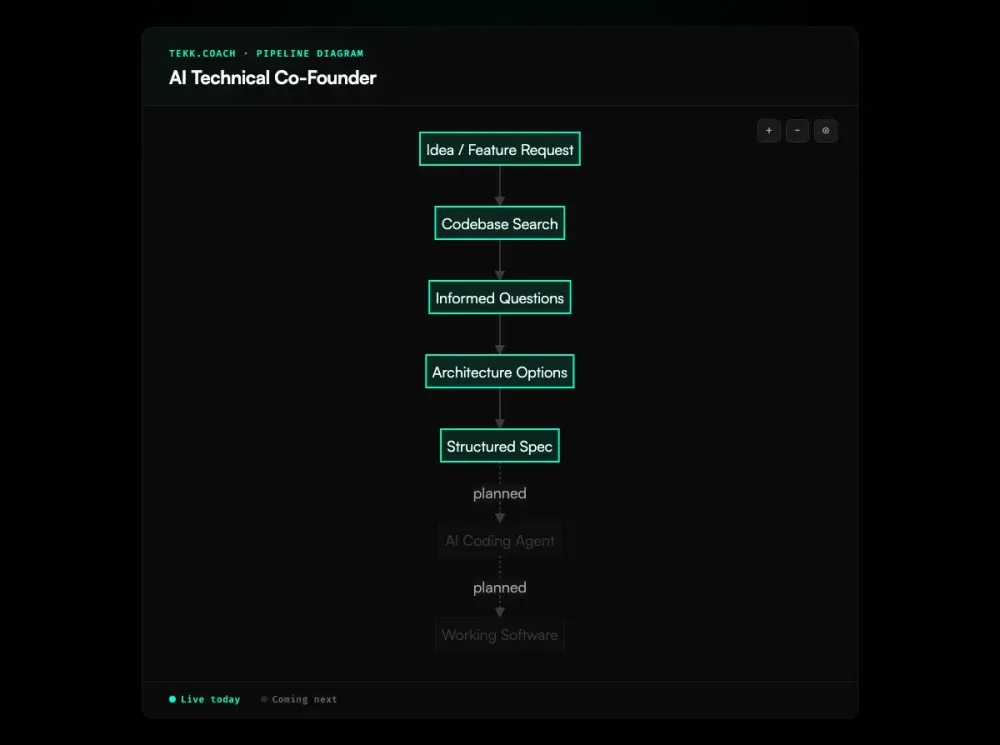
Tekk reads your repository before answering. Semantic search, file search, directory browsing. It knows your stack, your patterns, your dependencies. Then it presents 2-3 architectural approaches with honest tradeoffs. What each approach gives you. What it costs. What breaks.
That's what a technical co-founder does in a whiteboard session. Tekk does it grounded in your actual code.
Translating your ideas into executable specs
You describe the feature in plain language. Tekk asks 3-6 questions based on what it found in your code. Not "who is the target user?" but "your UserService already handles roles. Should the new permissions extend that or live in a separate layer?"
Then it writes the full spec. TL;DR. Building / Not Building scope boundaries. Subtasks with acceptance criteria and file references. Assumptions with risk levels. You hand the spec to Cursor or Claude Code and they execute correctly. This is spec driven development in practice — write the precise spec first, then let the agent execute.
Expert review when you need a second opinion
"Is my database schema going to hold?" "Are there security holes in this auth flow?" "Is my AI agent setup reasonable?"
Tekk reads the code, searches the web for current best practices, and gives you specific recommendations. The security expert, database architect, or AI engineer you don't have on the team. Available whenever you need it.
Web research for domains you don't know
Building a Stripe integration and not sure about the latest webhook patterns? Setting up an AI pipeline and don't know the current best practices? Tekk searches the web during planning and folds that knowledge into your spec. When your product is early-stage and you need a product requirements document before diving into feature specs, the ai prd generator covers that step. The learning curve compresses from days to minutes.
What Tekk doesn't do (yet)
Tekk doesn't sit in your investor pitch. It doesn't manage a team. It doesn't handle production incidents at 3am. It doesn't mentor you over coffee. These are real parts of the technical co-founder role that still require a human. Tekk gives you the engineering reasoning. The people stuff is still on you.
Why Solo Founders Choose Tekk
Your agents stop building the wrong thing
Without technical guidance, Cursor and Claude Code make their own architecture decisions. Sometimes they're right. Often they're not. Tekk makes those decisions first, grounded in your code, then tells the agent exactly what to build.
You stop second-guessing yourself
The nagging feeling that your code might be insecure, your schema might not scale, your approach might be fundamentally wrong. Tekk's expert review mode gives you honest, specific feedback. Not "this looks good" but "your auth flow stores tokens in local storage, which creates an XSS vulnerability. Here's how to fix it."
Zero equity, zero drama
No co-founder search. No equity split negotiations. No discovering six months in that your technical co-founder has a different vision for the product. Subscription pricing. Cancel anytime.
Your domain knowledge becomes the advantage
You know healthcare, logistics, finance, whatever your market is. That knowledge is worth more than coding skills in 2026. Tekk turns your domain expertise into technically grounded specs. You focus on the problem. Tekk handles the engineering reasoning.
How It Works
1. Connect your repo
Link your GitHub, GitLab, or Bitbucket repository. The agent profiles your codebase: languages, frameworks, services, dependencies, file structure.
2. Describe what you're building
Tell the agent in plain language. "Add subscription billing." "Build an admin dashboard." "Set up automated email sequences." No technical jargon required.
3. The agent thinks like a senior engineer
It reads your code. It asks questions grounded in what it found. It presents architectural options with honest tradeoffs. It doesn't just generate — it reasons.
4. Get a spec your agents can execute
The agent writes a structured spec into an editable document. Subtasks with acceptance criteria, file references, dependencies. Hand it to Cursor, Claude Code, or Codex. The spec tells the agent exactly what to build.
5. Review when you need it
Ask for a security review, architecture review, or performance check anytime. Tekk reads the code and tells you what's wrong and how to fix it. The expert second opinion you used to need a consultant for.
Who This Is For
Non-technical founders building a product
You have the business idea and the domain expertise. You're building with ai coding non technical founders in mind — domain knowledge carries more weight than ever in 2026. Research on Y Combinator founders shows that 42% had only an idea when they applied — domain knowledge matters more than technical skill. But you still need someone (or something) to make the technical decisions — which approach to take, how the new feature fits the existing code, what the spec should actually say. Tekk is that something.
Solo developers who aren't senior engineers
You can code but you're not an architect. You build features but you're not sure they're built right. You want a second opinion from someone who knows more than you do. Tekk reads your code and gives you the senior engineering perspective you're missing.
Bootstrapped teams that can't hire yet
You need CTO-level reasoning. You can't afford CTO-level salaries. Tekk fills the gap until you can hire — and the specs it produces become onboarding material for your first engineering hire.
What Is an AI Technical Co-Founder?
The "AI technical co-founder" is an emerging concept, not a formal product category. It describes AI tools that approximate parts of the technical co-founder role: architecture decisions, technical guidance, spec writing, code review, and translating business ideas into working software. The concept is driven by necessity: the global software engineer shortage is projected to reach 4 million unfilled positions, costing an estimated $5.5 trillion in losses by 2026.
No single tool fully replaces a human technical co-founder. AI coding agents (Cursor, Claude Code, Codex) handle code generation. No-code platforms (Lovable, Bubble) handle MVP creation. Chat AI (ChatGPT, Claude) gives ad-hoc advice. Fractional CTOs provide human judgment but cost $50K-150K annually — still a lot for a bootstrapped startup.
The gap: none of these read your codebase and reason about architecture the way a senior engineer would. AI coding agents are the hands. An AI technical co-founder is the brain — it decides what to build, how it should fit the existing system, and what the spec should say before the coding agent writes a line of code.
Frequently Asked Questions
Can AI really replace a technical co-founder?
Not entirely. A technical co-founder does architecture, mentorship, investor relations, team management, and production operations. AI can handle architecture decisions and spec writing when grounded in codebase context. It can't mentor you, manage a team, or explain your tech to investors. Tekk covers the engineering reasoning. The human parts are still human.
How is this different from just using Cursor or Claude Code?
Cursor and Claude Code write code. They don't decide what code to write. Give Cursor a vague instruction and it makes its own architecture decisions, often poorly. Tekk makes those decisions first — reads your code, reasons about the approach, writes a structured spec — then you hand the spec to Cursor. The spec tells Cursor exactly what to build. Different roles: Tekk thinks, Cursor executes.
I'm not technical at all. Will I understand the specs?
Tekk adjusts depth based on your level. Non-technical founders get clear explanations of architectural decisions, what each tradeoff means in plain language, and why the agent recommends a particular approach. You don't need to understand the code to understand the spec.
How does Tekk compare to hiring a fractional CTO?
A fractional CTO charges $200-500/hr in 2026, is available limited hours per week, and provides human judgment. Tekk provides engineering reasoning grounded in your actual codebase, available 24/7, at subscription pricing. Tekk covers architecture decisions and spec writing. A fractional CTO also covers investor relations, team hiring, and mentorship. Some founders use both — Tekk for daily engineering reasoning, a fractional CTO for monthly strategic check-ins.
What happens when my product gets complex?
Tekk reads your codebase as it grows. The more code you have, the more valuable codebase-aware planning becomes. Complex existing codebases are where Tekk has the biggest advantage — every new feature spec is grounded in your actual architecture, not generic recommendations.
Does Tekk work with Cursor, Claude Code, and Codex?
Yes. Tekk generates specs. Your coding agent executes them. Tekk works with Cursor, Claude Code, Codex, and Gemini. It's the planning layer, not a replacement for your coding agent.
Start Building with Senior Engineering Reasoning
You don't need to find a technical co-founder to build software that works. Connect your repo, describe what you're building, and get architecture decisions and structured specs grounded in your actual code. No equity. No hiring. No process.
[Try Tekk.coach Free →]