
Most AI spec writers take your prompt and return a document. That document could describe any project. It has no idea your auth system uses magic links, that your UserService already handles role-based access, or that your API follows a specific pattern. As ThoughtWorks noted in their analysis of spec-driven development, context-free AI output is the core limitation of prompt-to-code workflows.
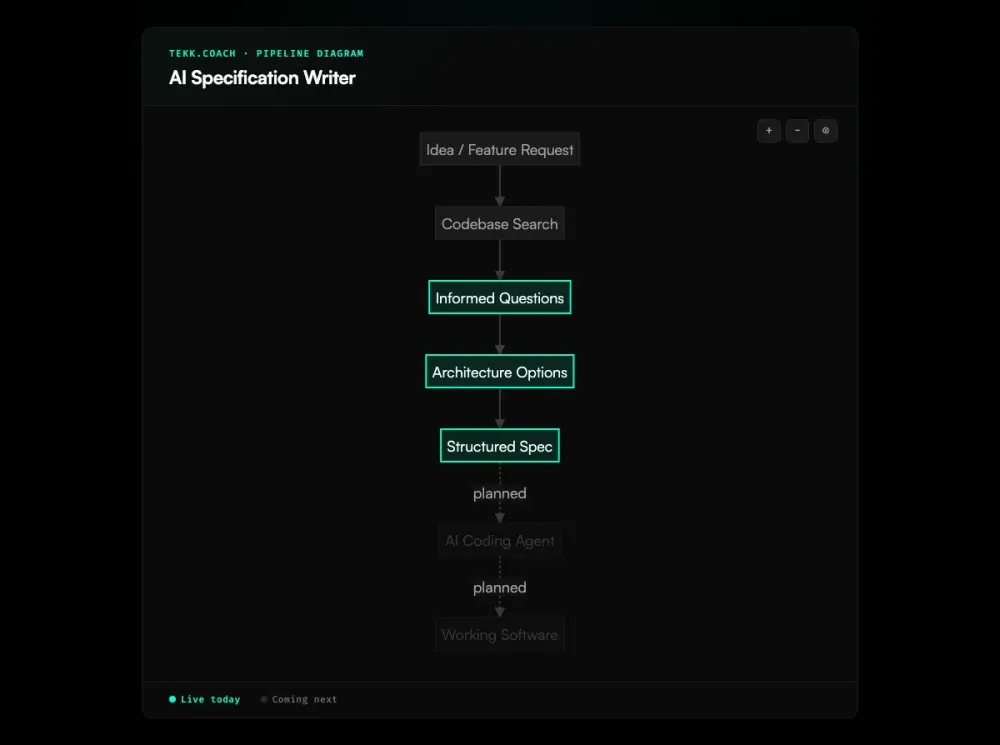
Tekk.coach reads your codebase before writing the first word. Every question is grounded in what it found. Every subtask references the actual files. Every spec is yours — not a template with your project name swapped in. This approach is the practical foundation of spec driven development: write the spec first, then let your coding agent execute.
Connect your repo. Describe the problem. Get a spec your coding agent can actually execute.
How Tekk.coach Writes Specifications
The moment you start a planning session in Tekk, the agent reads your codebase. Not a summary — the actual code. Semantic search across your files, regex lookups, directory structure, framework detection, dependency analysis. It knows what you're working with before you answer the first question.
Then it asks questions. Not "who is the user?" — your code already shows that. Instead: "Your UserService handles role-based access through a middleware chain. Should this feature extend that pattern, or does it need a separate permission model?" Every question is specific to your repo.
After your answers, it presents options. Two or three architecturally distinct approaches, each with concrete tradeoffs. Not abstract pros and cons — actual implications for your specific stack.
Then it writes the spec. It streams directly into a BlockNote rich text editor — a living document you can edit immediately. Not a chat message you copy-paste. Not a static markdown file you email around. A working specification your team builds from.
The spec includes: a TL;DR, explicit Building and Not Building scope boundaries, subtasks with acceptance criteria and file references, assumptions with risk levels, and validation scenarios. When Tekk hands this to Cursor or Claude Code, the agent knows exactly what to build, where to build it, and what done looks like.
Key Benefits
Specs that reference your actual files Every subtask names the specific files and patterns to touch. Your coding agent stops guessing. It executes against real targets.
Questions that know your codebase Generic questions produce generic specs. Tekk reads your code first — questions are grounded in your actual architecture, not a blank slate.
Explicit scope protection Every spec includes a "Not Building" section. You define the boundaries before anyone writes code. Scope creep requires a deliberate decision, not a default. This matters: research published in IEEE Access found that over 50% of software projects experience scope creep, and the inability to manage it is the primary cause of failure in 80% of failing software projects.
A living document, not a chat message The spec streams into a rich text editor. Edit it, share it, build from it. It stays connected to the planning session that created it.
Best practices built in For anything outside your current expertise — a new API, an auth pattern, a data pipeline design — Tekk searches the web during planning and folds current best practices into the spec. When your project needs a full product requirements document before feature-level specs, the ai prd generator handles that upstream step. As the Stack Overflow blog's guide to writing technical specs emphasizes, specs that encode best practices up front increase the chances of a successful project and decrease the chances of something going wrong during implementation.
How It Works
Step 1: Connect your repository Link your GitHub, GitLab, or Bitbucket repo. Tekk reads the codebase — languages, frameworks, file structure, dependencies. This happens before the planning session begins.
Step 2: Describe what you're building Open a task in Tekk and describe the feature or problem in plain language. No template to fill out.
Step 3: Answer grounded questions The agent asks 3-6 questions based on what it found in your code. Each question is specific to your repo. You answer; the agent builds on your answers without starting over each turn.
Step 4: Review your options For non-obvious problems, the agent presents 2-3 architectural approaches with honest tradeoffs. You pick the direction. For straightforward features, it skips straight to the spec.
Step 5: Get the spec The full specification streams into your task editor in real time. TL;DR, scope boundaries, subtasks with file references and acceptance criteria, assumptions with risk levels, validation scenarios. Edit it directly. It's your working document.
Who This Is For
Developers building with AI coding agents. If you're using Cursor, Claude Code, or Codex and your agents keep flailing — producing code that doesn't match your existing patterns, missing edge cases, needing constant re-prompting — the problem is spec quality. The Faros AI Productivity Paradox report found that 75% of engineers now use AI tools, yet most organizations see no measurable performance gains — because output speed without specification quality just produces more rework. Tekk fixes that at the source.
Solo founders and small technical teams. You don't have a senior architect on call. You're making implementation decisions yourself, sometimes in domains where you're not an expert. Tekk reads your code and brings that expertise to the planning session. You get a spec that reflects your actual architecture, not a generic best-practice template.
Anyone who's tired of copy-pasting context into chat. The .cursorrules file and the CONTEXT.md you maintain manually — that's a workaround for the codebase-blindness problem. Tekk solves it structurally.
This is not the right tool for enterprise teams that need Jira-style workflow governance, or for senior architects who already know exactly how to spec and just want a typist.
What Is an AI Specification Writer?
An AI specification writer is a tool that uses AI to generate structured technical documents defining what a feature should do, how it should behave, and how it should be built. In software development, a technical spec typically includes scope definition, subtasks with acceptance criteria, architectural decisions, assumptions, and validation scenarios.
The current generation of AI spec tools follows a prompt-in, document-out pattern. You describe what you want to build; the AI generates a spec. These tools work, but the output is context-free — the AI has no knowledge of your actual codebase, your existing patterns, or your current architecture. The spec could describe any project.
The next generation — and what Tekk.coach does — is codebase-first spec generation, also called automated spec generation from live code. The AI reads the repository before generating anything. Questions are grounded in what it found. Subtasks reference real files. The spec is tightly coupled to your specific project, not a generic template. GitHub's own exploration of this space, documented in their spec-driven development toolkit announcement, confirms the shift: instead of prompting for code directly, teams preemptively outline requirements and technical constraints before handing off to AI agents.
As AI coding agents become the primary way software gets written, specification quality becomes the critical bottleneck. An agent is only as good as the spec it receives. Red Hat's analysis of spec-driven development found that well-structured specs can achieve 95% or higher accuracy in AI implementations on the first attempt. Tools that generate accurate, file-referenced, scope-bounded specs are now the differentiator between coding agents that ship and coding agents that flail.
Frequently Asked Questions
What is an AI specification writer?
An AI specification writer uses AI to generate structured technical specifications from natural language input. In software development, these specs define what to build, explicit scope boundaries, subtasks with acceptance criteria, and implementation details. They're used to give AI coding agents (and human developers) precise instructions before work begins.
How does an AI specification generator work?
Most AI specification generators take a text prompt describing a feature and return a structured document. Tekk.coach works differently: it reads your codebase first using semantic search, file search, and directory analysis, then asks questions grounded in what it found, presents architectural options, and generates a spec with file-level references and acceptance criteria.
What should a technical specification include?
A complete technical specification should include: a TL;DR summary of what's being built, explicit scope boundaries (building and not building), subtasks with acceptance criteria tied to specific files or components, architectural assumptions with risk levels, and validation scenarios to verify the work. Tekk generates all of these as part of every planning session.
How is this different from using ChatGPT or Claude to write specs?
ChatGPT and Claude in chat mode have no knowledge of your codebase. They generate specs from your description alone, which means the output is generic — it describes a plausible version of your feature, not a version grounded in your actual architecture, patterns, or existing code. Tekk reads your repo first. The questions, options, and spec all reference what it actually found.
Can I use Tekk.coach for automated spec generation with Cursor or Claude Code?
Yes. Tekk is designed as the planning layer before code execution. Once the spec is complete, you use it as input for Cursor, Claude Code, Codex, or any AI coding agent. For teams running multiple agents simultaneously, ai agent orchestration handles decomposing the spec into parallel execution waves. The spec includes file references and acceptance criteria that give these agents precise execution targets — significantly reducing hallucination and rework.
What is spec-driven development, and how does Tekk support it?
Spec-driven development is a workflow where a structured specification is written before any code is generated, and that spec becomes the primary input for AI coding agents. As Martin Fowler's exploration of SDD tooling details, this approach is rapidly becoming a recognized engineering practice. Tekk supports this by producing specs with the depth and file-level grounding that coding agents need to execute correctly. The spec is a living document in Tekk's editor — not a chat message or a throwaway markdown file.
Is Tekk.coach only useful for large codebases?
No. Tekk works for any size repo. For new projects, it reads what exists and reasons about what to build. For mature codebases, the codebase-reading is where it adds the most value — it surfaces patterns, existing abstractions, and potential conflicts before the spec is written. Small projects benefit from the structure; larger projects benefit from both structure and context.
How do I get started with Tekk.coach?
Connect your GitHub, GitLab, or Bitbucket repository at tekk.coach. Create a task, describe what you want to build, and the planning session begins. The agent reads your codebase and asks its first questions within seconds. It's free to start.
Ready to Write Specs That Know Your Code?
Stop pasting context into chat windows and hoping the output matches your architecture. Connect your repo, describe the problem, and get a technical spec grounded in your actual codebase — with file references, acceptance criteria, and scope boundaries your coding agent can execute against.