
Scope creep doesn't start when a client asks for more. It starts when the spec never said no.
Tekk.coach reads your client's actual codebase and generates a structured plan with explicit scope boundaries before your developers touch a single file. Every plan includes a "Not Building" section — a documented list of what's out of scope. When the client asks for X two weeks in, you have the spec that already said X is out.
Free to start. No PM overhead. Just plans that hold.
How Tekk.coach Does AI Project Planning for Agencies
The typical agency workflow goes like this: client brief, some rough notes, paste a description into Cursor, hope the output is close enough. It isn't. The spec missed complexity. The developer had to interpret it. Three rounds of rework later, the project is over budget and the client thinks you underdelivered.
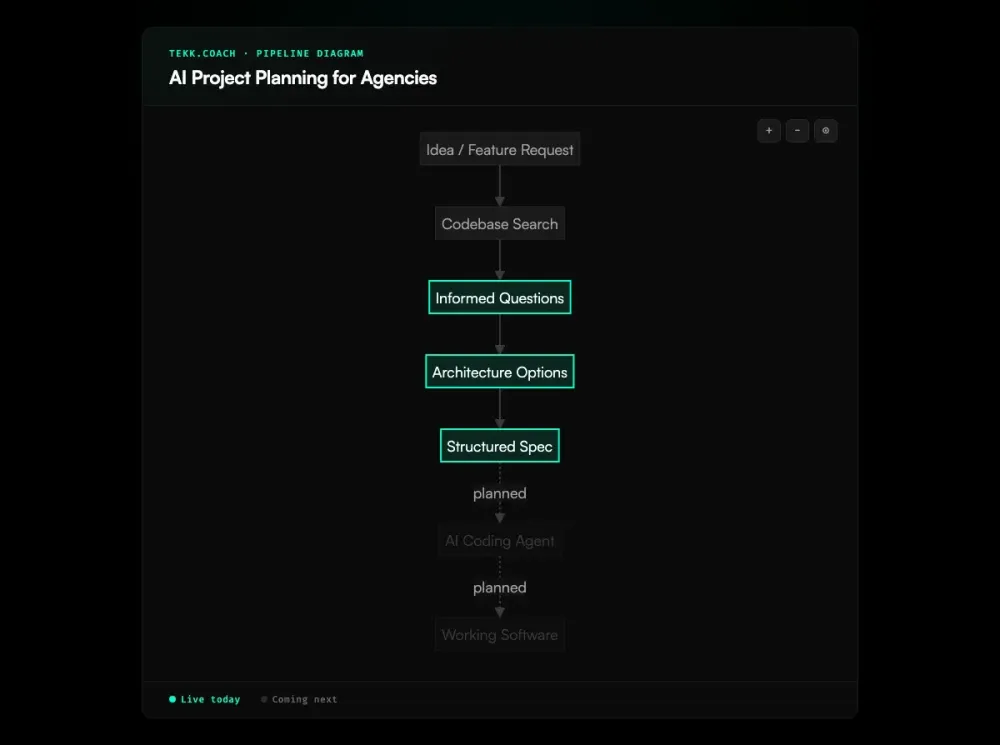
Tekk does the step that's missing. Before generating a plan, the agent connects to the client's GitHub, GitLab, or Bitbucket repo via OAuth and reads the actual codebase. Not a description of it — the code itself. Semantic search, file analysis, repository profiling. Every question and every scope decision is grounded in what's actually there, not what someone assumed was there.
The output is not a chat message. It's a living document: a structured spec with a TL;DR, a Building section, a Not Building section, subtasks with acceptance criteria and file references, and explicit assumptions with risk levels. That's the document your developer works from. That's the document you show the client when they push for more. This approach to spec driven development is what separates agencies that hold scope from agencies that renegotiate it every sprint.
For agencies doing AI project planning, this is the planning layer that feeds your developers and your coding agents. You still need Teamwork or Productive for billing and resource management. Tekk is not that. Tekk is what produces the technical plan they run on.
Key Benefits
Scope defined before code starts Every plan Tekk generates includes a "Not Building" section alongside the "Building" section. Explicit scope boundaries are baked into the spec. Client pushback has a documented answer.
Plans grounded in the actual codebase The agent reads the repo before asking a single question. Hidden complexity surfaces in the spec, not in sprint 3. Estimates based on what's actually in the code are more accurate and more defensible.
Specs your coding agents can execute If your developers use Cursor, Claude Code, or Codex, they need structured plans with file references and acceptance criteria — not paragraphs. Tekk produces exactly that. Less flailing, less rework.
Multi-turn planning that surfaces ambiguity The agent asks 3–6 questions grounded in what it found in the code. These aren't generic discovery questions. They reference specific files and patterns. Ambiguity gets resolved before it becomes a project problem.
Expert review without hiring specialists Security, architecture, and performance reviews on demand. The agent reads the client's code and flags structural issues — before you commit to a plan that builds on a broken foundation. For agencies whose clients ask for a dedicated technical guide throughout the engagement, an ai technical co founder provides that ongoing advisory layer.
How It Works
Step 1: Connect the repo Connect the client's GitHub, GitLab, or Bitbucket via OAuth. Tekk reads the codebase — semantic search, file analysis, repo profiling. This takes seconds.
Step 2: Describe the engagement Tell Tekk what you're building for this client. A feature, a migration, a new service. No formal template required.
Step 3: Answer informed questions The agent asks 3–6 questions grounded in what it found in the code. These target the real unknowns — not generic discovery. Your answers narrow scope before the plan is written.
Step 4: Review architecture options For decisions with real tradeoffs, Tekk presents 2–3 distinct approaches with honest pros and cons. You choose the direction. The client doesn't get to change that direction later — it's documented.
Step 5: Get the spec The plan streams into a living document editor. TL;DR at the top. Building section. Not Building section. Subtasks with acceptance criteria and file references. Assumptions with risk levels. Validation scenarios. This is the document your team works from.
Who This Is For
This is for development agencies doing agency project planning with AI coding agents and finding the planning layer broken.
You're running a dev agency of 3–30 people. Your developers use Cursor or Claude Code. You take client work — custom software, feature development, migrations. Scope creep is a constant threat. You've had at least one project go sideways because the client kept adding things and you couldn't point to a document that said those things were out of scope.
You're the technical lead or agency owner who writes the specs before handing work to developers. You know the specs aren't good enough. You're generating them with a chat AI without access to the client's actual codebase, which means they miss complexity and miss boundaries. You want a better process.
Your developers are already using AI coding agents, and you've noticed the output quality is directly tied to the quality of the spec. When the spec is precise and codebase-grounded, the agent ships correct code. When the spec is vague, the agent flails and you spend three days on rework.
Tekk is not for agencies that need full business operations in one tool — billing, client CRM, time tracking, invoicing. That's Productive or Scoro. Tekk is specifically the technical planning layer: the step between client requirements and developer execution.
What Is AI Project Planning for Development Agencies?
AI project planning for development agencies is the use of AI tools to generate technical plans, scope definitions, and feature specifications for client software projects. It sits between the client requirements phase and the development phase — turning rough briefs into structured, executable specs that developers (and AI coding agents) can act on without interpretation. An ai prd generator grounded in the client's codebase produces those specs with explicit scope boundaries, so the agency's developers know exactly what to build.
Traditional project planning for agencies relied on senior developers writing specs from memory, experience, and intuition. The problem: specs written without reading the actual codebase miss complexity, miss dependencies, and miss the constraints that only appear when you look at the code. The result is estimates that don't hold and scope that drifts.
In 2026, AI planning for development agencies has a new urgency. Agencies that have adopted AI coding agents — Cursor, Claude Code, Codex — discovered that these tools are powerful but dependent on the quality of their inputs. A one-paragraph task description produces mediocre code. A structured spec with file references, acceptance criteria, and explicit scope boundaries produces code that ships on the first pass. The planning step is no longer optional overhead; it's what separates agencies that ship fast from agencies that rework endlessly.
The current landscape includes general-purpose AI project management platforms (Forecast, Teamwork, Productive), which handle resource management, billing, and client communication but don't read codebases or generate technical specs. On the other end are AI coding agents, which execute plans but don't create them. Tekk sits in between: the planning layer that reads the codebase and produces the spec.
Frequently Asked Questions
What is AI project planning for agencies?
AI project planning for agencies uses artificial intelligence to help development agencies generate technical plans, scope definitions, and feature specifications for client projects. The goal is to produce plans that are accurate, scope-bounded, and structured enough for developers and AI coding agents to execute without ambiguity. The quality of the plan directly determines the quality of what gets built.
How does an agency project planning tool differ from regular project management software?
Project management software (Teamwork, Productive, Scoro) handles tracking, billing, resource allocation, and client communication. An agency project planning tool handles the technical planning step: reading the codebase, asking informed questions, defining scope, and generating structured specs. They're not substitutes — you need both. The PM tool runs the project; the planning tool produces the spec the project runs on.
How does Tekk.coach help with scope creep specifically?
Every plan Tekk generates includes a "Not Building" section — an explicit, documented list of what is out of scope. This is generated as part of the spec before coding starts. When a client asks for something outside the agreed scope, you have a document that already says that item is excluded. Scope creep is hardest to fight when scope was never defined precisely. Tekk forces that precision at the start.
Does Tekk work with AI coding agents like Cursor or Claude Code?
Yes. Tekk is designed as the planning layer that feeds AI coding agents. The specs Tekk produces include file references, acceptance criteria per subtask, explicit scope boundaries, and architectural context — exactly what Cursor, Claude Code, and Codex need to execute correctly. Vague task descriptions produce bad AI output. Tekk produces the structured input these agents need.
Can Tekk read a client's existing codebase?
Yes. Tekk connects to GitHub, GitLab, and Bitbucket via OAuth. The agent uses semantic search via embeddings, file search, regex, and directory browsing to understand the repo's structure, frameworks, dependencies, and patterns before generating any plan. This is what makes the plans accurate — they're grounded in the actual code, not a developer's description of it.
Is Tekk a replacement for tools like Productive or Teamwork?
No. Tekk is the technical planning layer — it generates specs, not project dashboards. Productive and Teamwork handle the operational side of running an agency: resource management, time tracking, billing, client communication. Tekk generates the technical specification those projects run on. Most agencies will use both.
What does a Tekk plan actually look like?
A Tekk plan is a living document that includes: a TL;DR summarizing what's being built and why; a "Building" section with subtasks, acceptance criteria, and file references; a "Not Building" section with explicit scope exclusions; assumptions with risk levels; and validation scenarios. It streams in real-time into an editable document editor. You can edit it before handing it to your developers.
Who at an agency should use Tekk?
The technical lead, senior developer, or agency owner who writes specs before work begins. The person whose job is to translate "what the client wants" into "what the developers will build." If you're currently doing that step in a general-purpose AI chat — without codebase access, without structured output, without explicit scope boundaries — Tekk is the better process.
Ready to Plan Your Next Client Engagement?
Your next client project starts with a spec. Make it one that actually holds — grounded in their real codebase, with scope boundaries that protect your team before code is written.
Connect the repo. Describe the feature. Get a plan your developers can execute and your client already agreed to.