
You ship code that only you've seen. No one else has read your auth flow, your database schema, or the service you wired together three months ago. That's not just lonely — it's a real risk. Architecture mistakes compound. Security issues go unnoticed. And by the time you find them, they're buried under months of work. 84% of developers now use AI tools, but only 29% trust their accuracy — and solo developers have no second set of eyes checking what those tools produced.
Tekk.coach reads your entire codebase and gives you the review your team isn't doing. Security gaps, structural problems, performance bottlenecks — found in your actual code, not flagged on a checklist.
Free to start. Connect your repo in two minutes.
How Tekk.coach Does Code Review for Solo Developers
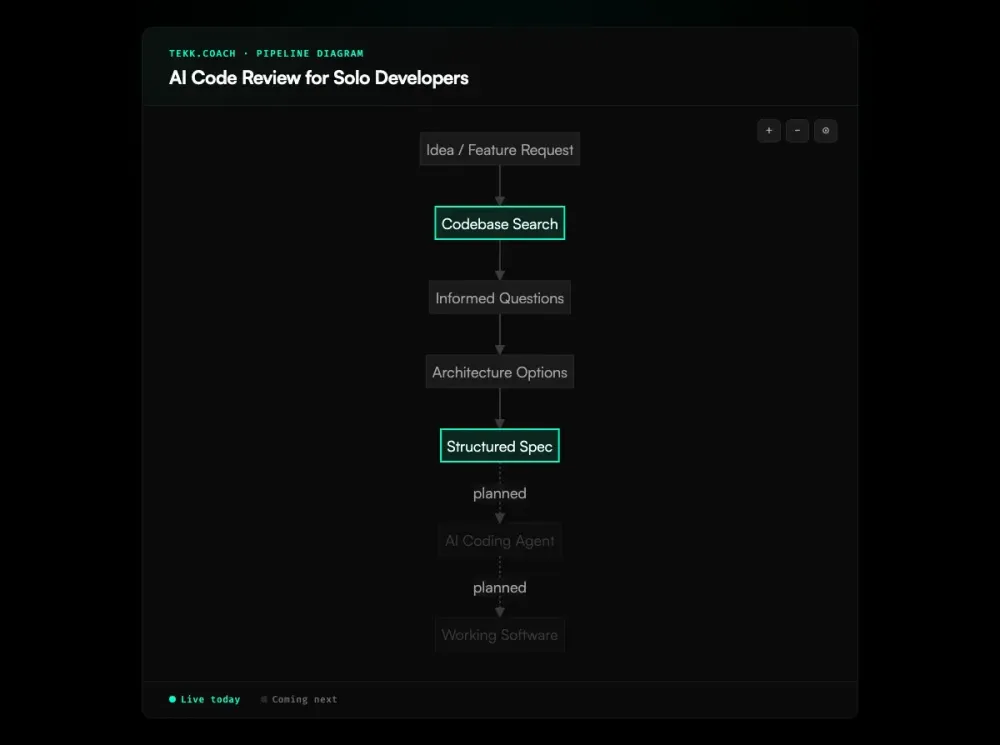
When you run a review in Tekk.coach, the agent starts by reading your codebase — not a PR diff, not a summary, your actual code. It uses semantic search across your files, regex lookups, directory browsing, and repository profiling. It knows your language, your framework, your dependencies, and how everything connects before it generates a single finding.
Then it searches the web for current best practices relevant to what it found. If your auth setup has a pattern that creates XSS exposure, it doesn't just flag it in the abstract — it tells you where in your code the problem lives, why it's a risk, and what to change.
You choose the review mode: security, architecture, performance, or agent improvement. Each mode brings a different lens. Security review looks for vulnerabilities across your codebase — referencing OWASP Top 10 patterns and current threat intelligence. Architecture review identifies structural issues and design patterns that will cause problems later. Performance review finds bottlenecks and optimization opportunities. Agent improvement review evaluates how you've set up your AI coding agents and suggests how to make them more effective. AI code review runs across your full codebase, not just recent diffs — that's what makes it useful for solo developers who rarely use PR workflows.
This is not a linter. ESLint and SonarQube catch style violations and known code smells — that's useful, but it's a different problem. Tekk catches the structural and architectural issues that static analysis doesn't touch: the database schema that will break under load, the API design that exposes data it shouldn't, the module boundaries that will make the codebase impossible to extend in six months.
Key Benefits
Codebase-wide, not diff-scoped PR bots review what changed. Tekk reviews what exists. If a security problem spans three files written three months apart, a PR review misses it. Tekk finds it.
Grounded in your actual code Every finding references your specific files, patterns, and architecture — not a generic checklist. The recommendation makes sense in context because Tekk read the context.
No peer review process required You don't need a PR workflow, teammates, or a review queue. Request a review when you need one. Tekk is available on demand.
Web-current best practices Tekk searches the web during your review to incorporate current guidance. You don't need to be a security expert to get security findings that reflect current threats.
Four expert lenses Security, architecture, performance, and agent improvement — each mode has a different focus. Run the one you need, or run all four before a major release.
How It Works
Step 1: Connect your repository Link your GitHub, GitLab, or Bitbucket account via OAuth. Tekk gets read access to your repo. Takes two minutes.
Step 2: Select a review mode Choose security, architecture, performance, or agent improvement. You can run multiple in one session. Tell Tekk what you're concerned about — the agent will factor that in.
Step 3: Tekk reads your codebase The agent explores your repository using semantic search, file search, regex, and directory browsing. It builds a picture of your architecture: services, dependencies, patterns, potential problem areas.
Step 4: Findings are delivered with specific recommendations
Not "consider using HTTPS." Specific: "Your auth flow stores JWT tokens in localStorage on line 47 of auth/session.ts. This creates XSS exposure. Use httpOnly cookies instead. Here's the change."
Step 5: You fix what matters Every finding includes what the problem is, why it matters, and how to address it. You decide which to fix first. The review is yours — Tekk doesn't push, auto-fix, or open PRs.
Who This Is For
This is for you if you're the only engineer on your project — and you know it.
Maybe you're a solo founder who writes the code. Maybe you're a freelancer shipping a client's product. Maybe you're building a side project nights and weekends and you've been the only reviewer since day one. You know code review matters. You've just never had anyone to do it with.
You're the right person for this if:
- You're shipping real code with no team reviewing it
- You're using AI coding agents (Cursor, Claude Code, Codex) with a vibe coding tool approach and want someone to check the foundations
- You've never had a security review and you're not sure what's in your auth or data layer
- You built something fast and now you're wondering what you missed
- You want a second opinion that actually understands your specific codebase
It's also for developers who just landed a solo project at a company — an internal tool, a new service, a prototype that became production. You have teammates, but not on this. You know you should have review. Tekk fills that gap without the overhead of formal review cycles.
It's not for you if you need a continuous, automated code review bot that runs on every PR across a large team. Tools like CodeRabbit are built for that. Tekk is for when you need a thoughtful, senior-engineer-quality review of what you've built — on demand, grounded in your code.
What Is AI Code Review?
Code review is the practice of having another engineer read your code before it ships — catching bugs, questioning architecture decisions, flagging security issues, and sharing knowledge. Traditionally, this means a teammate. For most of software development history, if you didn't have a team, you didn't have code review.
AI code review uses large language models to analyze code and generate findings the way a senior engineer would. VentureBeat's analysis of AI coding agents found that brittle context windows mean agents produce code that works at the function level while missing system-level issues — exactly the gap review is meant to catch. The early tools in this category — and there are many — focused on pull requests: an AI reads the diff and comments on the change. That works for teams. For solo developers, who often don't have a PR workflow and whose real problems aren't in any single diff, it solves the wrong problem.
The more useful framing for solo developers is AI peer review: a system that replaces the missing peer entirely. Not a bot that reviews your latest change — an agent that reads your whole codebase and tells you what's structurally wrong. As Addy Osmani has written, AI-assisted development demands more discipline around review, not less. Pairing review with spec driven development closes the loop — you plan against your codebase and verify the output meets the spec. That's a newer capability in 2026, and it's what Tekk.coach's review mode is built to do.
Frequently Asked Questions
What is AI code review for solo developers?
AI code review for solo developers is a review of your codebase by an AI agent that acts as a stand-in for the senior peer reviewer you don't have. Unlike PR bots that review diffs, it reads your full repository and identifies architectural, security, and performance issues that accumulate when no one is checking. It's on-demand — you request it when you need it, not as part of a continuous pipeline.
How is this different from a linter or static analysis tool?
Linters (ESLint, Prettier) and static analysis tools (SonarQube, Codacy) catch code quality issues: style violations, known anti-patterns, duplicate code, security smell rules. They're valuable, but they're pattern-matching against rules. Tekk's review mode reasons about your architecture — it reads how your systems connect and identifies problems that don't map to a rule set. An auth flow that's technically valid but architecturally exposes user data won't fail a lint check. Tekk will flag it.
Can AI replace peer code review?
For the specific problems peer review solves — catching logic errors in a specific change, surfacing style disagreements, knowledge transfer — human review is still better. But for solo developers who have no peer reviewer at all, AI code review addresses the gap that otherwise goes completely unfilled. Tekk doesn't simulate the social dynamics of peer review. It does the part that matters most when you're alone: finding the problems you can't see yourself.
How do solo developers do code review without a team?
The workarounds that exist — posting to Stack Exchange, asking at meetups, rubber ducking — are slow, shallow, and don't read your actual code. They give general advice. The Tekk approach: connect your repo, run a review mode, get findings grounded in your specific codebase. It's the same review you'd get from a senior engineer who joined your project and spent two hours reading everything.
What does Tekk's security review actually check?
Tekk reads your codebase with a security lens: authentication and authorization patterns, data exposure risks, token and secret handling, input validation, common vulnerability patterns relevant to your language and framework. It searches the web for current threat intelligence and best practices during the review. Findings are specific — you'll see which file, which pattern, and what the risk is. This is not a replacement for a professional security audit on a financial or healthcare system. It's the review most solo projects never get at all.
How is Tekk different from CodeRabbit for code review for solo devs?
CodeRabbit is a PR review bot. It reviews your pull request diffs and comments on changes — useful if you have a PR workflow and want fast feedback on each change. Tekk is not a PR bot. It reads your entire codebase and gives you findings about its overall architecture and security posture. The two tools do different things: CodeRabbit reviews what you changed, Tekk reviews what you've built. Many solo developers don't have a PR workflow at all, which makes CodeRabbit a poor fit. Tekk has no workflow dependency.
Is AI peer review worth it for solo developers?
If you're shipping code that real users depend on, yes. The main thing solo developers lose by not having a team isn't process — it's the second set of eyes that catches what you're too close to see. Architecture mistakes and security issues that a reviewer would catch in minutes can stay in production for months. Tekk gives you that catch before it costs you. It's free to start, so the barrier is low.
Do I need a PR workflow to use Tekk's code review?
No. Tekk's review mode is independent of your Git workflow. You don't need to create PRs, branches, or follow any specific branching convention. Connect your repo, select a review mode, and run it. It works on whatever state your repository is in.
Ready to Find What You've Been Missing?
You've been shipping code that only you've seen. Tekk.coach reads your entire codebase and tells you what a senior engineer would have caught. Security gaps, architectural problems, the things that seem fine until they aren't.
Connect your repo and run your first review in minutes. Free to start.