- What is AI architecture software for software developers?
- AI architecture software for software engineering applies large language models and code analysis techniques to review software system design — identifying structural issues, dependency problems, layer boundary violations, and design anti-patterns. It's distinct from building/structural architecture tools and from AI code generation tools. The goal is to evaluate and improve the structural quality of an existing codebase, not to generate new code.
- How does AI software architecture analysis work?
- The most capable tools read the complete repository — not just a PR diff — using techniques like semantic search via embeddings, file analysis, and directory traversal. They build a structural understanding of the system (services, dependencies, patterns, frameworks) and then reason about design quality against both internal consistency and external best practices. Output ranges from specific refactoring recommendations to high-level architectural observations.
- Is Tekk.coach an automated architecture review tool?
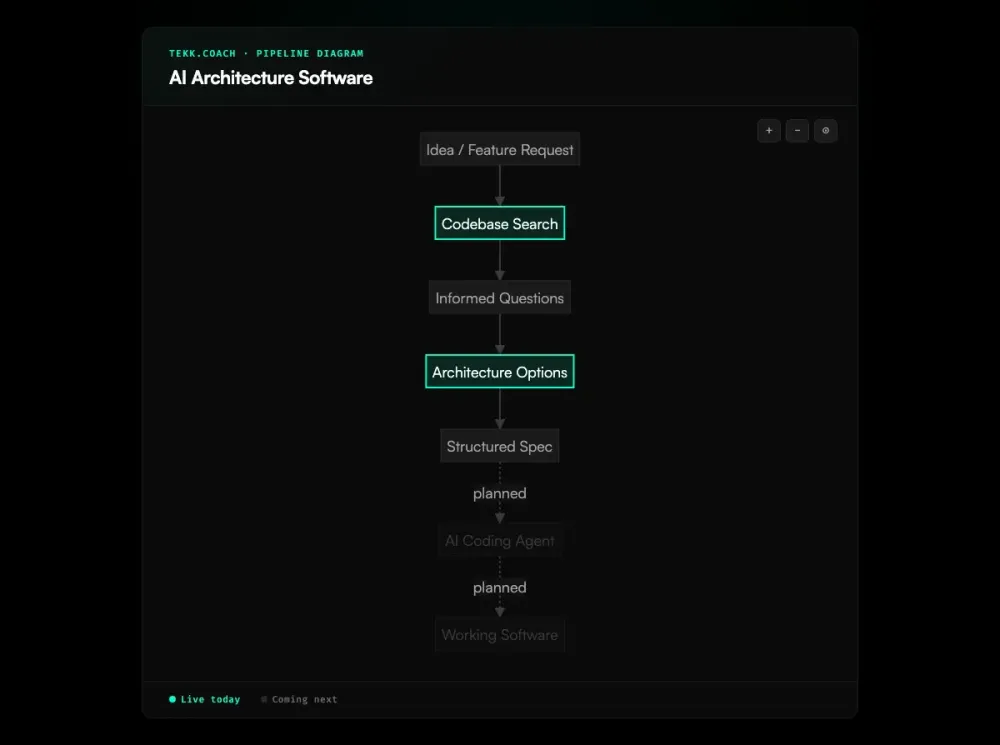
- Tekk's architecture review is on-demand rather than continuous pipeline integration. You trigger a review session, the agent reads your codebase using semantic search and repository profiling, and produces specific findings grounded in your actual code. It also searches the web for current best practices during the review. This is more like a structured review session with a senior architect than an automated CI gate — the output is richer, but it's not running on every commit.
- How is Tekk different from SonarQube or CodeRabbit?
- SonarQube and CodeRabbit run at PR level — they see what changed, not the whole system. They're strong for enforcing rules on every commit (dependency cycles, duplication, style). Tekk reads the complete repository before producing architectural opinions, making it better suited for structural design review: service boundary analysis, dependency direction, pattern consistency across the whole codebase. Different use cases, not competing substitutes.
- Can Tekk do architecture review for any tech stack?
- Tekk's codebase search covers languages, frameworks, services, and packages across GitHub, GitLab, and Bitbucket. Repository profiling is part of what runs before any review output. It's not limited to specific languages or frameworks — the review is grounded in your specific stack, not applied from a generic template.
- Who should use AI architecture software?
- The highest value is for developers and small teams who don't have a dedicated architect. This includes solo founders building products, small engineering teams (1-10 people) shipping features at AI-assisted speed, and developers who are working in technical domains outside their core expertise. Senior architects with a defined review methodology typically don't need it — they already do what the tool does. Large enterprise teams with existing architecture governance programs may prefer tools like vFunction or CodeScene that integrate with their existing workflows.
- Is AI architecture analysis reliable enough to trust?
- AI architecture software is most reliable for identifying patterns and anti-patterns that have clear structural signatures: circular dependencies, layer violations, coupling that shouldn't exist, missing separation of concerns. It's less reliable for architectural decisions that require deep organizational context (why a particular boundary was drawn) or for evaluating experimental patterns that aren't well-represented in training data. The recommendation: treat the findings as a starting point for a senior engineer review, not a replacement for it. Tekk's output names specific files and patterns — so verification is straightforward.
- Does Tekk's architecture review require any setup or instrumentation?
- No instrumentation required. Tekk connects to your repository via GitHub, GitLab, or Bitbucket OAuth — read access, no deployment changes. The review happens on your codebase as it exists in the repository. For teams comparing this against tools like vFunction (which requires runtime instrumentation) or CodeScene (which requires git history access and configuration), Tekk's setup is significantly lighter.