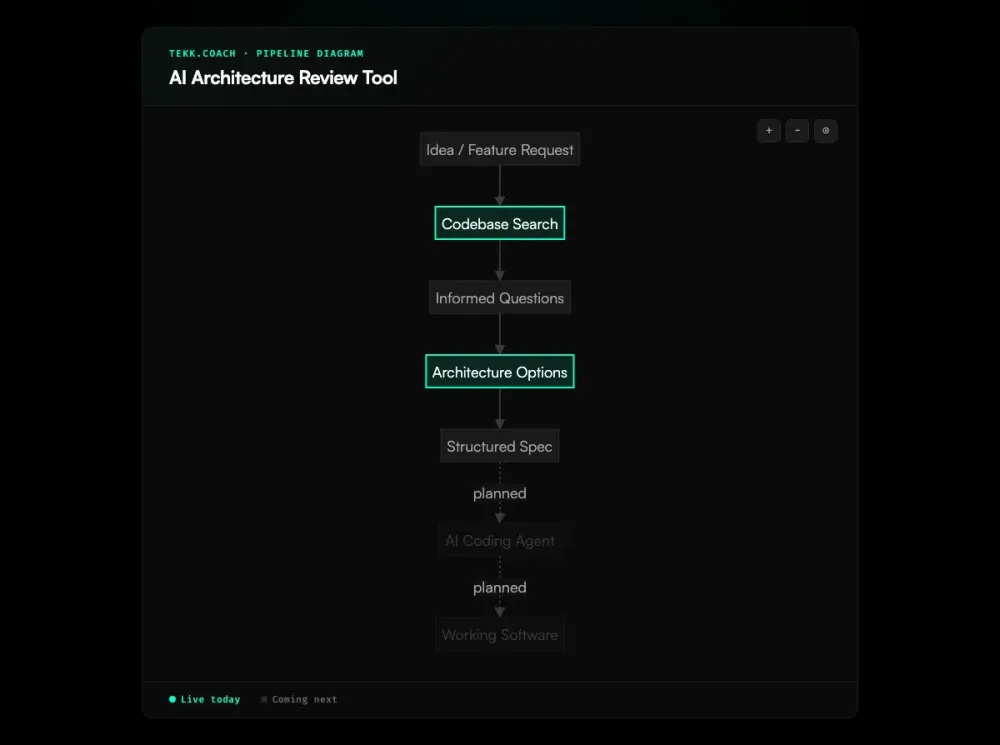
- What does an AI architecture review tool actually do?
- It reads your codebase and evaluates the structural design: dependency direction, layer separation, service boundaries, coupling patterns, anti-patterns, and adherence to architectural principles. The output is specific recommendations grounded in your actual code — not a generic checklist. Better tools also benchmark findings against current best practices via web research, not just internal consistency checks.
- How is an AI architecture review tool different from a code linter?
- Linters enforce style and syntax rules on individual files. Architecture review tools evaluate system design — the relationships between modules, services, and layers. Linters run fast on every file. Architecture review requires reading the complete repository to understand structural patterns. The questions are different: a linter asks "is this function formatted correctly?"; an architecture review tool asks "should this function even be in this layer?"
- Is Tekk.coach better than SonarQube for architecture review?
- They solve different problems. SonarQube enforces architecture rules (dependency cycles, layer violations) on every PR in CI/CD — it's a continuous gate. Tekk is an on-demand review that reads the complete codebase and produces richer structural findings, along with web research against current best practices. For teams that want CI/CD enforcement on every commit, SonarQube is the right tool. For teams that want deep architectural analysis on demand — particularly those without a dedicated architect — Tekk is more useful.
- How long does an AI architecture review take in Tekk?
- The codebase reading phase runs before the review output — semantic search, directory traversal, repository profiling. For most repositories, this happens in the same session. The review itself is conversational: you describe what you want to review, the agent reads the code, the findings arrive in the editor. No waiting days for a report.
- Can Tekk review architecture for any programming language?
- Tekk's codebase search runs across languages, frameworks, and services as part of repository profiling before any review. It's not limited to a specific language or framework. The review is grounded in your actual stack, not applied from a language-specific template.
- What architectural problems does Tekk catch that other tools miss?
- The most valuable catches come from reading the full repository rather than just the PR diff: circular dependencies between services, layer boundary violations that span multiple files, coupling patterns that will make future features expensive, and security gaps at the authorization and workflow level (not just signature-based vulnerabilities). These are the architectural problems that accumulate invisibly and become expensive — the kind that PR-level tools don't see because they weren't introduced in the latest change.
- Is an AI architecture review tool a replacement for a senior architect?
- No — and Tekk doesn't claim to be. Tekk surfaces structural issues that a senior architect would find. What it can't provide is the organizational context, historical knowledge, and judgment about tradeoffs under business constraints that an experienced architect brings. Treat the findings as a starting point: Tekk finds the structural problems, you (or a senior engineer) decide on the remediation strategy. For teams that have no architect at all, Tekk is significantly better than nothing.
- Do I need to instrument my application to use Tekk's architecture review?
- No. Tekk connects to your repository via GitHub, GitLab, or Bitbucket OAuth — read access to the source code. No runtime instrumentation, no deployment changes. This is a key difference from tools like vFunction, which analyzes running applications and requires instrumentation of the production or staging environment.