
Your codebase has structural problems you haven't found yet. Tight coupling. Missing abstractions. Dependencies that shouldn't exist. They're invisible in PR reviews and silent in static analysis — until they slow everything down. Research from Harvard Business School confirms that coupling between components is one of the strongest predictors of future maintenance costs, and that a small number of highly-coupled files generate a disproportionate share of defects.
Tekk reads your actual codebase and runs an on-demand architecture review. It finds structural issues before they compound into rewrites, and gives you specific recommendations tied to real files in your repo.
Free to start. Connect your GitHub, GitLab, or Bitbucket.
How Tekk Does AI Architecture Review
Most "code review" tools look at diffs — what changed in the last PR. That's useful for catching bugs. It tells you nothing about whether the underlying design is wrong. Even the top-rated AI code review tools in 2026 operate primarily at the PR level — they catch line-level issues, not structural ones. For line-level and security review alongside structural analysis, Tekk's ai code review mode covers both — reading your full codebase before generating any findings.
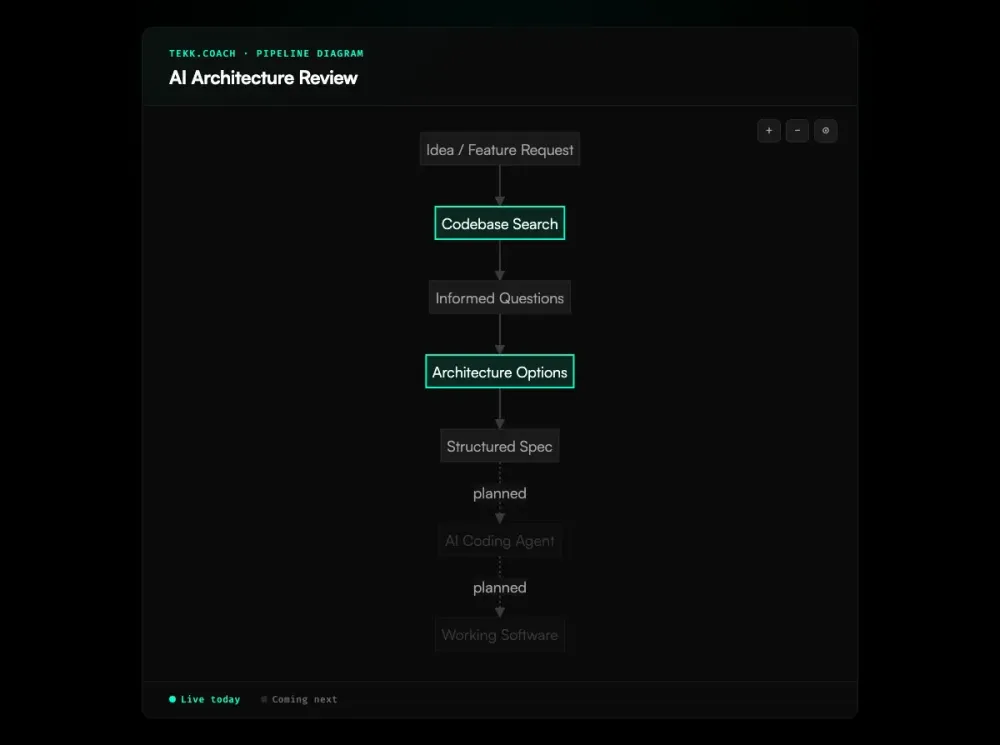
Tekk's architecture review mode reads the whole codebase. Before running any analysis, the agent searches your repository: semantic search via embeddings, file search, regex lookup, directory traversal, full repository profiling. It builds a picture of how your system is actually structured — not from a diagram you drew, from your actual code.
Then it searches the web for current best practices relevant to your stack and the issues it finds. The output is a set of actionable recommendations, each tied to specific files in your repo. Not "you might have coupling issues." More like: "your auth logic is spread across middleware/auth.js, routes/user.js, and services/session.js — it should be centralized."
This is ai architecture software that works from evidence, not templates. If a recommendation can't be grounded in your code, it doesn't get made.
Architecture review is available on demand. You request it when you need it — before a major refactor, before adding a new service, after onboarding a new engineer who notices something feels off. This is the right model for structural review. Continuous automated tools can check code style. They cannot assess whether your design decisions were correct.
Key Benefits
Catch structural problems before they compound. A tight coupling at month one is a major refactor at month twelve. According to a 2024 industry study, enterprises now face $1.52 trillion in accumulated technical debt, with architectural debt identified as the most damaging category. Tekk finds the issues when changing course is still cheap — not when you're deep into a rewrite.
Recommendations tied to your actual files. Every finding points to specific files and patterns in your repo. No generic checklists, no advice that might not apply to your stack. If it's not in your code, it's not in the review.
The senior architect you don't have on staff. Small teams and solo founders don't have a dedicated architect. As Martin Fowler argues in his Software Architecture Guide, the heart of thinking architecturally is deciding what is important and keeping those elements in good condition — but that requires someone with the experience to make those calls. Tekk fills that gap on demand — the same way you'd bring in an expert for a consultation, without the cost or the scheduling.
Covers security and performance overlap. Architecture problems and security problems are often the same problem. Tekk's architecture review flags where structural decisions create systemic risk — scattered auth logic, missing input validation centralization, data access patterns that bypass proper layers.
Free to start, no process overhead. Connect your repo. Request a review. Read the findings. No new CI/CD plugins, no review dashboards to configure, no approval chains. Just results.
How It Works
Step 1: Connect your repository. Link your GitHub, GitLab, or Bitbucket account via OAuth. Tekk reads your actual code — not a description of it.
Step 2: Request an architecture review. Tell Tekk what you want reviewed. A specific service, the whole codebase, a part of the system you're about to refactor. The scope is yours to set.
Step 3: The agent searches your codebase. Tekk runs semantic search, file search, regex lookup, and directory traversal across your repo. It profiles the repository — languages, frameworks, services, packages — to understand what it's looking at before making a single judgment.
Step 4: The agent researches current best practices. For your stack and the issues it finds, Tekk searches the web. Your recommendations are grounded in both your actual code and current engineering standards — not training data that may be 18 months stale.
Step 5: You get specific, actionable findings. The output is a set of architectural findings: what the problem is, why it matters, which files are involved, and what to do about it. Not a checklist. Not generic advice. Specific recommendations you can act on.
Who This Is For
Founders and developers without a dedicated architect. You're building a product. You're good at coding. But you don't have a senior architect on the team to catch the structural decisions that will hurt you later. Tekk is that resource, on demand. If you've been building with a vibe coding tool, structural review is the quality gate that catches what autonomous generation misses before it becomes a rewrite.
Teams before a major refactor or new service. You're about to make a significant structural change. Before you build on a broken foundation, get a clear picture of what's actually there and what needs to change first.
Engineering leads doing onboarding. New engineers are often the first to sense that something is architecturally wrong — they can't navigate the codebase, can't figure out where things belong. Tekk can validate that instinct and give the team a shared picture of what needs improvement.
This is not the right tool if you need continuous automated PR review (that's CodeRabbit, GitHub Copilot), static analysis and security scanning (that's SonarQube, Snyk), or enterprise IT portfolio management (that's Ardoq, LeanIX). Tekk does one thing in this domain: on-demand, codebase-grounded architecture review.
What Is AI Architecture Review?
Software architecture review is the practice of examining how a system is structurally designed — how components are organized, how they communicate, what depends on what, and whether those design decisions hold up under growth and change. It's distinct from code review, which looks at whether specific lines of code are correct. Architecture review asks whether the overall structure is sound.
Historically, this was done by senior engineers and architects reviewing design documents, running review board meetings, and walking through the codebase manually. It was expensive, slow, and heavily dependent on who happened to attend the review. Automated static analysis tools (SonarQube, Codacy) helped with code quality and security, but they operate at the file and line level — they cannot assess structural design decisions. Meanwhile, CAST's 2025 analysis of over 10 billion lines of code found that global technical debt has reached 61 billion days of estimated repair time — evidence that existing tools are not keeping up with structural decay.
AI architecture review applies large language models with full-codebase context to the same problem. A 2025 literature review on AI for software architecture confirms that AI is now being used for automated architectural design, trade-off analysis, and continuous documentation — though the field is still maturing. The key difference from earlier automated tools is context: a well-implemented AI architecture review reads the whole codebase, understands how components relate, identifies structural anti-patterns, and produces recommendations grounded in what's actually there. This shifts architecture review from a periodic, expensive process to an on-demand capability available to any team regardless of size. Once structural issues are identified, spec driven development is the practice that turns those findings into structured plans your coding agents can execute against.
The landscape in 2026 is still early. Most tools marketed as "AI code review" are PR review bots that operate on diffs. Genuine codebase architecture analysis — the kind that reads the whole system and reasons about structural design — remains underserved, particularly for small teams and solo founders who don't have a senior architect to run manual reviews.
Frequently Asked Questions
What is an architecture review tool?
An architecture review tool analyzes the structural design of a software system — how components are organized, how they depend on each other, and whether those design decisions will hold up over time. It's different from a static analysis tool (which checks code quality and security at the file level) and different from a PR review bot (which comments on code diffs). A genuine architecture review tool reads the whole codebase and reasons about structural decisions.
How does Tekk's AI architecture review work?
Tekk reads your actual repository before generating any findings. It uses semantic search, file search, regex, and directory traversal to build a picture of your system's structure. It then searches the web for current best practices relevant to your stack and the issues it finds. The output is a set of specific recommendations tied to real files in your repo — not a generic checklist.
Is Tekk an automated architecture review tool that runs on every commit?
No. Tekk's architecture review is on demand — you request it when you need it. This is intentional. Continuous automated tools can check code style and catch security vulnerabilities. Architecture review requires a different kind of reasoning: understanding your full system context and making judgment calls about design quality. You'd run a Tekk architecture review before a major refactor, when onboarding a new team member, or when something feels structurally wrong.
How is Tekk different from CodeRabbit or GitHub Copilot PR Review?
CodeRabbit and GitHub Copilot PR Review are PR review bots — they analyze what changed in a pull request and comment on specific lines of code. They're useful for catching bugs in new code. They cannot see whether the structural decisions behind that code are correct, because they only see the diff, not the full system. Tekk reads the entire codebase and assesses structural design, not individual line changes.
How is Tekk different from SonarQube or Codacy?
SonarQube and Codacy are static analysis tools. They analyze code quality at the file and method level: code smells, duplicate code, security vulnerabilities, test coverage. They're enforcement tools, best run in CI/CD. They cannot assess whether your service boundaries are wrong, whether your data access patterns are sound, or whether your module structure will scale. Those are architectural questions, not code quality questions.
What does Tekk look for in a code architecture analyzer review?
Tekk identifies structural issues: dependency problems (circular dependencies, inappropriate cross-layer access), tight coupling between components that should be loosely coupled, missing abstractions where logic is duplicated across files that should be centralized, design anti-patterns (God objects, wrong separation of concerns, inappropriate inheritance), and structural security issues (scattered auth logic, bypassed validation layers). Every finding includes which files are involved and what to do about it.
Does Tekk work with any tech stack?
Tekk supports any codebase connected via GitHub, GitLab, or Bitbucket. It reads your actual code and identifies structural patterns regardless of language or framework. The web research component means recommendations reflect current best practices for your specific stack.
Who runs software architecture reviews at small companies?
At larger companies, a dedicated architect or architecture review board does this. At small companies and startups, it often doesn't happen at all — or falls to the most senior engineer, who may not have time or may lack experience in specific areas (security architecture, distributed systems, data modeling). A vFunction analysis found that 51% of companies already dedicate more than a quarter of their IT budget to tech debt remediation, and organizations running monolithic architectures are 2.1x more likely to face velocity and scalability issues. Tekk fills this gap. It's the on-demand architectural expertise that small teams can't afford to hire full-time.
Ready to See What's Wrong with Your Architecture?
You probably already suspect something is off. Features are taking longer than they should. The codebase is hard to explain to new people. Something feels fragile.
Connect your repo and request a review. It's free to start. You'll get specific findings tied to your actual code — not a generic report.