
You're already using Cursor, Claude Code, or Codex. They work — until they don't. The agent builds something, it's not quite right, you explain again, it tries again. Rework. According to Sonar's State of Code survey, 66% of developers say their biggest frustration is AI output that's "almost right, but not quite." The problem isn't the agent. It's what you gave it.
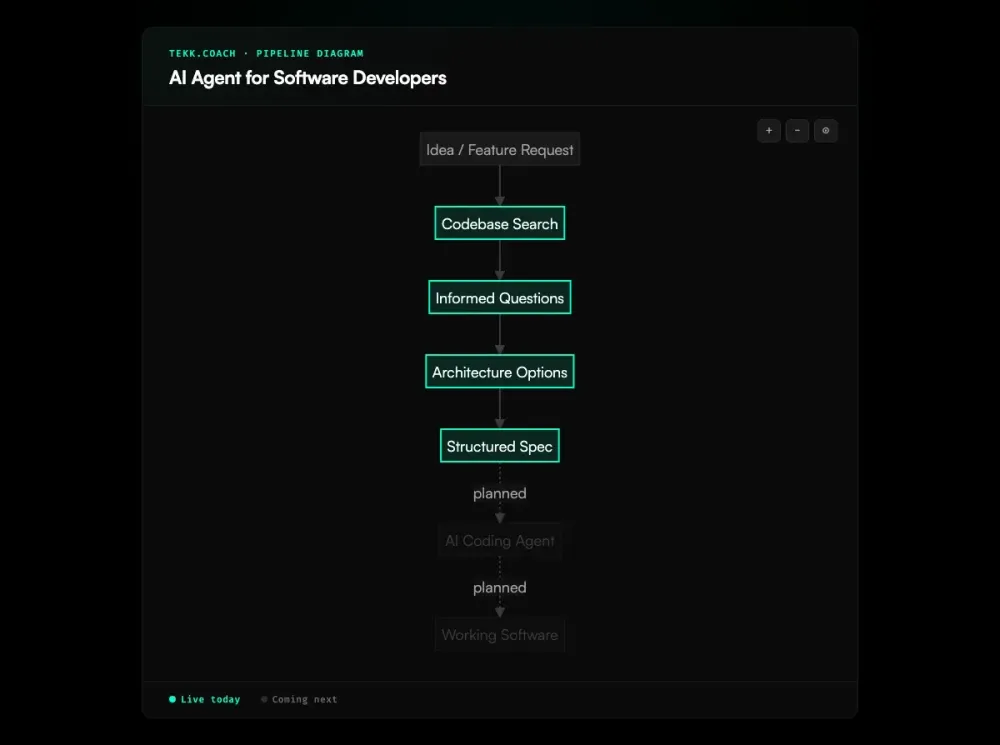
Tekk.coach is the planning agent that sits above your coding agent. It reads your actual codebase, asks informed questions, researches what it doesn't know, and produces a spec your coding agent can execute without flailing. You tell Tekk what to build. Tekk figures out exactly how. Then your agent builds it.
How Tekk.coach Works for Developers
Most developers using AI coding agents hit the same wall: the agent is capable but the output keeps missing. You ask for authentication, it builds the wrong one. You ask for an API integration, it guesses at your data model. You ask for a feature, it creates files in the wrong place. A METR study on experienced open-source developers found that AI tools actually made them 19% slower — not because the tools are bad, but because developers spend more time reviewing, correcting, and re-prompting than they save. The agent doesn't know your codebase. You do — but translating that into a prompt that actually works is its own skill.
Tekk solves this at the source. Before generating anything, the agent connects to your repository (GitHub, GitLab, or Bitbucket) and reads it — semantic search via embeddings, file search, regex, full directory browsing, and repo profiling that understands your stack, patterns, and existing architecture. It asks 3-6 questions grounded in what it found, not generic boilerplate. If you're building something outside your expertise, it searches the web for current best practices and folds that knowledge into your spec.
The output isn't a chat message. It's a living document — a structured spec streamed in real-time into an editable editor. Every plan includes a TL;DR, explicit Building / Not Building scope boundaries, subtasks with acceptance criteria and file references, assumptions with risk levels, and validation scenarios. That's what you hand to your coding agent. That's why it ships. This is spec driven development grounded in your actual codebase — not a template, but a precise description of exactly what to build.
If you're building with Claude Code, Cursor, Codex, or Gemini, Tekk is the planning layer that makes them dramatically more effective. It doesn't replace them — it makes every job they run start from a better position.
Key Benefits
Your coding agent stops flailing. Agents fail when they don't know your codebase and don't have a clear spec. Tekk handles both. The agent reads your repo before asking a single question. The spec it produces has file references, acceptance criteria, and scope boundaries. A deep comparison by Qodo found that agents with full codebase context produce roughly 30% less rework — that's the difference between shipping and spinning. Your coding agent knows exactly what to build and where.
No more specs lost in chat threads. Plans stream into a persistent, editable document — not a chat message that disappears. Every task lives on a kanban board with its full planning session attached. You can read it, edit it, and hand it to your agent days later.
Build confidently outside your expertise. Implementing an AI agent? A data pipeline? A payment integration? Tekk researches the domain during your planning session, evaluates approaches against your specific codebase, and surfaces what you don't know before your coding agent starts writing code you'll have to redo. For complex features that need structured requirements before any code is written, an ai prd generator grounded in your codebase closes the gap between what you intend and what gets built.
Explicit scope protection on every task. Every plan has a "Not Building" section — what's explicitly out of scope. That's the conversation you needed to have with yourself before giving the agent a vague brief. Scope creep disappears when scope is defined before execution starts.
Expert review without a senior engineer. Run a security review, architecture review, or performance review on your codebase at any time. Tekk reads your actual code, searches for current best practices, and tells you what to fix — grounded in your specific stack, not generic checklists.
How It Works
Step 1: Connect your repo. Link GitHub, GitLab, or Bitbucket via OAuth. Takes 30 seconds. Tekk gets read access to your codebase — that's all it needs.
Step 2: Describe what you're building. Create a task. Describe the feature, bug, or integration in plain language. You don't need to write the spec — that's what Tekk is for.
Step 3: Tekk reads the codebase and asks questions. The agent searches your repository — semantically, by file, by regex. It understands your stack, your patterns, your existing architecture. Then it asks 3-6 questions grounded in what it found. If the domain is unfamiliar, it searches the web and brings back current best practices.
Step 4: You get options (when they matter). For complex decisions with real tradeoffs — architecture choices, integration approaches, data model options — Tekk presents 2-3 distinct paths with honest tradeoffs. You pick one.
Step 5: The spec is written. A complete, codebase-grounded specification streams into your task editor. TL;DR, scope boundaries, subtasks with acceptance criteria and file references, assumptions with risk levels, validation scenarios. This is the spec your AI coding agent needs to execute correctly.
Step 6: Hand it to your coding agent. Copy the spec to Cursor, Claude Code, or Codex. Or wait for Tekk's execution layer (coming next) to dispatch it directly. Your agent runs from a spec that fits your codebase — not a paragraph that doesn't.
Who This Is For
Developers who are already using AI coding agents and hitting friction. You use Cursor or Claude Code every day. They're part of your workflow. But complex features keep coming out wrong, or you spend as much time fixing as building. DevOps.com reports that AI-assisted code churn — code discarded within two weeks of being written — is climbing fast. The bottleneck isn't the agent — it's the spec you're giving it. Tekk closes that gap. You'll spend less time explaining what you meant and more time reviewing what the agent built correctly the first time.
Developers building outside their expertise. You're a competent engineer but you haven't built this particular thing before — an AI integration, a caching layer, a search pipeline, a payment flow. Without Tekk: hours of research, a rough spec, and hope. With Tekk: the agent reads your codebase, researches the domain, and produces a spec that covers what you don't know yet. You go into execution knowing the architecture is sound.
Solo developers and small teams without senior coverage. No architect on call. No one to review before you execute. AI coding agents are your team. Tekk acts as the senior engineer in the planning session — interrogating assumptions, defining scope, surfacing risks, and producing a spec the team (you + your agents) can execute with confidence. Think of it as an ai technical co founder available for every planning session, not just when a senior engineer happens to have time.
Tekk is not the right fit if you're a senior architect who already writes tight specs and knows exactly what to hand your agents. If you've solved the planning problem, you don't need it. But if the bottleneck is figuring out what to build and how to say it precisely — Tekk is built for you.
What Is an AI Agent for Developers?
An AI agent for software developers is a system that can take a task, understand context, make decisions, and act — without constant human direction at each step. Unlike a code autocomplete tool (which reacts to a single prompt), an AI agent reasons across multiple steps, remembers context, uses tools like code search or web browsing, and iterates toward a goal.
In 2026, the dominant coding agents — Claude Code, Cursor, Codex, GitHub Copilot with agent mode — operate at the repository level. They can read multiple files, make cross-file changes, run tests, and iterate. According to the 2025 Stack Overflow Developer Survey, 84% of developers now use or plan to use AI tools in their workflow, with 51% using them daily.
What's emerged as the real differentiator isn't which agent you use — it's how clearly you specify the task. Agents that receive vague, decontextualized instructions produce incorrect or incomplete output. As RedMonk's analysis of agentic IDEs found, codebase context awareness is the top capability developers want from their AI tools. The developers shipping consistently with AI agents are the ones who've solved the specification problem, not the ones who switched to a newer model. The ai coding assistant for developers that matters most might not be the one writing the code — it might be the one planning what the code should do.
Frequently Asked Questions
What is an AI agent for software developers?
An AI agent for software developers is an autonomous system that takes a task, uses tools like code search, web browsing, and file editing, and works through it with minimal human input at each step. The leading examples in 2026 are Claude Code, Cursor, Codex, and GitHub Copilot in agent mode. They operate at the repository level — reading multiple files, making cross-file changes, running tests, and iterating. Tekk is a different kind of AI agent: it handles the planning step, not the coding step.
How does an AI coding agent actually help developers?
Coding agents automate the mechanical parts of development — writing boilerplate, implementing well-defined features, running repetitive changes across files. Research on GitHub Copilot showed developers completing tasks 55.8% faster when given well-scoped work — but the gains collapse on ambiguous tasks. They work best when given a specific, complete spec with clear scope. When given a vague paragraph, they make assumptions, build the wrong thing, and create rework. The more precise the input, the more accurate the output.
What's the difference between an AI agent and an AI coding assistant?
An AI coding assistant (like an autocomplete plugin) responds to a single prompt and helps you write the current line or function. An AI agent takes a higher-level task, reasons across multiple steps, uses tools, and executes with greater autonomy — making changes across files, running tests, and iterating. The distinction matters because agents need better input: a single ambiguous prompt produces an agent that runs in the wrong direction for much longer.
Why do AI coding agents produce the wrong output?
Usually because the spec was wrong or missing. The agent doesn't know your codebase — it infers from filenames and imports. It doesn't know what's out of scope — it keeps building. It doesn't know the current best practice for the domain — it uses what it's seen most. Tekk addresses all three: reads the actual codebase before planning, defines explicit "Not Building" scope, and searches the web for current best practices during the planning session.
Does Tekk.coach replace Cursor, Claude Code, or Codex?
No. Tekk is the planning layer — it decides what to build and how to spec it. Cursor, Claude Code, and Codex are the execution layer — they write the code. Tekk makes them more effective by giving them a complete, codebase-grounded spec instead of a rough prompt. If you use any of these tools today, Tekk adds a step before you paste your request in — a step that dramatically improves what comes out.
How does Tekk.coach work as an AI development agent?
Tekk runs a structured multi-turn workflow: it reads your connected repository, asks informed questions grounded in your actual code, presents architectural options when the decision matters, and writes a complete specification into a living document editor. The spec includes a TL;DR, scope boundaries (Building and Not Building), subtasks with acceptance criteria and file references, assumptions with risk levels, and validation scenarios. You then take that spec to your coding agent of choice.
Which AI agents does Tekk.coach work with?
Tekk generates specs compatible with any coding agent. Tested and supported today: Cursor, Claude Code, Codex, and Gemini. The coming execution layer will dispatch specs directly to these agents via OAuth — you approve the plan, select the agent, and Tekk handles the handoff. Today you copy the spec from Tekk's editor and paste it into your agent's input.
Is Tekk.coach free to start?
Yes. Tekk.coach is free to start. Connect your repository, create a task, and run your first planning session at no cost.
Ready to Ship Without Rework?
Your coding agent is only as good as its spec. Give it a codebase-grounded plan — one that knows your stack, defines the scope, and has acceptance criteria on every subtask. That's what Tekk produces.
Connect your repo and run your first planning session free. No PRDs. No alignment meetings. Just a spec that works.