
You write a spec. You hand it to engineering. Then you spend the next sprint in clarification meetings — three tickets asking what "handle the edge case" actually means, a Slack thread about which auth library you had in mind, a call to explain scope that wasn't in the doc.
The spec looked fine. The problem was that it didn't know the codebase.
Tekk is an AI agent for product managers that reads your repository before generating a single line of requirements. The output isn't a template-filled document — it's a technically grounded PRD with subtasks, acceptance criteria, file references, and explicit scope boundaries, streamed directly into an editable spec your team works from.
Try Tekk.coach Free →
How Tekk Works as an AI Agent for Product Managers
Most AI tools for product managers start with a template. They ask you questions, fill in the blanks, and produce a well-formatted requirements doc you export to Notion or Confluence. That doc still requires your engineers to figure out where the new feature fits — which files, which dependencies, what's already built and what isn't. You've outsourced the writing. You haven't solved the handoff. And according to Productboard's 2025 AI in Product Management report, 94% of product professionals now use AI tools daily — yet the spec-to-code gap persists because most tools operate without codebase context.
Tekk starts somewhere different: your codebase. Before generating anything, the agent runs semantic search across your repository, browses directory structure, profiles your languages and frameworks, and maps the dependencies relevant to what you're building. It reads your code the way a senior engineer would before taking on a ticket.
The PRD it produces is grounded in what's actually there. Subtasks are behavioral slices — "user can now do X" — with acceptance criteria and specific file references. The "Not Building" section defines scope boundaries before anyone writes code. Assumptions include risk levels. Validation scenarios are concrete and end-to-end. Teams using an ai prd generator that reads the codebase first consistently see fewer clarification cycles at the engineering handoff.
The spec isn't something you export. It streams into a live editable document inside your planning workspace — connected to the task, the codebase context, and the conversation that produced it. No copy-pasting from chat threads. No re-explaining context next session.
Key Benefits
Technically grounded PRDs, not template fills Tekk generates specs from your actual repository. Subtasks reference real files and existing code patterns. Engineering doesn't have to translate abstract requirements into a real codebase — the spec already did that work.
Subtasks with acceptance criteria engineering can act on Every plan includes end-to-end behavioral subtasks with acceptance criteria, file references, and dependencies. The level of precision AI coding agents (Cursor, Claude Code, Codex) need to execute without back-and-forth. Spec driven development is the practice that makes this possible — requirements tied to real code, not abstract descriptions. As Lenny Rachitsky documents, these coding agents now dominate fast development loops — making spec precision a direct productivity variable.
Explicit scope boundaries before a line of code is written Every spec has a "Not Building" section. What's in, what's out — defined upfront. This is the structural discipline that template-based PRDs skip, and it's where scope creep starts.
A living document, not a chat message The spec lives in your workspace as an editable rich-text document. Revise it inline. Link it to the task. It persists across sessions, connected to the codebase context that generated it.
How It Works
Step 1: Connect your repository Link your GitHub, GitLab, or Bitbucket repo. Tekk profiles it — languages, frameworks, services, dependencies — before your first session.
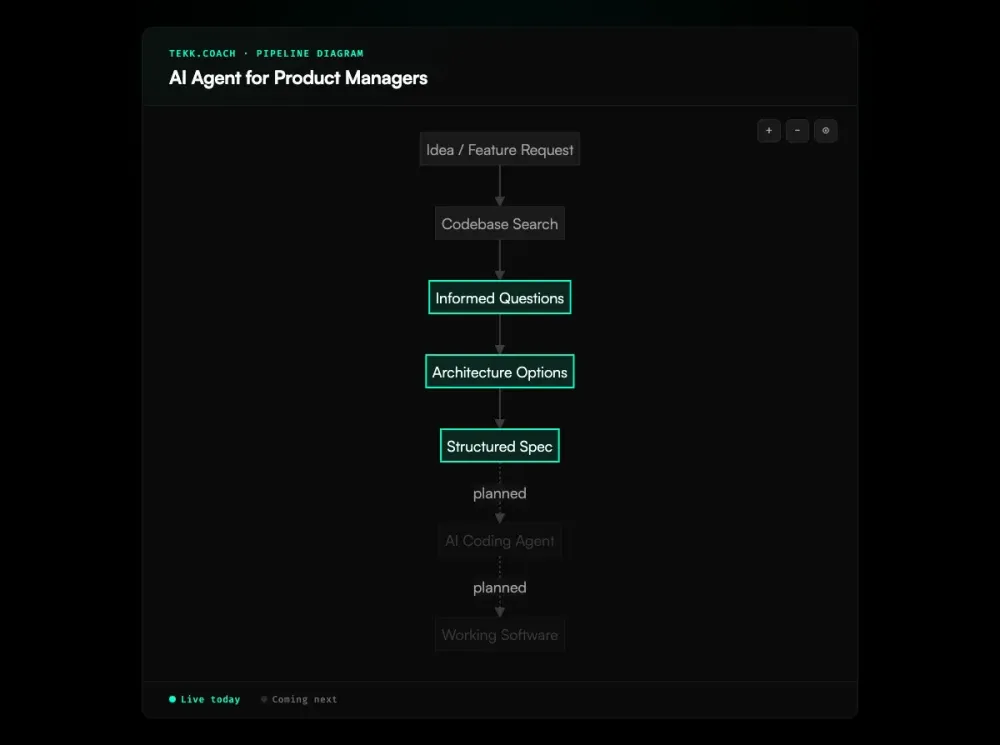
Step 2: Describe the feature Tell Tekk what you're building. One sentence is enough to start. The agent asks 3–6 questions grounded in what it found in the code — no generic questions about things the codebase already answers.
Step 3: Review architecture options When there's more than one viable approach, Tekk presents 2–3 architecturally distinct options with honest tradeoffs. You pick one, or push back, or ask for more.
Step 4: Get the spec The agent writes the full PRD in real time, streamed into a BlockNote editor as your working document. TL;DR, scope boundaries, subtasks with acceptance criteria and file references, assumptions with risk levels, validation scenarios.
Step 5: Hand it off Edit the spec inline if needed. Send it to engineering — or trigger your AI coding agent. The spec has what it needs to execute.
Who This Is For
You're a PM at a startup or a small team. You own requirements and you work directly with engineers — there's no dedicated architect in the middle translating your specs. You write PRDs, engineers implement them, and somewhere between those two steps, details get lost.
You've tried ChatPRD. It's fast and produces solid-looking documents — trusted by over 100,000 PMs for a reason. But your engineers still come back with questions, because the spec was written in the abstract. It didn't know your auth setup, your current data model, or which third-party library you're already using. ChatPRD gave you a polished template. It didn't give you a spec engineering could execute without you.
You might also use Linear's AI features or Notion AI for requirements. Same problem — these tools work on top of your ideas, not inside your codebase. The gap between "what the spec says" and "what the code needs" doesn't close.
If you're working with AI coding agents — Cursor, Claude Code, Codex — this gap becomes acute. These agents execute from prompts. A vague paragraph produces a flailing agent that builds the wrong thing and needs three rounds of correction. What they need is the kind of spec Tekk produces: subtasks with acceptance criteria, file targets, and scope boundaries. Not a template. Not a paragraph. Lenny Rachitsky calls this the shift from copilot AI to agentic AI — and it demands a fundamentally different kind of input.
Tekk is also useful if you're non-technical and you know it. Not in a condescending way — just that you're speccing features in a codebase you don't spend every day reading. Tekk bridges that. You describe the problem in plain language. The agent reads the code and generates a spec that reflects what's actually there.
Who it's not for: PMs who need enterprise approval workflows, Jira-style governance, or custom backlog management at scale. Tekk is opinionated and lightweight — no process theater.
What Can an AI Agent Do for Product Managers?
An AI agent for product managers is a system that handles part of the PM workflow autonomously — drafting requirements, analyzing feedback, generating specs, surfacing tradeoffs — rather than waiting for a human to prompt each step.
The category covers a wide range: tools like ChatPRD operate as AI writing assistants (you provide context, they produce structured output); platforms like BuildBetter.ai focus on feedback synthesis and discovery; broader AI agents work across research, documentation, and communication in parallel.
The shift that matters for 2025–2026: AI coding agents have made the quality of PM specs a direct productivity variable. McKinsey's State of AI report found that organizations redesigning workflows around AI achieve 2–3x higher productivity gains than those bolting AI onto existing processes. When Cursor or Codex executes from a well-structured spec, it ships working code. When it executes from an ambiguous paragraph, it generates rework. Product managers who write for AI coding agents need output at a different level of precision than PMs who write for human engineers alone.
The gap that no existing PM AI tool has closed: codebase awareness. Templates produce well-formatted requirements. What's missing is requirements that reflect the specific architecture, dependencies, and file structure of the product being built. The AI PM Tools Directory's 2026–2030 forecast identifies this as the central unsolved problem in the category — discovery, prioritization, and strategic decision support still lack the "act for me" capability tied to real product context. That's where the clarification meetings come from — and it's the specific problem Tekk addresses.
Frequently Asked Questions
What is the best AI agent for product managers?
The right answer depends on what part of the PM workflow you're trying to improve. For PRD and spec generation grounded in your actual codebase — specifically for teams using AI coding agents — Tekk.coach is built for that problem. For general writing assistance and document generation without codebase integration, ChatPRD is the most widely used dedicated PM tool. For customer feedback synthesis and discovery, BuildBetter.ai or Dovetail are stronger options. Aakash Gupta's guide to AI tools for PMs provides a useful breakdown of the broader landscape.
How does Tekk help product managers write better specs?
Tekk reads your repository before generating requirements. It runs semantic search, browses file structure, and maps relevant dependencies — then writes subtasks with acceptance criteria, file references, and explicit scope boundaries grounded in what's actually in your code. The output addresses the most common spec failure: requirements that look correct but require engineering to fill in all the gaps about how they map to the real codebase.
What is the difference between Tekk and ChatPRD for product managers?
ChatPRD is a chat-based PRD tool — you describe your feature, it generates a well-formatted requirements document you export to Linear, Notion, or Confluence. It's fast and produces professional output, but it operates without any knowledge of your codebase. Tekk reads your codebase first. The spec it produces includes specific file references, existing code patterns, and dependency context that ChatPRD can't provide. If you're handing specs to human engineers at a small team or to AI coding agents, Tekk produces output that requires less interpretation.
Can Tekk replace a technical PM or engineering partner?
No. Tekk is a planning tool, not a decision-maker. It surfaces tradeoffs, presents architecture options, and produces detailed specs — but you're the one making product decisions. PMs who already have deep technical expertise and a strong engineering partner may find the planning workflow less necessary. Tekk adds the most value when there's a gap between PM-level context and engineering-level implementation detail.
How does Tekk generate codebase-aware PRDs?
Before writing a single requirement, Tekk's agent searches the connected repository using semantic search (embeddings-based), file search, regex search, and directory browsing. It profiles the repo: languages, frameworks, services, packages. When generating the spec, subtasks reference the real files that will be affected, acceptance criteria reflect how the existing system works, and scope boundaries account for what's already built. Supports GitHub, GitLab, and Bitbucket.
Does Tekk support the full product development lifecycle for product managers?
The current live workflow covers planning and specification: codebase search, informed questions, architecture options, structured spec generation, review mode (security, architecture, performance), and kanban task management. The execution layer — dispatching approved specs to AI coding agents like Cursor, Codex, and Claude Code — is coming next. When it ships, ai agent orchestration will handle routing those specs to the right agents in dependency-ordered waves. Today, Tekk is where you plan and spec. The handoff to coding agents is manual; orchestration is the next step.
Start Planning Free →
If your sprints keep opening with clarification meetings, the spec is the problem — not your engineers. Connect your repo, describe one feature, and see what a codebase-grounded PRD actually looks like.
Start Planning Free →