
Most engineers using Cursor, Codex, or Claude Code hit the same wall: the agents are capable, but nothing coordinates them. Tasks conflict. Context gets lost. You become the orchestrator — manually routing work, resolving dependencies, tracking progress across chat windows. As one practitioner put it, running multiple agents simultaneously is like walking multiple dogs at once — if you don't know where you're going, you'll get tangled. That's not orchestration. That's overhead.
Tekk.coach is the orchestration layer between you and your coding agents. It reads your codebase, generates a structured spec, decomposes it into dependency-ordered subtasks, and dispatches work to the right agents — with real-time progress tracked on a kanban board.
[Try Tekk.coach Free →]
Key Benefits
Your agents get specs, not paragraphs. Every coding agent produces better output when given precise, codebase-grounded inputs. Tekk generates the specs that make your agents effective. The quality of orchestration is bounded by the quality of the inputs.
Dependency ordering built in. Subtasks are sequenced by execution dependency, not arbitrary order. The API contract is written before the frontend component. The database migration runs before the service layer. This is the structural discipline that prevents agent cascade failures — a problem a comprehensive arXiv survey on multi-agent orchestration identifies as the primary failure mode in uncoordinated multi-agent systems.
Scope enforcement by default. Every spec includes an explicit "Not Building" section. Agents can't implement what isn't specified. Scope creep is structurally prevented, not aspirationally hoped for.
One workspace for planning and tracking. Kanban board with To Do / In Progress / Done. Each card links to the full planning session with codebase context. No more scattered markdown files across chat windows.
BYO agents. No lock-in. Cursor, Codex, Claude Code, Gemini — connected via OAuth, the same way GitHub connects today. You keep your existing agent subscriptions. Tekk coordinates them. Platforms like Cursor are scaling autonomous agent execution and Codex now supports parallel subagents — Tekk sits above all of them.
How It Works
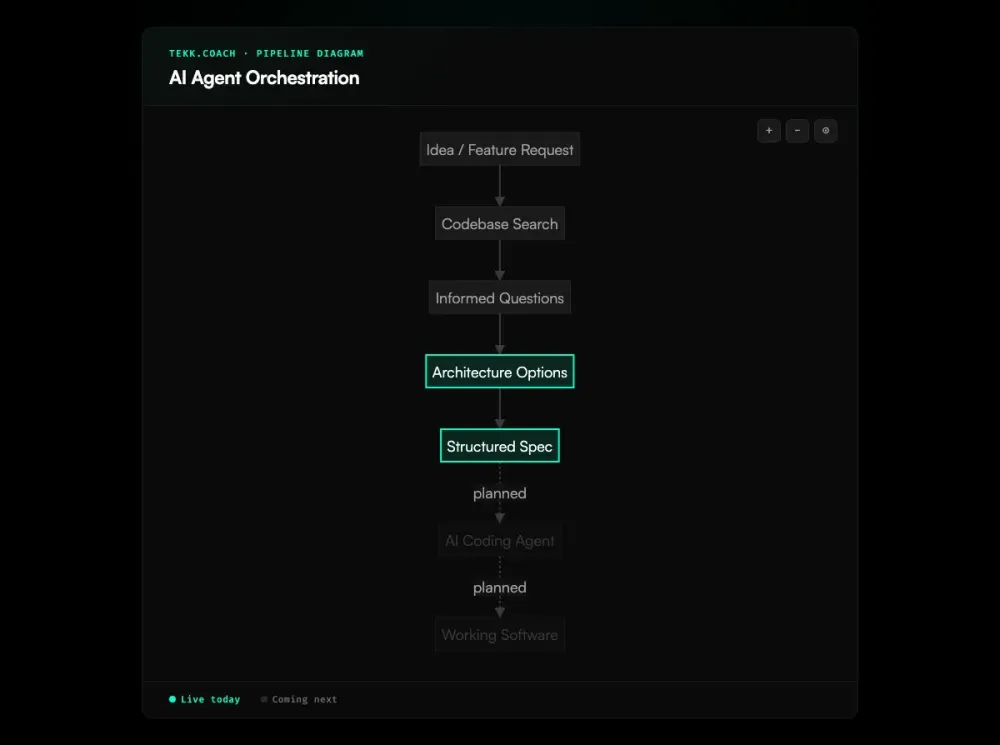
Step 1: Connect your codebase. Link your GitHub, GitLab, or Bitbucket repository. Tekk indexes it for semantic search — your agent now knows what you have before it asks a single question.
Step 2: Describe what you're building. Not a spec. Not a structured prompt. Just describe the feature or problem in plain language. "Add magic link authentication" or "Build a data export pipeline" — Tekk handles the rest.
Step 3: Work through the planning session. The agent asks 3-6 informed questions based on what it found in your code. Optionally presents 2-3 architecturally distinct approaches. You choose a direction.
Step 4: Review your spec. A complete specification streams into your task editor: TL;DR, Building/Not Building scope boundaries, subtasks with acceptance criteria and file references, dependency ordering, assumptions with risk levels, validation scenarios. Editable in real-time.
Step 5: Execute. (Coming next.) Click Execute. Select your agent — Cursor, Codex, Claude Code, Gemini. Tekk decomposes approved subtasks by dependency, groups independent subtasks into parallel execution waves, and dispatches to agents. All work goes to a single shared feature branch. One PR for human review.
Who This Is For
Founders and solo builders shipping with AI coding agents. You're using Cursor or Claude Code but you're manually managing what gets built and when. That's coordination overhead you shouldn't be carrying. Tekk handles it.
Small engineering teams (1–10 people) without a dedicated architect. You're touching domains — auth, payments, AI pipelines — where you don't have deep expertise. Tekk's planning agent surfaces the right questions and architecture options before you write a line of code. Combining ai project planning with orchestration means the plan and the dispatch happen in the same session.
Developers who are tired of rework. The third time you rebuild the same feature because the spec was vague is the last time. Tekk generates specs that your agents can actually execute against, grounded in your actual codebase.
It's not for enterprise teams that need Jira-style workflow governance, custom approval chains, or 47 sidebar items. Tekk is opinionated and lightweight by design.
What Is AI Agent Orchestration?
AI agent orchestration is the coordination of multiple AI agents — each with distinct capabilities and tool access — to accomplish complex tasks no single agent can complete alone. An orchestrator decomposes a complex goal into subtasks, assigns them to appropriate worker agents, manages execution dependencies, and aggregates results.
In software development, this pattern has become essential because modern codebases are too large and complex for single-agent loops. Gartner predicts 40% of enterprise applications will integrate task-specific AI agents by end of 2026, up from less than 5% in 2025. A feature might require a security review, API design, frontend implementation, database migration, and test generation — each suited to a different specialized agent.
The field has two distinct layers. The execution layer consists of the coding agents themselves: Cursor, Codex, Claude Code, Gemini. The orchestration layer sits above them — decomposing tasks, routing work, managing dependencies, tracking progress. The ai agent workflow that connects these two layers is what determines whether agents execute with precision or produce expensive rework. As Addy Osmani writes in The Code Agent Orchestra, the hard problem isn't making agents smarter — it's making them work together. Most developers have execution agents. Few have an orchestration layer. That gap is where rework, conflicts, and manual coordination overhead live.
Frequently Asked Questions
What is AI agent orchestration?
AI agent orchestration is the coordination of multiple AI agents to accomplish complex tasks through structured task decomposition, dependency management, and parallel execution. In software development, the orchestrator decomposes a feature into subtasks, routes them to appropriate coding agents (Cursor, Codex, Claude Code), manages execution order based on dependencies, and tracks progress. Without an orchestration layer, developers become the coordinator — which defeats the purpose of autonomous agents.
How do you orchestrate multiple AI coding agents?
The correct pattern is orchestrator-workers: a central coordinator that understands the full task decomposes it into subtasks, groups independent subtasks for parallel execution, sequences dependent subtasks correctly, and dispatches each to the right agent. The missing piece most teams overlook is the planning layer before execution — generating a codebase-grounded spec with explicit acceptance criteria per subtask before any agent starts writing code.
What's the difference between an AI agent and an orchestrator?
An AI agent executes tasks: it writes code, runs tests, searches files. An orchestrator coordinates agents: it decomposes goals into subtasks, assigns tasks to agents, manages dependencies, and tracks progress. Cursor, Codex, and Claude Code are agents. Tekk.coach is the orchestration layer. The distinction matters because agents are excellent executors but poor planners — they need structured inputs, not vague prompts.
What tools handle AI agent orchestration for software development?
LangGraph provides a low-level orchestration framework but requires you to build the orchestration logic yourself. AWS Bedrock Agents manages multi-agent infrastructure but isn't specialized for coding. Kiro handles spec generation and task sequencing but is IDE-locked and single-agent. A 2026 comparison of 8 parallel coding agent tools found that most focus on execution isolation but lack a planning layer. Tekk.coach is the only tool combining codebase-aware spec generation (live) with multi-agent execution dispatch (coming next) in a unified workspace with kanban visibility.
What is wave-based parallel execution for coding agents?
Wave-based parallel execution groups subtasks into dependency-ordered execution waves. Wave 1 contains all subtasks with no dependencies — they run simultaneously across multiple agents. Wave 2 contains subtasks that depend on Wave 1 results. Wave 3 depends on Wave 2. And so on. This approach maximizes parallel throughput while respecting execution order constraints, and routes all agent work to a single shared branch for one clean PR.
Do I need to replace my current coding agents to use Tekk.coach?
No. Tekk.coach connects to the agents you're already using — Cursor, Codex, Claude Code, Gemini — via OAuth authentication, the same way GitHub connects today. You keep your existing agent subscriptions. Tekk provides the planning intelligence and orchestration layer on top.
What's the planning workflow before orchestration dispatch?
Tekk's planning workflow is: Search (agent reads your codebase) → Questions (3-6 informed questions based on what it found) → Options (2-3 architecturally distinct approaches with tradeoffs, when applicable) → Plan (complete spec streamed into editable document). The spec includes TL;DR, Building/Not Building scope boundaries, subtasks with acceptance criteria and file references, dependency ordering, assumptions with risk levels, and validation scenarios. This planning workflow is live today.
Is multi-agent execution dispatch live in Tekk.coach today?
The planning workflow — codebase reading, informed questions, options, spec generation — is live today. Multi-agent execution dispatch (routing subtasks to Cursor, Codex, Claude Code, Gemini in dependency-ordered parallel waves) is coming next. The kanban board, review mode, and web research during planning are also live.
Ready to Try Tekk.coach?
Your coding agents are only as effective as the specs they execute against. Connect your repo, describe the feature, and get a codebase-grounded spec in minutes — not a chat message.
[Start Planning Free →]