
Giving your agents a paragraph and hoping for the best isn't a workflow. It's faster flailing.
Your agents are only as good as what you hand them. Tekk builds the structured agentic coding workflow that comes before any agent touches your code — grounded in your actual codebase, with scope boundaries and acceptance criteria baked in. Your agents execute. They don't wander.
[Try Tekk.coach Free →]
How Tekk Does the Agentic Coding Workflow
Most developers have the execution layer covered. Cursor, Codex, Claude Code — these are good tools. What they don't have: a planning layer that produces specs grounded in the actual repo. A New Stack analysis of 2026 agentic development trends confirms the shift: engineers are moving from writing code to coordinating agents, and the plan-then-execute pattern is becoming the standard architecture.
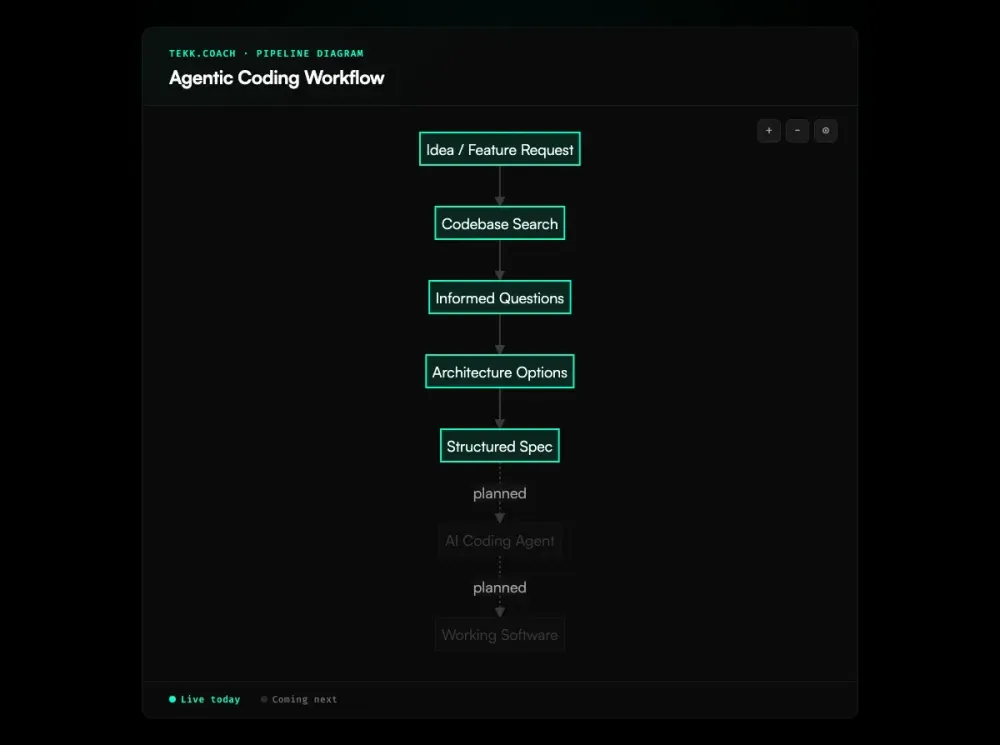
Tekk is that planning layer. Every session runs through a five-stage pipeline: Search → Questions → Options → Plan → Execute. The first four stages run today. Each one grounds the next step in codebase context so that when a spec finally hits your coding agent, the agent has everything it needs to execute correctly. For teams running multiple agents in parallel, ai agent orchestration is the coordination layer that routes that output to the right tools.
The output isn't a chat message you paste somewhere. It's a living spec that streams into an editable document — with a TL;DR, explicit scope boundaries, subtasks with acceptance criteria and file references, assumptions with risk levels, and concrete validation scenarios. That's what a coding agent needs. That's what Tekk produces.
The Execute stage — dispatching approved specs directly to Cursor, Codex, Claude Code, or Gemini via OAuth — is coming next. Steps 1-4 are live now.
Key Benefits
Structured multi-stage workflow, not one-shot prompting Each stage builds on the last. The agent reads your code first, then asks informed questions, then presents real tradeoffs, then writes the spec. Nothing is guessed. Nothing is skipped. Research confirms this matters: a study on professional developers and AI agents found that professionals don't vibe code — they carefully control agents through planning and structured oversight, reserving autonomous execution for well-described, scoped tasks.
Codebase-grounded at every step Before generating anything, Tekk searches your repository — semantic search, file search, regex, directory browsing, full repo profiling. Every question and every plan references your specific files, patterns, and dependencies. Not boilerplate. CodeScene's analysis of agentic coding patterns shows that agents operating with codebase context and fast feedback loops produce healthier code — and that well-grounded codebases see roughly 50% lower token consumption for comparable tasks.
Options with real tradeoffs, not a wall of text When a decision matters, Tekk presents 2-3 architecturally distinct approaches with honest tradeoffs. You pick the direction before the spec gets written. No rework because the agent guessed wrong.
Spec output your agentic tools can actually execute
What developers type into Cursor: "Add magic link auth to my app". What Tekk hands Cursor: a complete spec with database schema, API routes, acceptance criteria per subtask, file targets, and a "Not Building" section. The difference between an agent that ships and one that spins.
How It Works
The Tekk agentic development workflow runs in five stages.
Stage 1: Search The agent reads your codebase before asking a single question. Semantic search for intelligent code discovery. File search and regex for precise lookups. Directory browsing for structural understanding. Repository profiling across languages, frameworks, services, and packages. Supports GitHub, GitLab, and Bitbucket.
Stage 2: Questions With codebase context in hand, the agent asks 3-6 questions grounded in what it found. Not generic prompts — questions that reference specific files, call out real patterns, and surface architectural decisions the plan will depend on. Your answers are the foundation of every option and subtask that follows.
Stage 3: Options When a real tradeoff exists, the agent presents 2-3 architecturally distinct approaches. Each option includes what you get and what you give up. You choose before anyone writes a spec. When there's an obvious path, this stage is skipped — Tekk doesn't manufacture complexity.
Stage 4: Plan The agent writes the complete spec, streamed in real time into the task editor as the actual working document. Every plan includes: TL;DR, Building / Not Building scope boundaries, subtasks with acceptance criteria and file references, assumptions with risk levels, and concrete end-to-end validation scenarios. This is spec driven development applied to the agentic context — structured enough for an agent to execute against, editable enough for you to refine before dispatch.
Stage 5: Execute (coming next) Dispatch approved specs directly to your agentic coding tools — Cursor, Codex, Claude Code, Gemini — via OAuth. Tekk decomposes plan subtasks by dependency order, groups independent subtasks into parallel waves, and tracks real-time progress on the kanban board.
Who This Is For
Developers building with agentic coding tools who've hit the wall. You're using Cursor or Claude Code. You're getting output, but it's not quite right — wrong file, missed edge case, scope creeping in directions you didn't authorize. The problem isn't the agent. It's that it never got a real spec. Tekk fixes that.
Teams who want a repeatable agentic development workflow without ceremony. No 20-page PRDs. No alignment meetings. No backlog grooming rituals. Connect your repo, describe the problem, work through the five stages, and hand a structured spec to your agent. It takes an hour to plan what would have taken a week to rework. The discipline is real enough that MIT's Missing Semester now teaches agentic coding as a core CS skill alongside version control and shell scripting.
AI-forward founders and small teams who are tired of scattered markdown files and chat threads. You're building across domains where you're not the expert — security, payments, data pipelines. Tekk searches the web during planning to bring current best practices into the spec, so you're not flying blind into your agent's code. Structured ai project planning makes that research actionable — tied to your codebase and ready to hand off.
What Is an Agentic Coding Workflow?
An agentic coding workflow is a structured process for using autonomous AI agents in software development — planning, codebase grounding, and human checkpoints before the agent touches a line of code. The alternative is one-shot prompting: type a description, hope the agent delivers, debug what comes out. Structured workflows resolve architectural decisions and scope boundaries upfront. The agent gets a real spec. It executes.
The framing came fast. Andrej Karpathy popularized "vibe coding" in early 2025 — describe what you want, let the AI figure out implementation. By early 2026, he reframed it as "agentic engineering": same capability, professional discipline applied on top. The community landed on a clear split: vibe coding for prototypes, structured workflows for production.
The field is evolving toward a plan-then-execute pattern. Research from the 2026 Anthropic Agentic Coding Trends Report shows multi-agent pipelines becoming the standard for complex work, with specialized roles (feature author, test generator, code reviewer, architecture guardian) and human approval at key checkpoints. The planning layer — what Tekk handles — is what determines whether those downstream agents execute well or flail. AI agentic coding is powerful. Structure is what makes it reliable.
Frequently Asked Questions
What is an agentic coding workflow?
An agentic coding workflow is a structured process for using autonomous AI coding agents — where planning, codebase grounding, and human review happen before the agent writes any code. Unlike one-shot prompting, it breaks the work into defined stages: understanding the codebase, asking informed questions, evaluating architectural options, writing a structured spec, and then executing. The goal is agents that ship, not agents that spin.
What is agentic development?
Agentic development is the broader practice of building software where AI agents take on multi-step tasks autonomously — navigating codebases, running tests, iterating on failures, and completing work across multiple files with minimal hand-holding. It's the evolution from "AI suggests a line of code" to "AI executes a complete feature workflow." The 2025 Stack Overflow Developer Survey shows 52% of developers already report a positive productivity impact from AI tools, though trust remains split — more developers actively distrust AI accuracy (46%) than trust it (33%). The term gained professional framing in early 2026 as a distinct discipline from vibe coding.
How does an agentic coding workflow differ from regular AI coding?
Regular AI coding is typically reactive and one-shot: you prompt, you get output, you review. An agentic coding workflow is proactive and multi-stage: the agent reads your codebase first, asks questions grounded in what it found, presents tradeoffs, and writes a structured spec before anything is executed. Structured workflows resolve ambiguity upfront rather than discovering it after the agent has written a thousand lines.
What is AI agentic coding?
AI agentic coding means using AI agents that operate autonomously across the full development lifecycle — not autocomplete, but real multi-step execution: reading codebases, writing tests, running them, handling failures, and iterating. Cursor, Claude Code, and Codex are the current tools. The emerging discipline is about how to structure that autonomy so agents produce reliable output rather than plausible-looking code that breaks in production.
How does Tekk structure its agentic development workflow?
Tekk runs five stages: Search (codebase reading before any questions), Questions (3-6 grounded in what was found), Options (2-3 architectural approaches with real tradeoffs), Plan (complete spec as a living document with scope boundaries, acceptance criteria, and file references), and Execute (dispatch to agentic coding tools — coming next). The first four stages are live today. Each stage builds on the last so nothing is guessed and nothing is skipped.
What agentic coding tools does Tekk support?
Tekk is designed to work with Cursor, OpenAI Codex, Claude Code, and Gemini. Today, Tekk produces the structured spec those agents need to execute correctly. The Execute stage — dispatching specs directly to these tools via OAuth, tracking progress on the kanban board — is the next capability shipping. Tekk connects through native auth flows, the same way GitHub connects today.
How do I set up an agentic coding workflow with Tekk?
Connect your repository (GitHub, GitLab, or Bitbucket) and create a task describing what you need to build. Tekk's agent reads your codebase, asks questions grounded in your actual code, presents architectural options if a real tradeoff exists, and produces a structured spec. You review and edit the plan in the living document editor, then — once the Execute stage ships — dispatch directly to your preferred agentic coding tools. No configuration files. No ceremony.
Start Planning Free →
Your agentic coding tools are waiting on a spec that actually tells them what to do. Connect your repo, run through the workflow, and hand your agents something they can execute against.
[Start Planning Free →]